

D2740 vs D6740 is one of the most common crown coding questions in dental billing. Both codes involve porcelain or ceramic crowns, but they do not describe the same type of restoration.
The D2740 dental code fits a single porcelain or ceramic crown on a natural tooth. The D6740 dental code fits a porcelain or ceramic retainer crown used as part of a fixed bridge. ADA CDT references list D2740 as “crown, porcelain/ceramic,” while bridge coding references describe D6740 as a porcelain or ceramic retainer crown for bridge work.
This difference matters because the payer does not look at material only. The payer also checks the role of the tooth in the treatment plan.
For example, a ceramic crown on tooth #14 might use dental code D2740 when it restores one damaged natural tooth. Yet a ceramic crown on tooth #20 might need dental code D6740 when it anchors a bridge that replaces tooth #19.
That small coding choice affects claim review, reimbursement, and documentation. Virtual Dental Billing helps dental practices review the crown dental code before submission, so the claim tells the payer the correct clinical story.
Quick Code Table for Porcelain and Ceramic Crowns
D2740 vs D6740 becomes easier when the dental team checks 3 things before choosing the code: the tooth type, the restoration role, and the material. A crown on a natural tooth does not always use the same code if that crown supports a bridge.
Here is a simple code table for the most common crown and bridge cases:
| CDT Code | Best Use | Where It Fits | Material |
|---|---|---|---|
| D2740 | Single crown | Natural tooth, standalone restoration | Porcelain or ceramic |
| D6740 | Retainer crown | Natural tooth, part of a fixed bridge | Porcelain or ceramic |
| D2750 | Single PFM crown | Natural tooth, standalone restoration | Porcelain fused to metal |
| D6750 | Retainer PFM crown | Natural tooth, part of a fixed bridge | Porcelain fused to metal |
| D6245 | Pontic | Missing tooth space in a bridge | Porcelain or ceramic |
The D2740 dental code should fit a single crown that restores one natural tooth. The D6740 dental code should fit a bridge retainer crown that helps support a pontic.
A pontic is the replacement tooth in a bridge. It does not sit on a natural tooth root, so it needs a pontic code instead of a crown dental code.
This is where claim mistakes happen. A bridge might include 2 retainer crowns and 1 pontic, so the claim should show each part of the bridge correctly.
Virtual Dental Billing checks this before claim submission. Our team reviews whether the code matches the tooth’s role, the material, and the treatment plan, because clean code selection helps reduce payer questions.
What Does D2740 Mean?
The D2740 dental code is used for a single porcelain or ceramic crown on a natural tooth. This means the crown restores one tooth by itself and does not connect to a bridge, pontic, or other fixed partial denture unit.
In simple words, dental code D2740 fits a standalone crown. The tooth still has its natural root, and the crown covers that tooth because it needs full coverage and support.
This code often comes up when a patient has a cracked tooth, a large failing filling, a root canal-treated tooth, or a tooth with weak remaining structure. If the dentist places an all-ceramic or porcelain crown on that one tooth, D2740 is often the code dental teams review first.
Many offices also search for the D2740 dental code description because they want to confirm the material. The key point is that D2740 relates to porcelain or ceramic material, not porcelain fused to metal.
That matters because a porcelain crown dental code should match the real crown material. If the crown has a metal substructure, the claim may need a different code, such as D2750, based on payer rules and clinical documentation.
The crown ADA code should never be selected by habit. The dental team should check the material, tooth role, and treatment plan before sending the claim.
Virtual Dental Billing helps practices avoid this common mistake. Our team reviews the dental code for crown claims before submission so the code, narrative, tooth number, and attachments support the same service.
What Does D6740 Mean?
The D6740 dental code is used for a porcelain or ceramic retainer crown on a natural tooth. This crown is not working alone. It supports a fixed bridge and helps hold the replacement tooth in place.
In simple words, dental code D6740 fits a crown that acts as an anchor for a bridge. The tooth still has its natural root, but the crown becomes part of a larger bridge unit.
Many dental teams search for the D6740 dental code description because this code looks close to D2740 at first. Both involve porcelain or ceramic material, but the role of the crown changes the code.
A retainer crown porcelain ceramic case usually includes at least one pontic. The retainer crown sits on the support tooth, while the pontic fills the missing tooth space.
For example, a patient is missing tooth #19. The dentist plans a 3-unit bridge using teeth #18 and #20 as support teeth. The porcelain or ceramic crowns on #18 and #20 point toward D6740, while the missing tooth space needs a pontic code.
This is why the D6740 dental code should not be used for a single crown. It should fit a bridge retainer crown, not a standalone restoration.
Virtual Dental Billing helps dental practices check bridge claims before submission. Our team reviews the dental code D6740, pontic code, tooth numbers, material, and payer notes so the claim shows the full bridge design clearly.
D2740 vs D6740: What Is the Main Difference?
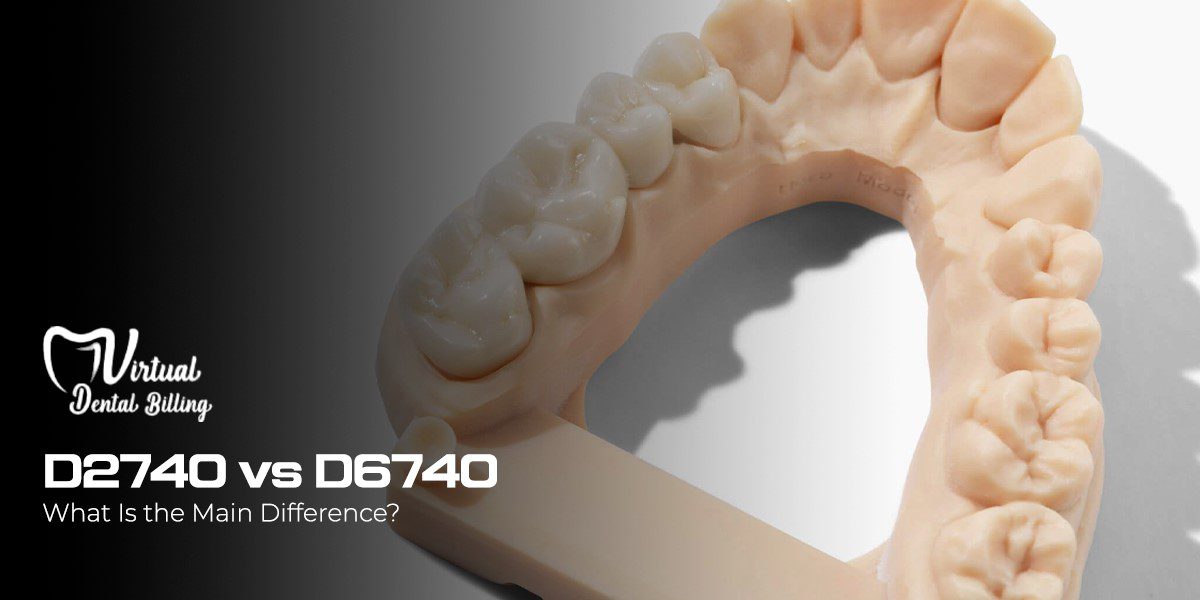
D2740 vs D6740 comes down to the role of the crown in the treatment plan. D2740 fits a single porcelain or ceramic crown on a natural tooth, while D6740 fits a porcelain or ceramic retainer crown that supports a fixed bridge.
Both codes involve porcelain or ceramic material, so the material alone does not decide the code. The dental team should check whether the crown stands alone or works as part of a bridge.
| Coding Question | D2740 | D6740 |
|---|---|---|
| Does the crown stand alone? | Yes | No |
| Is the crown part of a bridge? | No | Yes |
| Does the crown support a pontic? | No | Yes |
| Does it involve porcelain or ceramic material? | Yes | Yes |
| Does it fit a natural tooth? | Yes | Yes |
| Should it be used for a single crown? | Yes | No |
| Should it be used for a bridge retainer? | No | Yes |
The easiest way to choose between these codes is to ask one question: “Is this crown part of a bridge?” If the answer is no, the D2740 dental code might fit the claim. If the answer is yes, the D6740 dental code might fit the retainer crown.
For example, a ceramic crown on a broken molar is often reported with dental code D2740 when it restores that tooth only. A ceramic crown on a support tooth beside a missing tooth often points to dental code D6740 when it anchors a bridge.
This difference affects more than code choice. It helps the payer understand whether the office completed one crown or part of a fixed partial denture.
Virtual Dental Billing reviews this difference before crown claims go out. Our team checks the crown dental code, tooth role, bridge design, material, and documentation so the claim does not confuse the payer.
When Should Dental Offices Use D2740?
Dental offices should use D2740 when the dentist places a single porcelain or ceramic crown on a natural tooth. The crown should restore that one tooth only, without connecting to a pontic or bridge.
The D2740 dental code often fits cases where the tooth has deep cracks, a large broken filling, weak structure, or a full coverage need after root canal treatment. The key point is simple: the crown works alone.
For example, a patient comes in with tooth #30 fractured around an old filling. The dentist removes decay, builds the tooth back up, and places a ceramic crown on that same natural tooth. In this case, dental code D2740 may fit because the crown restores one tooth and does not support a bridge.
Many teams search for 2740 dental code, or ADA code D2740, because they want to confirm if zirconia fits here. In many billing cases, a zirconia crown may fall under a porcelain or ceramic crown code when the payer accepts that material under the ceramic category.
Still, the office should not choose D2740 based on material only. The claim should also match the tooth number, X-ray, narrative, treatment note, and lab details.
Use D2740 when these points match:
- The crown restores one natural tooth.
- The crown is not part of a fixed bridge.
- The material is porcelain or ceramic.
- The clinical note supports full coverage.
- The claim attachments support the need for the crown.
The porcelain crown dental code should tell the payer what the dentist did and why the tooth needed full coverage. If the payer sees weak documentation, it may ask for more records or apply a different benefit.
Virtual Dental Billing helps practices check the dental code for a crown before submission. Our team reviews whether D2740 fits the treatment, material, and claim support, so the office has a cleaner path to payment.
When Should Dental Offices Use D6740?
Dental offices should use D6740 when the dentist places a porcelain or ceramic retainer crown on a natural tooth as part of a fixed bridge. This crown does not work alone. It helps support the bridge and hold the pontic in place.
The D6740 dental code fits the support teeth in a bridge case. These teeth carry the retainer crowns, while the pontic replaces the missing tooth space.
For example, a patient is missing tooth #19. The dentist plans a 3-unit porcelain or ceramic bridge from tooth #18 to tooth #20. In this case, teeth #18 and #20 are the support teeth, so dental code D6740 may fit the retainer crowns. The missing tooth #19 would need a pontic code.
This is why ADA code D6740 should not replace D2740 on a single crown claim. Even if both crowns look similar in the mouth, the claim code changes because the clinical role is different.
A retainer crown porcelain ceramic case should meet these points:
- The crown sits on a natural support tooth.
- The crown is part of a fixed bridge.
- The crown helps support one or more pontics.
- The material is porcelain or ceramic.
- The claim shows the bridge design clearly.
The D6740 dental code description matters because the payer needs to see that the crown works as part of a larger prosthetic plan. If the claim only shows a crown without clear bridge details, the payer may request more information.
Virtual Dental Billing helps dental offices review bridge claims before submission. Our team checks the dental code D6740, pontic code, tooth numbers, material, and attachments so the payer sees the full treatment clearly.
Which Related Crown Codes Cause Confusion?
Some crown claim errors happen because dental teams compare only the material and forget the role of the tooth. D2740 vs D6740 is the main confusion, but other crown and bridge codes also create billing mistakes.
The crown ADA code should match 3 things: the tooth type, the crown material, and the purpose of the restoration. If one of these details changes, the code may change too.
Here are related codes dental offices often mix up:
| CDT Code | What It Usually Means | Common Confusion |
|---|---|---|
| D2740 | Porcelain or ceramic crown on a natural tooth | Used by mistake for bridge retainers |
| D6740 | Porcelain or ceramic retainer crown for a bridge | Used by mistake for single crowns |
| D2750 | Porcelain fused to metal crown on a natural tooth | Confused with all-ceramic crowns |
| D6750 | Porcelain fused to metal retainer crown for a bridge | Confused with ceramic bridge retainers |
| D6245 | Porcelain or ceramic pontic in a bridge | Confused with retainer crown codes |
The D2750 dental code is different from D2740 because the material includes metal under the porcelain. That makes it a porcelain-fused-to-metal crown code, not an all-ceramic crown code.
The same idea applies to bridge retainers. D6740 fits a porcelain or ceramic retainer crown, while D6750 fits a porcelain fused to metal retainer crown.
Bridge coding also creates confusion between retainers and pontics. A retainer crown sits on a support tooth, while a pontic fills the missing tooth space.
This is where dental code D6240 or a related pontic code may enter the claim, depending on the material and payer rules. The office should not use a crown dental code for the missing tooth space when the restoration is a pontic.
Implant crowns need extra care too. A natural tooth crown code does not always fit an implant case. If the case involves an abutment-supported porcelain ceramic crown or an implant-supported crown, the team should check the implant crown code path before using D2740.
Many offices also search for the dental code for zirconia crown or zirconia crown CDT code. In many cases, zirconia may fall under porcelain or ceramic coding, but the final code should still match the tooth role and payer guidance.
Virtual Dental Billing reviews these related codes before claim submission. Our team checks whether the claim involves a single crown, retainer crown, pontic, PFM material, ceramic material, or implant restoration so the code supports the actual treatment.
Common Claim Mistakes With Crown Codes
Crown claims often get delayed when the code does not match the treatment role. D2740 vs D6740 looks simple, but one wrong choice can make the payer question the whole claim.
The biggest mistake is using D2740 for a crown that is part of a bridge. If the crown supports a pontic, the claim should be reviewed for D6740 instead of a single crown dental code.
Another mistake is using D6740 for a standalone crown. The D6740 dental code is not meant for a single tooth crown that works alone. It belongs with bridge retainer cases.
Dental teams also run into problems when they choose the code by material only. Porcelain or ceramic material matters, but the payer still needs to know if the crown is a single unit, a retainer crown, a pontic, or an implant restoration.
Here are common claim mistakes to watch:
- Using D2740 for a bridge retainer.
This can make the claim look like a single crown instead of part of a fixed bridge. - Using D6740 for a single crown.
This can confuse the payer because the claim does not show a bridge or pontic. - Mixing ceramic and PFM codes without checking the lab details.
D2750 and D6750 fit porcelain-fused-to-metal cases, not all-ceramic cases. - Leaving out pontic codes in bridge claims.
A bridge claim needs the right retainer and pontic codes so the payer sees the full restoration. - Using natural tooth codes for implant cases.
Implant crowns may need a different code path, especially when the case involves an abutment or implant-supported restoration. - Sending weak documentation.
X-rays, narratives, tooth numbers, material details, and clinical notes should support the selected code.
Clean coding starts with one question: what role does this crown play? If it restores one natural tooth, dental code D2740 may fit. If it anchors a bridge, dental code D6740 may fit.
Final Takeaway
The difference between D2740 and D6740 is not only about porcelain or ceramic material. The real difference is the crown’s job in the treatment plan.
Use the D2740 dental code when the crown restores one natural tooth as a standalone restoration. Use the D6740 dental code when the porcelain or ceramic crown works as a bridge retainer.
This small coding difference can affect claim review, reimbursement, patient billing, and office follow-up. When the code, tooth number, material, and documentation all match, the claim becomes easier for the payer to understand.
Virtual Dental Billing helps dental practices review crown codes before claims go out. Our team checks the porcelain crown dental code, bridge details, pontic codes, implant-related details, and payer requirements so your billing process stays cleaner.
If crown code confusion is slowing your claims, Virtual Dental Billing can help you reduce coding mistakes, avoid preventable denials, and keep reimbursement moving with more confidence.