
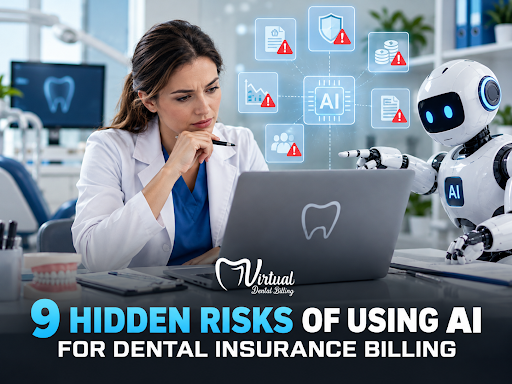
When an automated dental insurance eligibility process verifies that a patient has coverage but fails to capture restrictions that dictate whether the procedure will be covered, that can lead to serious billing problems and expensive mistakes. Even though a patient may seem like a good candidate for a crown, the claim may be denied, or the payment may vary due to an exhausted annual max, waiting period, or plan exclusions.
Where dental practices rely on AI-generated insurance summaries but do not verify the insurance benefit, the challenge of capturing the problem increases. Missed coverage information can result in an incorrect treatment estimate, surprise patient charges, extra insurance claim follow-up, and unpaid claims. Worse yet, these mistakes could remain undiscovered until the explanation of benefits is received.
So, how can dental practices benefit from AI without putting claim accuracy or patient trust at risk? The key is recognizing what billing activities can be done automatically and where human expertise is still required. This is the point of view we take at Virtual Dental Billing when we talk about automated decisions: what the risks are and how we can explain what checks can be performed to mitigate those risks.
In what follows, we’ll look at some of the unknown dangers of relying on AI to do dental insurance billing, how these issues impact reimbursement, and what kinds of steps dental practices can take before the claims go out the door.
Where AI Dental Billing Errors Begin
AI dental billing mistakes frequently start with automated verification of insurance, which tells the health plan an insurance ID is in place, without the AI system noticing the restrictions for a particular treatment. One should not presume eligibility and actual reimbursement are the same, because they are not, and a patient’s insurance summary may be incomplete, thus resulting in inaccurate estimates, claim denials, and surprising patient accounts.
An individual might, for instance, have active dental insurance with benefits for restorations, but then their plan may limit their crown replacement coverage for a specific time. If the automated system ignores that limitation, the billing workflow may allow the billing team to calculate an insurance coverage for a procedure expected to be reimbursed, but not so by the payer.
But the absence of “misinformation” isn’t always the issue. Sometimes, automated dental insurance verification gives accurate details of the dental insurance policies without clarifying the application of waiting periods, maximum bounds, or frequency limits in the planned dental treatment. Therefore, staff might consider that a successful eligibility check means that the claim will be paid.
AI dental billing mistakes may also stem from the limitations of the coverage and those of the dental coding system, such as the CDT code, missing attachments from the dental system, or outdated insurance data. The lack of these details prior to submission can cause these errors, which can lead to delayed reimbursement and higher administrative effort.
AI’s power to deliver information quickly and accurately must coexist with the need for patients to seek reliable billing advice, which must be done by a dental professional. It helps to understand how this difference can be used to more easily see any issues ahead of claim processing and patient estimates.
1. Confusing Active Insurance With Actual Procedure Coverage
Covered dental insurance policies do not guarantee that a patient will be covered for the care that they need. However, if an AI verifier determines that there is an active policy with no restrictions on procedures, then dental practices can reasonably expect that the insurer will accept the request for services that may not be covered.
For example, think of a patient with a missing crown that requires a new crown. An automated eligibility check confirms that the policy is on and restorative services are covered at 50%. Using that information, the billing team creates an estimate that will include the expected insurance contribution amount. But it has a plan with a 5-year crown replacement limitation, etc., and the previous crown was replaced 3 years ago. As a result, the insurer may refuse to pay the benefit even though the patient is covered.
Things get worse when these predictions are used to guide treatment. When informing patients that they will be reimbursed but are not, it can lead to delinquent balances, more billing calls, and patient mistrust.
Furthermore, dental insurance eligibility checking does not always include enough information to establish if a specific procedure is covered. There are specific periods of time regarding frequency, waiting periods, missing teeth, and replacement of some parts of the documentation that may require further confirmation with the payer.
How to prevent this billing error:
Billing teams should reserve treatment estimates in the following way before finalising the estimate:
- Ensure patient status for treatment date.
- Discuss program-specific “in” and “out” criteria.
- In the event of replacement restrictions, review the history of treatments.
- Document non-resolved coverage questions prior to quoting the patient.
Finally, not only is it important to verify the status of a dental insurance plan, but also that it is accurate. By educating patients before treatment about coverage restrictions, dental practices can help detect reimbursement pitfalls sooner and help customers determine what these bounds will look like relative to their posted benefit amount.
2. Relying on Insurance Data That May Be Incomplete or Outdated
Older dental insurance details can put the accurate treatment plan estimate at risk of becoming an unexpected patient balance. Though AI may provide accurate benefit information for verification, the information could vary prior to the patient receiving care.
If an insurance office verifies a patient has $1200 left on his or her annual maximum when the dentist contacts them, then this patient has $1200 left to continue payments. Another provider files a claim prior to the scheduled date that leaves only $400 in benefits. This is the problem because if the billing department still relies on the previous verifications, then the patient’s payment owed for the insurance may be more than what their policy allows them.
Thus, it is safe to conclude that it is not a failure in data collection that is the problem. Rather, it is based on information that is no longer relevant to the patient’s current benefits.
When automated dental insurance verification systems are re-using previously retrieved information without evident indication of which records have been retrieved or the date it was last verified, this becomes an issue of concern. Billing staff may prepare estimates without checking the verification date for the bill, causing an incorrect estimate to be prepared, as they are unaware that they have prepared an estimate on an old balance.
In addition, recent claims, changes to policies, and pending insurance activity can introduce conflicting data between the benefits when verified and those that can be accessed upon processing the claim.
How to reduce the risk of outdated insurance data:
- Recheck benefits for time-sensitive items prior to high-cost procedures.
- Ensure that you are interested in the latest payer response(s).
- Check remaining annual maximums/deductions and check benefits used recently.
- Identify missing or conflicting insurance data to follow up.
Being able to confirm dental insurance benefits is far more than an administrative or administrative-related chore for a dental practice – it’s a matter of time. Frequent audits can help billing staff catch changes sooner, minimize unnecessary discrepancies in estimates, and provide more accurate estimates of additional costs that may be incurred out of the budget.
3. Incorrect CDT Code Selection Before Claim Submission
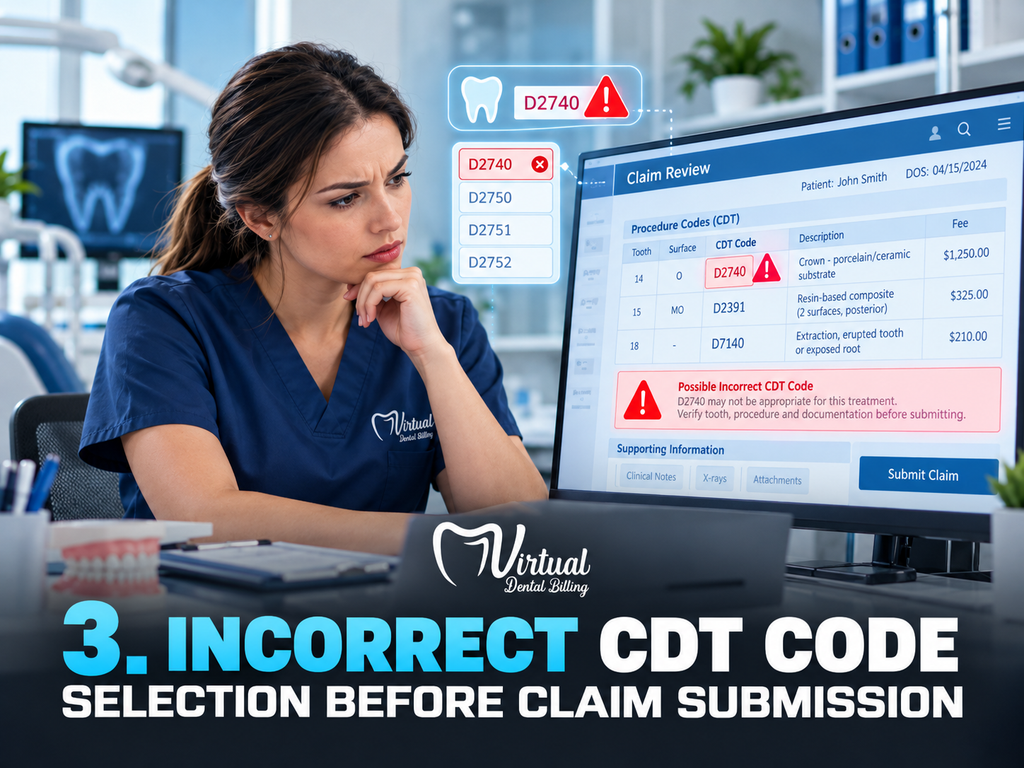
There may be instances where errors with CDT codes happen as a result of AI tools providing a CDT code that might seem to fit the given scenario but does not add up to what’s actually finished in the office. Though there is a lot of specific clinical details in dental procedures, it is possible that some of this data can be misrepresented or re-requested if the dentist is claiming without consulting a patient’s record. Dental procedures tend to cover a lot of clinical details, and a dentist can submit a claim that is inaccurate, require supplemental records if they do not review a patient’s record, or withhold payment if they do not review a patient’s record.
For example, a patient who goes for a core buildup prior to the placement of a crown. The software might come up with a buildup code from the clinical notes, but not be aware whether the documentation constitutes a separately reportable procedure. The insurer will ask questions about the claim or ask for more data if it’s suggested by the billing staff without a review of the treatment record and coding requirements.
But it is more than picking out a right-looking code. Dental billing automation may come up missing clinical details, overlook important details in abbreviated treatment notes, or take details that fall short of fully describing the services rendered. Results of the system’s coding review may not match the clinical documentation, so the code may be submitted even if there are no error messages.
The American Dental Association states that CDT codes must reflect the procedures done. Furthermore, with a valid code comes no guarantee that the insurance plan will cover treatment.
How to prevent incorrect CDT code selection:
- Compare AI-suggested codes with the dentist’s documented treatment.
- Confirm that the current CDT code description matches the procedure performed.
- Review clinical notes and supporting records before submitting complex claims.
- Refer unclear coding recommendations to the treating dentist or a qualified coding professional.
In the end, dental coding is as much about the right code selection and clinical documentation as it is about the automated suggestions. Dental practices can detect coding discrepancies with careful review of the claims before sending them to payers to avoid unnecessary claim corrections.
4. Missing Documentation Required for Claim Approval
AI-driven billing software may be programmed to automatically approve claims without attending to the clinical documentation if it lacks necessary data, leading to the rejection of claims. Incomplete clinical claims may be denied because AI-enabled claim management systems have been programmed to approve claims without reviewing the clinical information. Automated tools can identify blank fields, but they may not be able to determine if records attached to those have been sufficient to support the procedure being billed.
For example, a clinical narrative or supporting radiographs may be required based on the specific payers’ requirements for a crown claim. If the system identifies that there are attachments without seeking to understand their relevance, the insurer may seek further evidence prior to processing.
Hence, it is not always incorrect coding or insurance details in dental billing that are likely to be the cause of error. Sometimes, documentation looks complete but doesn’t meet the payer’s requirements.
Before submitting claims, billing teams should:
- Confirm specific results or requirements for attachments to the provider based on the provider’s type.
- Correlate radiographs and history with the billed procedure.
- Identify missing information for clinical monitoring.
Through proper dental claim documentation, practices can reduce preventable delays and unnecessary follow-ups.
5. Overlooking Annual Maximums, Deductibles, and Frequency Limits
One potential dental insurance billing mistake involves automatically paying out the expected reimbursement without deducting any available annual maximum, deductible or frequency caps. When a treatment is covered, even so, these restrictions may substantially decrease the reimbursement money that is paid by the insurance provider.
For instance, a person requires $1,000 in treatment and has $300 left in her yearly limit. If the system uses its regular percentage of coverage to estimate the bill as per the plan, then the patient may find himself accruing an unexpected bill that exceeds that limit.
But automated dental benefit verification doesn’t always register more recent use of benefits or procedure-specific restrictions. This means that using just the percentage of coverage displayed can lead to inaccurate estimates of treatment and patient balances that are generated.
To prevent these errors, billing teams should:
- Confirm remaining annual benefits and applicable deductibles.
- Review frequency limits and previous treatment dates.
- Recheck benefit details before finalizing patient estimates.
Ultimately, accurate dental insurance billing requires reviewing plan limitations alongside coverage percentages, helping practices communicate more reliable financial expectations.
6. Applying the Wrong Rules When Patients Have Multiple Insurance Plans
Which Dental Insurance Plan Pays First?
With coordination of benefits in dental insurance, the primary plan handles the claim first. The second plan reviews what’s left, but depending on its rules, it may pay less than expected or nothing at all.
| Patient’s situation | What needs attention |
| Child covered by both parents | Check the birthday rule and any exceptions. |
| Coverage under a court order | Review the court order before deciding which plan pays first. |
| Claim going to secondary insurance | Make sure the primary EOB is available. |
| Plan includes a nonduplication clause | Check whether the primary payment leaves anything payable by the secondary plan. |
Where Does AI Get It Wrong?
AI dental billing automation can identify both policies but still select the wrong primary payer. The mistake is easy to miss when the system doesn’t account for a court order or the secondary plan’s payment rules.
What Should the Billing Team Check?
- Confirm which plan should receive the claim first.
- Check for court orders or other exceptions.
- Review the primary EOB before billing secondary insurance.
- Verify the secondary payment before finalizing the patient’s balance.
These checks help keep dental insurance claims processing on track without relying on the software’s payer selection alone.
7. Mistaking AI-Generated Payment Estimates for Confirmed Reimbursement
Why Doesn’t the Insurance Payment Match the Estimate?
The AI dental insurance estimates provide an approximation based on the information provided in the benefits but not necessarily the insurance company’s ultimate determination of the insurance coverage amount. The practice’s payment can change even if the calculation seems to be correct, if plan restrictions are not accounted for or if claims go unpaid during application.
Let’s think about somebody who is getting a $ 1,200 crown. A doctor uses the software to come up with a $600 figure for insurance, and the patient believes he is paying for the rest of the bill. That doctor uses the software and determines the insurance billing is $600, and the patient expects to pay the remaining $600. But the insurer has an alternative benefit provision and only pays $400. Now, the patient has only a $200 bill remaining to continue the treatment.
What Should the Billing Team Confirm?
| AI-generated estimate | Confirmed insurer payment |
| Calculated before treatment | Determined after claim processing |
| Based on available benefit information | Based on the insurer’s claim adjudication |
| Can change when limitations apply | Reported on the explanation of benefits (EOB) |
Billing teams should be able to clarify with patients the amounts that are estimates and the amounts that have been confirmed before discussing dental insurance reimbursement.
This difference should help to avoid payment issues with your dentist’s billing that may result in frustration at the front desk.
8. Allowing Small Billing Errors to Move Through Multiple Automated Steps
How Does One Billing Error Affect the Entire Claim?
With AI dental billing automation, one missing piece of insurance information can make its way through multiple billing processes without anyone realizing it. The issue escalates if the information from preceding automation steps is not mixed and matched for accuracy.
How the Error Spreads
Step 1 — Insurance Verification: The system misses a crown replacement restriction.
Step 2 — Treatment Estimate: The software calculates insurance coverage without considering that restriction.
Step 3 — Claim Submission: The claim is submitted based on the original treatment and billing information.
Step 4 — Payment Processing: The insurer denies the benefit, leaving the practice to review the patient’s balance.
Where Should Human Review Happen?
Dental insurance claim denials should be avoided by billing team staff who, prior to preparing an estimate and verifying claim details before submission, check coverage restrictions.
This also speaks to the fact that dental billing quality control is crucial at all points of handoff, particularly when a number of automated tasks rely on the same insurance information.
9. Losing Visibility Into Why AI Made a Billing Decision
Who Is Responsible When an AI-Processed Claim Goes Wrong?
AI dental billing software can alter or adjust procedure codes, pinpoint missing information, and approve claims submitted for reimbursement without a clear reason. If the claim is denied, it becomes challenging for a billing staff member to determine if there was a change recommended by a doctor or by the parsing system, or if the problem was in the claim itself.
What Should Be Recorded?
| Billing activity | Details worth keeping |
| Insurance verification | Payer response and verification date |
| CDT code changes | Original code, revised code, and reason |
| Claim submission | Submission date and staff approval |
| Denial follow-up | Payer explanation and corrections made |
Why Does This Matter?
If they aren’t set up to track the billing audit trail of a dentist, the staff could make the same mistake in several claims. Furthermore, promoters of data that is not understandable, are not easy to determine who reviewed an automatic change.
To maintain billing compliance for the dental office, important changes to claims should be documented and only proceed if staff has approved them.
How to Reduce Dental Billing Automation Risks

The best way to mitigate dental billing automation risk is to understand what tasks to rely on AI and what to take time to review yourself. Billing teams should review automated actions not automatic processes, and instead they should review only where there is a possibility for incorrect information affecting reimbursement or patient balances.
A 5-Step Review Before Claim Submission
Step 1 — Check Insurance Benefits
Verify coverage, any limits, or continue. Establish coverage, including limits and alternative restrictions, if any, that could impact payment.
Step 2 — Match CDT Codes With Clinical Notes
Analyze suggested codes vs. the treatment done. Find any discrepancies between documentation and code and clear them up prior to submission.
Step 3 — Review Claim Attachments
Ensure that narratives, radiographs, or supporting documentation is provided which fits the Payer’s requirements, and not just as uploaded files!
Step 4 — Flag Unclear AI Recommendations
If an AI dental billing software recommends changing a code or indicates any benefits that conflict, recommend the case to a qualified member of your team for review.
Step 5 — Record the Final Approval
Include the Payer response, corrections, and Reviewer information with the claim to ensure future follow-up is not based on a hunch.
When quality control measures are enforced at these points, dental billing is not identified as a problem after the denial, and the team is able to submit quality billings.
When Is Human Review Necessary in AI Dental Billing?
There are cases where the dental billing process requires human intervention when recommendations made during automation are about insurance benefits which are unclear, clinical judgment, or decisions that may impact a patient’s financial liability. AI can streamline the gathering of specific claims but should not be the sole decision-making tool for any billing.
Which Tasks Need Human Approval?
| Billing task | What AI can handle | When staff should step in |
| Insurance verification | Retrieve policy details | Benefits are missing or conflicting |
| CDT coding | Suggest procedure codes | Code doesn’t match clinical notes |
| Claim attachments | Flag missing documents | Clinical evidence needs review |
| Payment estimates | Calculate expected benefits | Coverage restrictions remain unclear |
| Denial management | Sort denials by reason | Appeals or corrections need judgment |
What Happens When Staff Skips the Review?
If not submitted for manual review for dental insurance claims, the estimate or unsupported coding changes may pass unnoticed to the payer.
The main focus with Virtual Dental Billing should be dental billing accuracy automate repetitive tasks, and keep seasoned billers engaged in more impactful tasks like reimbursement and patient balances.