
Your dental hygienist places Arestin into a patient’s periodontal pocket, records the procedure, and sends the insurance claim. Days later, the payer requests additional records or denies the charge. The treatment was completed, but the claim may not clearly explain why it was needed.
The D4381 dental code covers the localized delivery of an antimicrobial agent into diseased gum tissue, per tooth. When billing for Arestin, insurers may review periodontal pocket depths, bleeding on probing, previous scaling and root planning (SRP), and other clinical records before making a coverage decision.
Yet documentation alone doesn’t guarantee payment. Some dental plans limit D4381 to specific clinical situations, while others exclude the procedure entirely.
This guide explains D4381 Arestin documentation requirements, how payer rules affect coverage, and what dental teams should check before submitting claims to reduce avoidable billing problems.
What Does the D4381 Dental Code Cover?
The D4381 dental code describes the localized delivery of antimicrobial agents through a controlled-release vehicle into diseased crevicular tissue, per tooth. Dentists commonly use this code when placing Arestin into periodontal pockets as part of periodontal treatment.
Arestin contains minocycline hydrochloride, an antibiotic delivered through tiny microspheres. It is FDA-approved for use alongside scaling and root planing (SRP) to help reduce periodontal pocket depth in adults with periodontitis.
Is D4381 Billed Per Tooth or Per Pocket?
One important billing detail is that D4381 is reported per tooth, not per periodontal pocket.
For example, if a dentist places Arestin into two diseased pockets around the same tooth, that does not automatically justify reporting D4381 twice. The CDT descriptor identifies the tooth as the reporting unit.
Dental teams should record the treated tooth number and individual application sites, even though the procedure code is reported per tooth.
This distinction matters because incorrect units can create billing errors and lead to claim adjustments or denials.
Is D4381 the Same as Scaling and Root Planing?
No. Scaling and root planing removes plaque and calculus from root surfaces, while Arestin provides localized antimicrobial treatment.
| Procedure | Purpose |
| D4341/D4342 | Scaling and root planing to treat periodontal disease |
| D4381 | Localized delivery of a controlled-release antimicrobial agent, per tooth |
Although Arestin is used alongside periodontal therapy, D4381 is a separate procedure code. Whether an insurer reimburses it separately depends on the patient’s benefits and the payer’s clinical policies.
Does Using Arestin Automatically Qualify for D4381 Coverage?
No. Correctly reporting the D4381 dental code does not guarantee payment.
Some insurers cover localized antimicrobial treatment only under specific circumstances, while others exclude it from dental benefits.
Before submission, the billing team should confirm the patient’s coverage and make sure the clinical record explains why treatment was provided.
When additional clinical justification is needed, well-prepared dental claim narratives can help communicate the treatment details clearly.
The key point: D4381 identifies the procedure performed, but the patient’s plan determines whether that procedure qualifies for reimbursement.
What Documentation Do Payers Require for D4381 Arestin Claims?
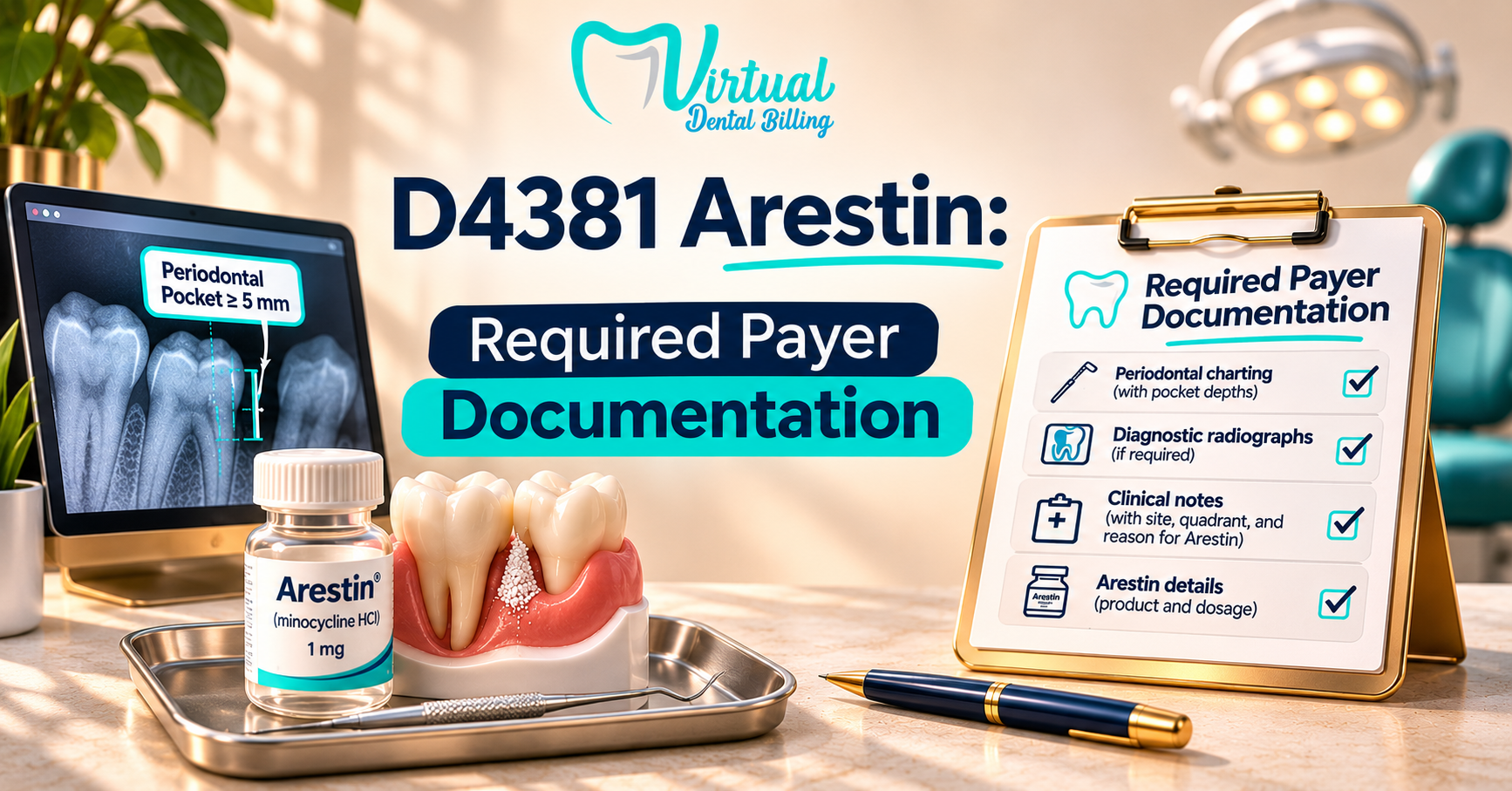
Most dental payers need clinical evidence showing why localized antimicrobial treatment was necessary. For D4381 Arestin claims, this evidence commonly includes periodontal charting, diagnostic radiographs, and treatment notes.
However, requirements vary by insurance company and plan. For example, Delta Dental’s claim documentation guidelines list radiographs, periodontal charting, and diagnostic notes for D4381.
1. Current Periodontal Charting
Periodontal charts help insurers evaluate the patient’s gum condition and identify the areas requiring treatment.
The clinical record should include:
- Probing pocket depths: Measurements in millimeters around the affected teeth.
- Bleeding on probing: Recorded findings that support the periodontal assessment.
- Clinical attachment loss: Documented measurements when applicable.
- Tooth and site identification: Exact teeth and periodontal sites receiving Arestin.
- Charting dates: Evidence showing when the measurements were recorded.
Current charting matters because insurers may reject outdated records. For example, some Delta Dental policies require periodontal charting completed within the previous 12 months.
2. Diagnostic Dental Radiographs
Dental X-rays help support the periodontal diagnosis and show relevant bone levels.
Depending on the payer, acceptable documentation may include bitewing or periapical radiographs.
Images should be dated, clear, and relevant to the teeth being treated. Still, radiographs alone may not explain why Arestin was selected, so the clinical notes must provide that context.
3. Previous Scaling and Root Planing Records
Since Arestin is used alongside scaling and root planing, documenting earlier SRP treatment can help explain the patient’s periodontal history.
Useful records include:
- Dates of previous SRP appointments.
- Teeth or quadrants treated.
- Periodontal findings before and after SRP, when available.
- Re-evaluation results showing areas of continued concern.
Not every insurance company requires the same SRP history. Some policies have specific timing or treatment-sequence rules that the billing team must verify.
4. Detailed Arestin Treatment Notes
The treatment record should explain what was performed and why.
Include the date of service, tooth number, application site, antimicrobial product used, periodontal diagnosis, and clinical reason for treatment.
For example, the note might describe a persistent 6 mm periodontal pocket at a specific tooth after previous periodontal treatment, when those findings are documented.
This gives the payer a clearer understanding of the procedure instead of relying on the CDT code alone.
Quick D4381 Documentation Checklist
| Documentation | Why It Matters |
| Periodontal chart | Shows pocket depths and periodontal findings |
| Diagnostic X-rays | Supports the periodontal diagnosis |
| SRP history | Provides previous treatment context |
| Clinical notes | Identifies the procedure and clinical need |
| Tooth and site details | Supports accurate per-tooth reporting |
| Payer benefit verification | Confirms coverage restrictions and attachment rules |
Important: This is a preparation checklist, not a universal attachment requirement. Only the payer’s applicable policy determines which records must accompany the claim.
Before treatment, dental teams can use a dental insurance verification checklist to identify coverage exclusions, authorization requirements, and supporting documents that may be needed.
Complete, consistent records help insurers review D4381 dental code claims more efficiently and reduce avoidable requests for additional information.
What Pocket Depths and SRP History Do Insurance Companies Review?
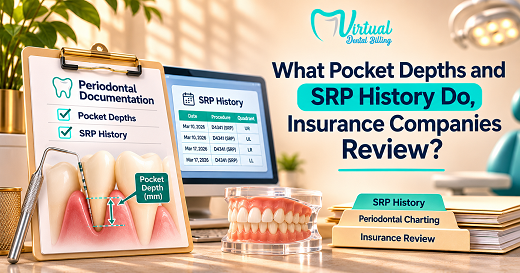
Insurance companies often review periodontal pocket depths and previous scaling and root planing (SRP) before deciding whether to cover D4381. The goal is to determine whether localized antimicrobial treatment meets the plan’s clinical requirements.
However, there is no universal pocket-depth requirement for every dental insurance plan.
Do 5 mm or 6 mm Periodontal Pockets Qualify for D4381?
Some dental payers consider 5 mm periodontal pockets for D4381 coverage, particularly when the records show continued inflammation after periodontal treatment.
For example, Aetna’s D4381 clinical policy identifies isolated pockets measuring at least 5 mm with persistent signs of periodontal disease as part of its criteria for plans that still cover the procedure.
Blue Cross Blue Shield of Massachusetts provides another example. Its published D4381 criteria specify 5–6 mm pocket depths with bleeding on probing, following active and maintained nonsurgical periodontal treatment.
Still, a 6 mm pocket does not automatically guarantee payment. The insurer may also review bleeding, previous treatment, benefit limitations, and whether the condition is localized.
Why Does Previous SRP Treatment Matter?
Previous SRP records can help demonstrate whether periodontal pockets have responded to initial treatment.
Some payers require evidence of persistent or recurrent periodontal disease after SRP rather than covering antimicrobial treatment solely because deep pockets are present.
For example, Aetna requires a healing period of 6 weeks to 6 months after SRP before D4381 can qualify under its covered-plan criteria.
To support the clinical history, dental teams should document:
- Previous SRP date: When periodontal treatment was completed.
- Treated teeth or quadrants: The exact areas receiving SRP.
- Re-evaluation findings: Updated probing depths and bleeding observations.
- Persistent disease sites: Specific locations where periodontal concerns remain.
- Treatment decision: The clinical reason localized antimicrobial therapy was selected.
These details help establish a clear treatment timeline for payer review.
What Happens When SRP History Is Missing?
Missing treatment dates or re-evaluation findings may make it difficult for an insurer to determine whether D4381 meets its coverage criteria.
Even when clinical treatment is appropriate, incomplete records can delay processing or lead to requests for additional documentation.
Dental offices facing similar issues can review these common dental claim denial reasons to identify other documentation problems before submission.
The key takeaway: Pocket depth matters, but it is only one part of D4381 coverage. Dental teams must review the patient’s plan, previous periodontal treatment, and current clinical findings before expecting reimbursement.
How Do D4381 Requirements Differ Between Dental Payers?
D4381 insurance coverage varies between dental insurance companies because each payer has its own clinical criteria, documentation rules, and benefit limitations.
Some insurers may reimburse Arestin under specific conditions, while others exclude it from most plans. This means dental teams must verify the patient’s benefits instead of assuming that all payers follow the same rules.
D4381 Coverage Comparison: Aetna vs. BCBS vs. Delta Dental
| Dental Payer | D4381 Coverage and Requirements |
| Aetna | Excludes D4381 from most dental plans. Certain older group plans may retain coverage if they meet strict clinical criteria. |
| Blue Cross Blue Shield of Massachusetts | Lists 5–6 mm pockets with bleeding on probing after nonsurgical periodontal treatment. Its published guideline limits treatment to once per tooth every 24 months, up to two teeth per quadrant. |
| Delta Dental | Published PPO and Premier claim guidelines require bitewing radiographs, periodontal charting, and clinical notes for D4381 review. Coverage depends on the specific plan. |
These differences show why D4381 payer documentation requirements should be checked before treatment whenever possible.
Why Does Aetna Deny Many D4381 Claims?
Under Aetna’s dental clinical policy, D4381 is generally excluded from plans that became effective after October 1, 2016.
Some older group plans may still provide benefits. For those plans, Aetna applies clinical criteria for isolated periodontal sites that have not responded adequately to previous treatment.
This means even excellent documentation cannot overcome a benefit exclusion.
Does Delta Dental Require Attachments for D4381?
Delta Dental’s published claim submission guidelines identify D4381 among the periodontal procedures requiring supporting documentation for its Premier and PPO patients.
These guidelines specify bitewing radiographs, periodontal charting, and notes that include the periodontal diagnosis and case type.
Still, submitting the requested records does not automatically confirm that the patient’s plan covers Arestin.
What Should Dental Teams Verify Before Treatment?
Rather than relying on general payer guidelines, dental offices should confirm three important details:
- Benefit eligibility: Is D4381 included or excluded under the patient’s specific plan?
- Clinical restrictions: Does the payer limit treatment based on pocket depth, previous SRP, or the number of teeth?
- Frequency and submission rules: Has the patient reached a benefit limit, and which attachments are required?
Professional dental insurance verification services can help practices confirm these details and identify potential coverage problems before claims are submitted.
The key takeaway: There is no single D4381 coverage rule that applies to every dental payer. Confirming plan-specific benefits helps dental teams prepare accurate claims and explain possible patient costs before treatment.
How Should You Write an Arestin D4381 Claim Narrative?
A clear D4381 claim narrative explains why localized antimicrobial treatment was performed and connects the procedure to the patient’s documented periodontal condition.
Simply writing “Arestin placed” may not give the insurance reviewer enough information to evaluate the treatment. Instead, the narrative should connect the clinical findings, treatment history, and procedure performed.
What Should a D4381 Narrative Include?
An effective Arestin insurance claim narrative should identify:
- Tooth number and treatment site: Where Arestin was placed.
- Clinical findings: Documented pocket depth, bleeding, or other relevant periodontal findings.
- Periodontal diagnosis: The condition supporting treatment.
- Previous SRP: Treatment dates and follow-up findings when relevant.
- Reason for Arestin: Why localized antimicrobial therapy was selected.
- Date of placement: When the procedure was performed.
Only include findings supported by the patient’s clinical record. Some payers may request additional information.
What Common Narrative Mistakes Should You Avoid?
Even when the treatment is properly documented, poorly written narratives can make claims harder to review.
Avoid these mistakes:
- Vague explanations: Writing only “Arestin applied” without clinical context.
- Missing tooth numbers: Failing to identify the tooth receiving treatment.
- Unsupported measurements: Including pocket depths that do not match the periodontal chart.
- Incorrect treatment dates: Reporting an SRP or placement date that conflicts with the clinical record.
- Repeated procedure units: Billing multiple D4381 units for different pockets on the same tooth.
These problems may lead to additional information requests, claim corrections, or denials.
Dental practices should also review documentation gaps during routine billing audits. Our guide to dental billing money leaks explains how coding mistakes and missed billing checks can affect collections.
The key takeaway: Strong D4381 narratives don’t need complicated language. They need accurate clinical details that explain what was treated, why it was necessary, and how the procedure relates to the patient’s periodontal history.
Why Do Dental Insurance Companies Deny D4381 Claims?
Dental insurers may deny D4381 Arestin claims because of benefit exclusions, missing clinical records, unmet treatment criteria, or incorrect billing details.
Still, not every denial means the procedure was coded incorrectly. Sometimes, the treatment is properly documented, but the patient’s insurance plan simply does not cover localized antimicrobial therapy.
1. D4381 Is Excluded From the Patient’s Benefits
Some insurance plans do not cover D4381, regardless of the patient’s periodontal condition.
For example, Aetna excludes D4381 from most dental plans, although certain older group plans may have different benefits.
What to do: Review the patient’s benefit details and the explanation of benefits (EOB). If the procedure is excluded, additional clinical notes generally will not change the coverage decision. If the denial conflicts with the patient’s benefits, request clarification or reconsideration.
2. Required Clinical Documentation Is Missing
Incomplete periodontal charts, missing radiographs, or unclear treatment notes can prevent the payer from evaluating the claim.
Delta Dental specifically identifies D4381 among the periodontal procedures requiring supporting clinical documentation under its published submission guidelines.
What to do: Review the payer’s request and submit the missing records through its approved process. Make sure the attachments match the tooth numbers and treatment dates reported on the claim.
3. Treatment Does Not Meet the Payer’s Clinical Criteria
Even when D4381 is covered, an insurer may deny payment if the documented findings do not satisfy its clinical policy.
For example, some plans require evidence of persistent periodontal inflammation following previous SRP treatment.
What to do: Compare the clinical record with the payer’s specific criteria. If the documentation supports coverage, submit a reconsideration or appeal with the relevant records.
Never change probing depths or treatment dates simply to meet an insurance requirement.
4. Frequency Limits or Billing Units Are Incorrect
Some plans restrict how often localized antimicrobial treatment can be reimbursed or how many teeth qualify during a treatment period.
Since D4381 is reported per tooth, billing separate units for multiple pockets on the same tooth can also create problems.
What to do: Check previous treatment history, payer frequency rules, and the reported tooth numbers before correcting or resubmitting the claim.
How Should Dental Teams Respond to D4381 Denials?
The next step depends on the actual denial reason.
| Denial reason | Recommended action |
| Benefit exclusion | Verify plan coverage and patient financial responsibility |
| Missing documentation | Submit the requested clinical records |
| Clinical criteria not met | Review findings and appeal only when supported |
| Frequency limitation | Check treatment history and plan restrictions |
| Incorrect billing units | Correct the claim using documented tooth-level treatment |
Instead of repeatedly resubmitting the same claim, dental teams should identify the exact problem using the payer’s EOB, remittance advice, or claim response.
Reliable dental insurance billing services can support claim corrections, payer follow-ups, and appeals when the available records justify further review.
The key takeaway: Successful D4381 denial management starts with identifying whether the issue involves coverage, clinical eligibility, or claim accuracy. Each requires a different response, and no appeal can guarantee reimbursement.
What Should You Check Before Submitting a D4381 Claim?
Before submitting a D4381 dental code claim, dental teams should complete a final review of the patient’s benefits, clinical records, and billing details. Even small errors, such as an incorrect tooth number or missing attachment, can delay claim processing.
The following checklist can help identify problems before the claim reaches the insurance company.
D4381 Arestin Claim Submission Checklist
| What to Check | Required Action |
| Insurance eligibility | Confirm active coverage and whether the plan includes D4381 benefits. |
| Payer restrictions | Review pocket-depth criteria, frequency limits, and any authorization requirements. |
| Correct CDT code | Report D4381 for the localized antimicrobial procedure performed. |
| Tooth numbers and units | Match each reported tooth to the treatment record and avoid duplicate units for the same tooth. |
| Clinical documentation | Confirm that charting, radiographs, and treatment notes support the claim. |
| SRP treatment history | Check previous treatment dates and re-evaluation findings when required by the payer. |
| Claim attachments | Include the documents required by the patient’s specific insurance plan. |
| Patient responsibility | Review applicable coverage limitations and communicate estimated out-of-pocket costs. |
How Can You Catch Errors Before Sending the Claim?
The final review should compare three records: the clinical treatment notes, dental insurance claim, and payer requirements.
For example, if the clinical record shows Arestin placement on tooth #30 but the insurance claim reports tooth #31, the mismatch should be corrected before submission.
Similarly, if the payer requires current periodontal charting, the billing team should confirm that the correct dated record is attached rather than assuming the insurer already has it.
After submission, check the clearinghouse response or payer acknowledgment to confirm that the claim was accepted for processing. An accepted claim is not the same as an approved or paid claim.
Why Does a Pre-Submission Review Matter?
Consistent claim checks help dental offices reduce preventable rejections, avoid unnecessary resubmissions, and identify benefit limitations early.
Including these reviews in a structured dental revenue cycle management process also helps teams maintain accurate records and monitor claims from submission through payment.
The key takeaway: A successful D4381 billing workflow starts before claim submission. Verifying coverage, clinical evidence, tooth-level coding, and attachments helps prevent avoidable billing problems, even when reimbursement is not guaranteed.
How Can Virtual Dental Billing Help With D4381 Claims?
Managing D4381 Arestin claims requires more than entering the correct CDT code. Dental practices must coordinate clinical documentation, payer requirements, claim submission, and follow-up while keeping their daily operations running.
Virtual Dental Billing helps dental offices manage these administrative tasks and identify billing problems before they turn into unpaid claims.
1. Insurance Verification and Claim Review
Our billing team helps verify patient benefits, identify D4381 coverage restrictions, and review claim information before submission.
For periodontal claims, we work with the clinical records supplied by the practice to check whether tooth numbers, treatment dates, and supporting documentation are consistent.
This helps reduce avoidable errors without changing the dentist’s clinical findings.
2. Documentation and Claim Submission Support
Incomplete attachments or unclear narratives can slow down claim reviews.
Our team helps organize the available periodontal records, prepare supporting claim information, and submit documentation according to the payer’s requirements.
When an insurer requests additional records, we help coordinate the response with the dental office.
3. Denial Follow-Up and AR Recovery
Even properly prepared D4381 claims may be delayed or denied.
Our dental AR recovery services help practices investigate unpaid insurance balances, review denial reasons, follow up with payers, and submit corrections or appeals when appropriate.
For excluded procedures, we help identify the coverage issue rather than repeatedly submitting claims that are unlikely to qualify for payment.
4. Clearer Billing Workflows for Dental Practices
Consistent claim tracking helps practices understand which claims are pending, denied, paid, or waiting for additional information.
At Virtual Dental Billing, we support dental offices with insurance verification, claim processing, denial management, and ongoing revenue cycle management.
Our goal is to help dental teams spend less time handling billing problems while maintaining accurate claims and clear payer communication.
Need help managing D4381 claims? Explore our dental billing services to see how we can support your practice’s insurance claims and follow-up process.
While no billing company can guarantee D4381 reimbursement, accurate records, timely communication, and consistent follow-up can help prevent avoidable claim delays.
Frequently Asked Questions About D4381 Arestin Billing
1. Is D4381 Used Only for Arestin?
No. The D4381 dental code covers the localized delivery of qualifying controlled-release antimicrobial agents into diseased periodontal tissue. Arestin is one example, but D4381 is not a product-specific code. The treatment must meet the CDT description and applicable billing requirements.
2. Can D4381 Be Billed on the Same Day as Scaling and Root Planing?
D4381 and scaling and root planing are separate procedures that may be reported when both are performed and properly documented. However, some insurers require a healing or re-evaluation period after SRP before covering localized antimicrobial therapy. Same-day reimbursement depends on the patient’s specific plan.
3. Does Pretreatment Approval Guarantee D4381 Payment?
No. Even when an insurer provides a pretreatment estimate or authorization, final reimbursement may depend on eligibility, plan limitations, clinical documentation, and claim review. Dental offices should explain this distinction to patients before treatment.
4. Does a D4381 Claim Require a Periodontal Diagnosis?
The clinical record should identify the periodontal condition supporting treatment. Some payers also request specific diagnostic information, including periodontal staging and grading. Billing teams should follow the applicable payer instructions and use only diagnoses supported by the dentist’s documentation.
5. Can You Appeal a D4381 Claim Denied for Missing Records?
Yes, when the payer allows reconsideration or appeal. Dental teams can submit the requested periodontal charts, radiographs, or treatment notes within the applicable deadline. Still, additional documentation will not necessarily reverse a denial caused by an explicit benefit exclusion.
6. Who Pays for Arestin When Dental Insurance Does Not Cover D4381?
Patient responsibility depends on the insurance plan, provider agreement, and applicable billing rules. Dental practices should verify whether the charge can be passed to the patient and explain the estimated cost before treatment. An insurance denial does not automatically mean the entire charge is billable to the patient.
Conclusion: Better Documentation Starts Before D4381 Claim Submission
Accurate D4381 Arestin billing depends on more than selecting the correct dental procedure code. Dental teams need reliable periodontal records, clear clinical justification, and an understanding of each payer’s coverage requirements.
Some insurers may cover localized antimicrobial treatment under specific conditions, while others exclude it entirely. Reviewing these differences early helps practices identify potential payment problems before submitting claims.
Virtual Dental Billing supports dental practices with insurance verification, claim preparation, documentation coordination, denial follow-up, and revenue cycle management.
With a consistent billing process, your practice can reduce avoidable claim errors, manage outstanding balances more effectively, and spend more time focusing on patient care.