
Every day, a dental office sends out claims and waits for insurance payments to come back clean. But the problem starts when cash slows down due to missing one X-ray. Sometimes, a benefit detail is not checked carefully; it can also cause delayed payment. The biggest mistakes that teams made and nobody caught before the claim went out are that they used the wrong code.
AI dental billing in 2026 is changing day by day; it strats from check claims, verifying benefits, catching coding issues, posting payments, and tracking denials before they impact cash flow. It does not replace skilled dental billers. Instead, it helps medical billing teams catch problems earlier, move faster, and spend more time on payer judgment, appeals, and payment accuracy.
Truth is, most dental billing problems do not start when the payer denies the claim. They start earlier, inside the chart, the benefit check, the CDT code choice, or the attachment review. That is where dental billing automation can help.
For Virtual Dental Billing, the strongest position is simple: AI helps the workflow, but expert billers protect the revenue. The best results show when smart tools only help real billing knowledge, not to perform complete practice or to handle every payer decision alone.
What Is AI Dental Billing in 2026?
AI dental billing is the process of using smart billing tools to help dental teams so they can easily complete every task, from start to end. In 2026, it supports trained billers to make claims successfully, but it cannot be a full replacement for real payer knowledge and billing judgment.
AI dental billing: software-supported billing that uses automation and pattern detection to help dental teams review claims, benefits, payments, and denials with better speed and accuracy.
You can consider it as a second set of eyes inside the billing process. It scans any claim and deeply checks for mistakes even before submission, and points out missing details. It helps spot a weak benefit check and group denial patterns so the billing team knows which payer, code, or service is causing the most trouble.
But one thing is also important here: software does not understand every dental case in the same way as an experienced biller does. It may flag a missing attachment, but it cannot always decide if the payer needs a periapical X-ray, a narrative, perio charting, or a prior treatment history.
What AI Can Check
When you run automation for dental billing, you can get help with routine checks that slow down the revenue cycle in result. These checks may include:
- Patient and subscriber details before claim submission.
- Missing X-rays, narratives, perio charting, or other attachments.
- Possible CDT code mismatch warnings.
- Basic eligibility and plan status details.
- Claim status and payer response tracking.
- EOB and ERA matching during payment posting.
- Repeated denial patterns by payer, code, or service type.
- Aging claims that need faster A/R follow-up.
This matters because many claim problems are small at first. One wrong subscriber ID, one missing tooth clause, or one outdated code can turn into a delayed payment, a denial, or extra work for the front desk.
What AI Cannot Safely Own Alone
AI dental billing software can aid in the process, but it shouldn’t make all the billing decisions. Dental claims still depend on clinical notes, payer rules, plan limits, provider setup, and patient-specific benefit details.
Human billers still need to review:
- Complex payer rules.
- Quality of claim narratives and of documentation.
- Corrected claims and appeals.
- Medical necessity details.
- Specialty billing cases, particularly OMS, implants, perio, and ortho.
- Underpayments and write-off errors.
- After insurance pays, patient’s balance questions.
Here is the simple way to look at it: AI can catch patterns, but expert billers catch meaning. That difference matters when revenue is on the line.
How Is AI Changing Dental Billing in 2026?
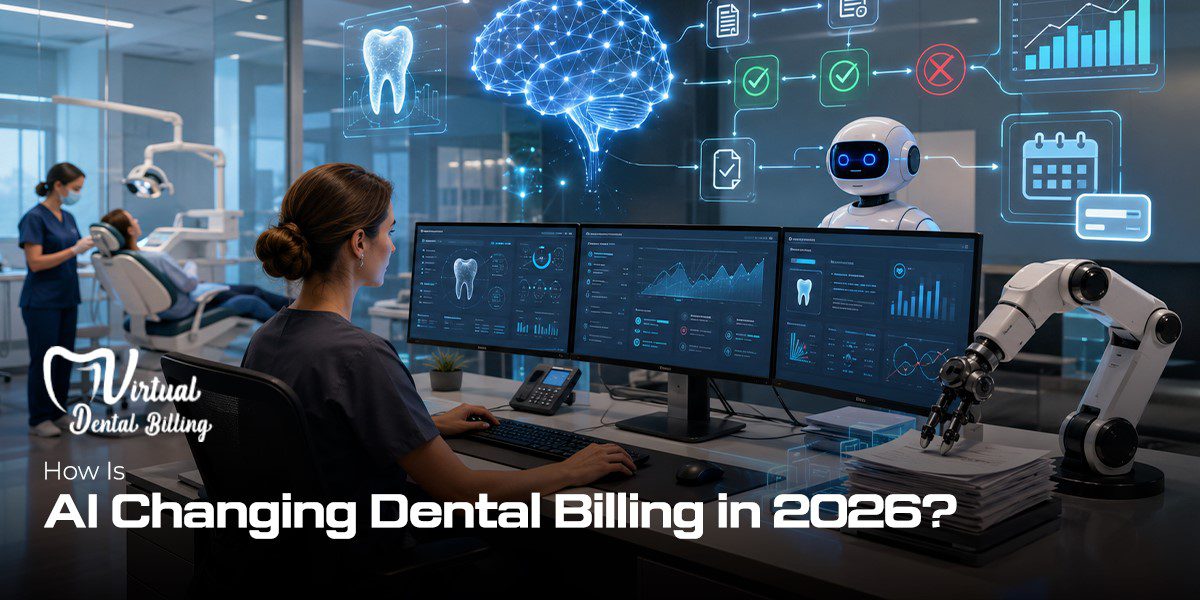
AI dental billing is changing dental billing by catching problems earlier in the dental revenue cycle. Instead of waiting for a denial, practices can now check claims, benefits, codes, and payer patterns before submission. That matters in 2026 because payer checks are stricter, and billing teams already carry heavy manual work.
Here is what changed.
Billing Problems Are Moving Closer to the Start
Earlier, many offices found claim issues after rejection.
Now, AI claim scrubbing can flag common risks before the claim goes out, such as:
- Missing attachments
- Weak benefit details
- Possible CDT code mismatch
- Subscriber information errors
- Payer-specific documentation gaps
This is where AI dental claims processing gives billing teams more control. It does not make the final judgment, but it shows where the claim needs a closer look.
Verification Is Becoming a Bigger Pressure Point
Insurance verification is no longer a quick yes-or-no check. A patient may have active coverage, but that does not mean the plan will pay for a crown, SRP, implant, or night guard.
That is why automated dental insurance verification is becoming more useful. It helps pull plan data faster, while trained billers still confirm limits, exclusions, waiting periods, downgrades, and annual maximums.
Why 2026 Feels Different
The numbers show why practices are paying attention. Zentist’s 2026 report says 71% of dental billing professionals named real-time insurance verification as their top daily challenge, 78% reported more denials or payer scrutiny over the past 12 months, and 58% have already adopted or plan to adopt AI and automation tools in 2026.
So, dental revenue cycle automation is not replacing the billing team. It is helping smaller teams manage repeat work faster.
Think about the daily load:
- More payer scrutiny
- More documentation pressure
- Higher patient responsibility
- Faster software adoption
- More pressure on smaller teams
For this reason, the best use of AI in dental revenue cycle management is practical. Let software handle repeat checks, queue sorting, and payment posting automation support. Then let expert billers handle payer judgment, appeals, underpayments, and dental claim denial prevention.
That is also where dental billing services with AI make sense. The tool speeds up the work, but the billing expert protects the money.
Shift 1: AI Claim Scrubbing Moves Before Submission
AI claim scrubbing is a vital process in enhancing dental claim quality before submission to the payer. It validates attachments, codes, provider information, patient information, service dates, and any potential issues related to the payers. The aim is unambiguous: the number of unnecessary denials, the number of corrected claims, and the number of payments in rework are reduced to a minimum.
When it comes to dental billing, this is one of the major shifts in the field of AI dental billing, as the reviews precede the damage.
However, previously, many billing teams faced issues only when the claim got rejected by the payer. It was already mid-Morning by then in the office. Someone was needed to reopen the claim and locate the missing detail to fix the problem, add the proof, and return it.
The hours are now ripe for dental billing automation to help identify such points early.
What AI Claim Scrubbing Checks
An efficient Clinic AI dental claims processing system can assess the claim prior to submission and alert providers to these common pitfalls:
- Ensure patient and subscriber information is accurate prior to the claim exiting the system.
- Match the CDT code with the procedure, provider note, and treatment record.
- Add an X on missing X-rays, perio charting, narratives, intraoral photos, or other attachments.
- Examine often utilized frequency limitations, waiting durations, and health necessity risks.
- Ensure that high-risk claims are reviewed by a human before being sent in.
- Send risky claims for human review before submission.
This is not always an endorsement of all content approved by the software. It simplifies the billing team’s claim queue and allows them to dedicate more time to claims that require human intervention.
Expert Observation
It is one of the places in which I can see AI helping perhaps more than any other place. A tool can be developed to detect when a crown claim is missing from its associated X-ray. That is useful. Nevertheless, a well-trained biller is aware of the subsequent query: what type of image or benefit history or date of prior crown does this payer wish? That little change counts! However, before becoming a denial, AI claim scrubbing can point to the issue, with an expert biller knowing how to resolve it.
Shift 2: Insurance Verification Gets Faster, But Not Fully Automatic
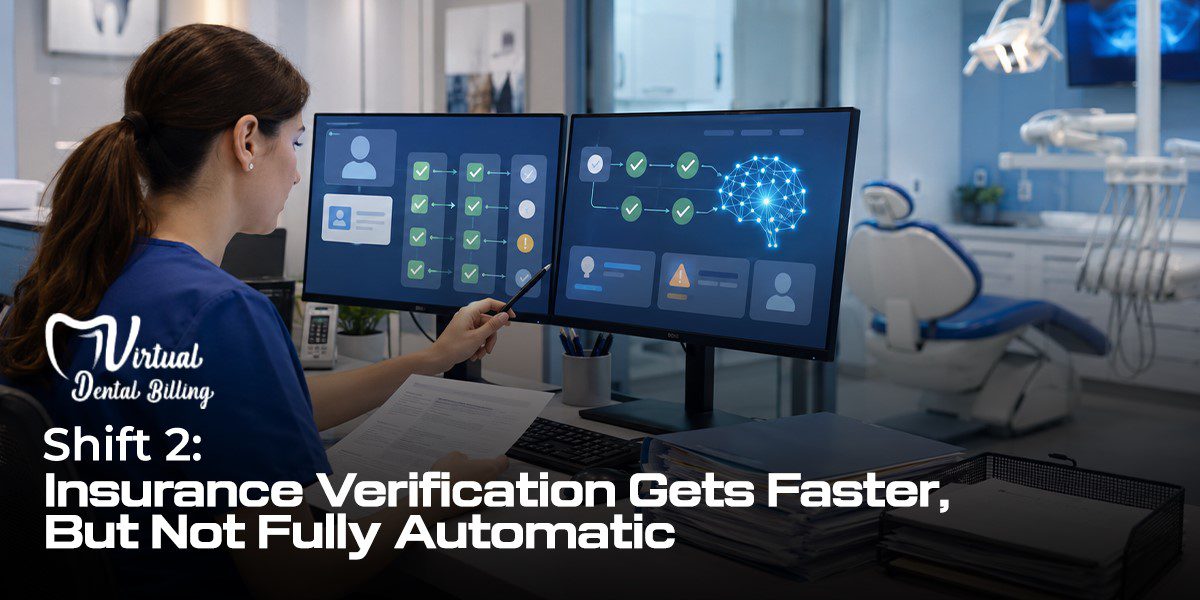
AI can speed up insurance verification by pulling eligibility data, plan status, deductibles, remaining benefits, and basic coverage details faster than manual portal checks. Still, active coverage does not always mean a procedure will be paid. Benefit-level review remains the part where human billing judgment matters. This is where many dental offices lose trust with patients.
The front desk checks insurance and sees active coverage. The patient gets a crown, SRP, implant consult, or night guard. Then the claim comes back lower than expected, or it does not pay at all. Why? Because the first check only confirmed the plan was active. It did not confirm the exact rules tied to that treatment.
Active coverage vs benefit-level verification
Benefit-level verification: checking whether a specific service, such as a crown, SRP, implant, or ortho treatment, is covered under the patient’s plan rules.
Active coverage answers a basic question: Is the patient covered today? Benefit-level verification goes deeper:
- Has the crown frequency limit already been used in the last 5, 7, or 10 years?
- Does the plan have a missing tooth clause for implants or bridges?
- Does the patient have a waiting period for major services?
- Will the payer downgrade a posterior composite to an amalgam benefit?
- Does SRP need perio charting, bone loss proof, or quadrant-level history?
- How much annual maximum is left after previous claims?
This is why automated dental insurance verification works best as the first pass, not the final answer. It can pull the plan data faster and help reduce portal checking, supporting cleaner estimates. But a trained billing team still needs to read the benefit breakdown like a payer would read the claim. Here is the real value: the team does not just check if insurance is active. They review the details that affect treatment estimates, claim payment, and patient responsibility. That matters because wrong estimates create two problems at once. The practice waits longer for money, and the patient feels surprised after treatment. In 2026, AI dental billing software can make verification faster, but expert review still makes it safer.
Shift 3: CDT Code Support Becomes Smarter
AI can help dental teams spot CDT code problems earlier, but it should not choose codes without clinical and billing review. In 2026, code accuracy matters because claims for 2026 dates of service must use the correct CDT 2026 codes, and outdated or deleted codes can create payment risk.
This is not a small update year.
Delta Dental says the CDT 2026 update includes 31 new codes, 12 revised codes, 6 deletions, and several policy revisions. Practices should use 2026 codes for services performed on or after January 1, 2026.
That means old habits can create new denials.
A code that worked last year may need a new descriptor, stronger documentation, or a different claim review path this year. That is exactly where dental billing automation can help, because it gives the team a warning before the claim reaches the payer.
Where AI Helps With CDT Codes
A strong AI dental claims processing setup may help the billing team catch:
- Code mismatch warnings when the note and procedure do not line up.
- Deleted code alerts before an outdated CDT code reaches the payer.
- Documentation prompts when the chart note does not support the code.
- Common code-pair issues when two services appear on the same claim.
- Specialty code risks for OMS, implants, perio, endo, or ortho billing.
Think about a crown claim. The software may flag the code, the tooth number, or the missing image. That helps. Still, the claim only becomes strong when the note, attachment, history, and payer rule all support the same story.
Where Human Review Still Wins
AI can warn the team, but it cannot fully understand why the dentist chose that treatment. Human review still wins when the claim depends on:
- Clinical intent
- Payer policy
- Narrative quality
- Frequency rule exceptions
- Specialty billing, such as OMS claims
For example, an OMS claim may need more than the right code. It may need a surgical narrative, radiographic proof, anesthesia details, tooth position, medical necessity, and a payer-specific attachment path. That is why AI in dental revenue cycle management should support expert billers, not replace them. Smart tools can flag the risk. Skilled billers decide how to make the claim strong enough to pay.
Shift 4: Denial Prevention Starts Earlier
Dental claim denial prevention moves upstream in the billing process with the help of AI. Rather than wait for the claim to be rejected by the payers, billing teams can determine what are some of the potential claim denial pitfalls beforehand. This will help practices minimize denials for lack of documentation, incorrect codes, unenacted benefits, and payer guidelines. This is a significant change that occurred as most denials don’t come out of the blue.
Many begin with a little miscolor on an X-ray, for example, isn’t sent; a wrong digit in the subscriber identification; a frequency rule on the plan that no one is scrutinizing closely. When the denial is received, days, and sometimes weeks, have been lost at the office.
Then the billing staff must take the claim back out, review the payer response, retrieve documentation, resolve problems, and resubmit the claim. The smarter play is to detect this risk before it departs from the practice with AI dental billing.
Common Denial Risks AI Can Flag
An effective AI Claim Scrubbing process can assist the billing team with identifying denial risks, including:
- The lack of an X-ray, perio chart, intraoral photo, or treatment narrative.
- Incorrect Subscriber ID, patient birthdate, group number, or relationship to subscriber.
- There is no code consistency with the clinical note, tooth number, surface, or procedure history.
- Risk of the limitations of frequency of services for crowns, exams, X-rays, cleanings, or perio maintenance.
- Prior authorization requirements for implants/oral surgery/orthodontic or major treatment.
- Benefit maximum – when a lot of the patient’s annual maximum is remaining, but the doctor prescribes near the benefit maximum.
- COB problems with primary and secondary insurance.
This is where AI dental claims processing gives billers a cleaner starting point.
Why Denials Need Expert Judgment
While AI can categorize denial patterns, it may not always be able to make the most appropriate next move. A trained biller must still determine if the claim should be appealed, corrected and re-submitted, or submitted with additional documentation, or written off as per the payer rule. That judgment matters. If a crown claim is denied, a narrative and previous crown date might be required. Perio charting and bone loss proof may be required for an SRP denial. Surgical notes, radiographs, and anesthesia information may be required on an OMS claim. Thus, dental billing automation can identify the risk, but dental billers select the answer that protects the payment.
Shift 5: Payment Posting and EOB Review Get Faster
Payment posting automation through AI’s EOB reading, payment claim matching, and enabling the billing team to identify discrepancies between billed and paid amounts. It’s not just about speed. The actual magic is when underpayments, incorrect write-offs, and deductions are reviewed prior to their aging. At first glance, this aspect of billing seems straightforward.
The payment is from the payer. The team posts it. Patient Balances are updated.
However, in the world of real dental billing, a single posting error could be the starting point for a ripple effect. The practice might not adhere to best practices when it writes off, bills the patient, and/or misses an underpayment, or maybe it sends a wrong balance statement.
This is where AI dental billing software is coming in handy within EOB review. It can quickly read payment information and can assist the billing staff in checking and verifying the amount paid by the payer and the amount claimed by the claim.
What AI CAN’T HELP POST. What AI Can’t Help Post.
With proper AI dental claims processing systems, they are able to organize and review:
- ERA data – from electronic payments from payers.
- EOB PRECARE information related to claim lines and procedure codes.
- Correct insurance payments made onto patient accounts.
- Payer reductions, adjustments, and write-offs.
- Plan-imposed deductibles.
- Out-of-pocket payment.
- Claim-level notes – for payment, denial, or part payment.
This provides a “cleaner” posting trail for the billing team.
What looks like it’s left to human checking? What remains to be manually processed?
While AI can perform tasks such as matching numbers, its abilities shouldn’t be taken for granted when it comes to revenue decisions.
The trained biller must check:
- Underpaid claims that are below the fee per contract.
- Contract fee issues, the payer or plan type that is under contract.
- Improper adjustments that diminish the practice collections.
- Claims Secondary to Primary Insurance.
- When there are two plans, coordination of benefits.
- Balancing the accuracy of patients before sending statements.
This section flows easily into the scope of work of Virtual Dental Billing with the addition of Payment Posting Services or EFT Reconciliation Services for a Virtual Dental Billing company. While AI can speed up the posting process, human intervention ensures accurate posting of funds.
Shift 6: A/R Follow-Up Becomes More Organized
AI can help billing teams organize A/R follow-up by sorting claims by age, payer, denial reason, amount, and urgency. This saves time because billers do not have to start every morning by manually hunting for the highest-risk claims. They can focus on the accounts most likely to affect cash flow. This matters because unpaid claims do not all deserve the same level of attention. A $42 claim from 12 days ago is not the same as a $1,400 crown claim sitting at 74 days. A routine hygiene claim is not the same as an implant, surgical extraction, or SRP claim close to a timely filing deadline.
That is where dental revenue cycle automation becomes useful. It helps the billing team see what needs attention first, instead of digging through the aging report line by line.
How AI Helps Prioritize Aged Claims
A strong AI dental billing workflow can help organize aged claims by real collection risk:
- Sort unpaid claims by dollar amount, so high-value claims do not sit unnoticed.
- Group claims by payer, so billers can work similar follow-ups together.
- Flag repeat denial reasons, such as missing attachments or benefit limits.
- Identify claims near timely filing limits before the practice loses appeal options.
- Push high-value or aging claims to expert review first.
This does not replace follow-up work. It gives the biller a better starting point.
Where Virtual Dental Billing Fits
For Virtual Dental Billing, this connects naturally with 30, 60, and 90-day A/R follow-up. AI can help sort the list, but expert billers still make the calls, check payer portals, review claim notes, and decide the next action.
Shift 7: Human Billing Experts Become More Valuable
AI does not make dental billers less useful. It makes strong billers more valuable because routine checks move faster, while difficult work still needs human review. The offices that gain the most in 2026 will pair dental billing automation with expert claim review, payer follow-up, denial appeals, and payment accuracy checks.
This is the part many practices misunderstand.
AI can flag a weak claim, but it does not know the full story behind the treatment. It can read an EOB, but it may not question a suspicious write-off. It can group denials, but it cannot always decide which claim deserves an appeal and which one needs correction first.
So the real shift is not “AI replaces billing experts.”
The real shift is this: AI removes some repetitive work, so expert billers can spend more time on the decisions that protect collections.
What AI Should Handle
AI dental billing software works best with repeatable billing checks, such as:
| Task | Where AI Helps |
|---|---|
| Claim review | Flags missing fields, attachments, and code warnings. |
| Verification support | Pulls eligibility, plan status, and basic benefit data. |
| Denial tracking | Groups common payer denial patterns. |
| Payment posting support | Matches EOB and ERA details faster. |
| A/R organization | Sorts unpaid claims by age, payer, amount, and risk. |
This gives the billing team better visibility before problems age.
What Expert Billers Should Handle
The judgment-heavy work still belongs with trained dental billing experts.
That includes:
- Appeals that need payer-specific arguments.
- Complex payer calls where portal data does not explain the issue.
- Narrative cleanup when the clinical note does not fully support the claim.
- Specialty billing, especially OMS, implants, perio, endo, and ortho.
- Underpayment disputes when the payer pays less than the contracted fee.
- Patient billing questions after insurance posts.
- Compliance-sensitive decisions involving patient data and billing access.
This last point matters. HHS explains that the HIPAA Security Rule requires covered entities and business associates to use administrative, physical, and technical safeguards to protect electronic protected health information.
For Virtual Dental Billing, this is where expert support stands out. AI in dental revenue cycle management can make work faster, but trained billers still protect accuracy, compliance, and revenue.
AI Dental Billing vs Human Billing Review
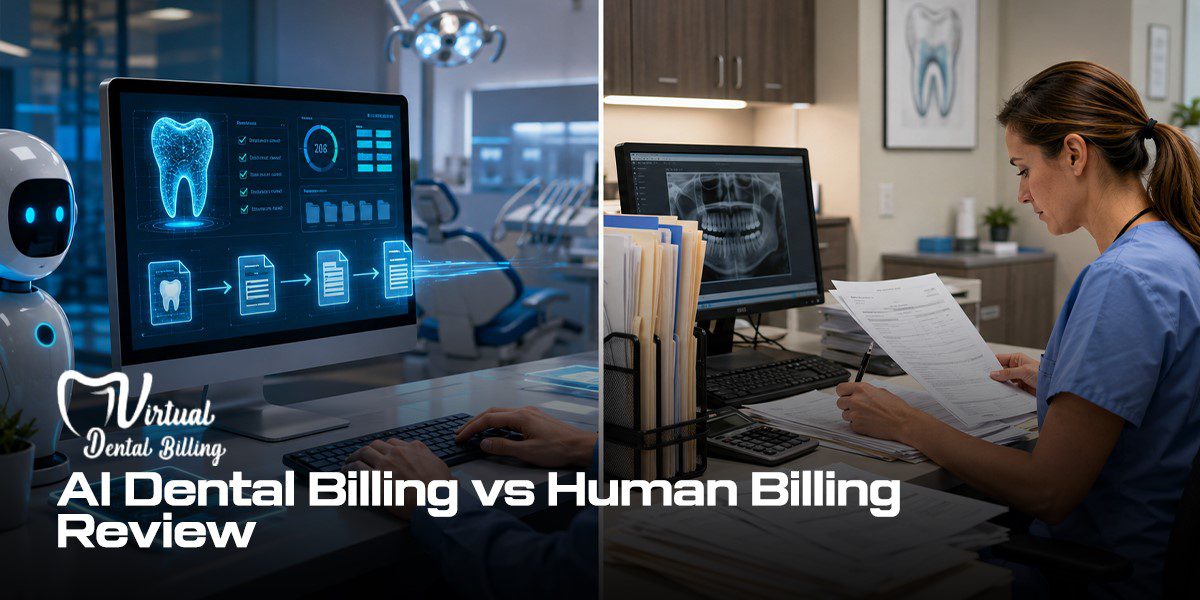
The best dental billing workflow in 2026 is not AI-only or human-only. AI works best for repetitive checks, pattern detection, and queue organization. Human billers work best for judgment, payer communication, appeals, coding context, documentation review, and patient-facing financial accuracy.
Comparison Table
| Billing Task | AI Can Help With | Human Review Still Needed For |
|---|---|---|
| Claim scrubbing | Missing fields, attachments, and code warnings | Payer-specific rule judgment |
| Insurance verification | Eligibility status, plan data, and deductibles | Benefit limits, downgrades, and exclusions |
| CDT coding support | Deleted code alerts and mismatch warnings | Clinical reason and payer policy |
| Denial tracking | Grouping denial reasons | Appeal strategy and resubmission choice |
| Payment posting | EOB matching and ERA posting help | Underpayment and adjustment review |
| A/R follow-up | Claim queue prioritization | Payer calls and high-risk claims |
Final Takeaway
AI is changing dental billing in 2026, but dental practices should not treat it like a magic button. The real win comes when AI catches routine problems early and expert billers handle the judgment-heavy work that protects collections. That is the safest way to look at AI dental billing.
Software can flag missing attachments, sort unpaid claims, support payment posting automation, and help billing teams see denial patterns faster. Still, revenue protection depends on the people who understand payer rules, clinical notes, claim narratives, CDT codes, EOB details, and patient balance accuracy.
So, the strongest billing workflow is not built on software alone. It is built on smart tools and trained billing experts working together.
If your office wants cleaner claims, faster follow-up, better payment accuracy, and fewer avoidable denials, Virtual Dental Billing can support your team with AI-aware billing workflows backed by real dental billing expertise.
The goal is simple: fewer billing gaps, stronger claim review, and a cleaner path from treatment to collection.