
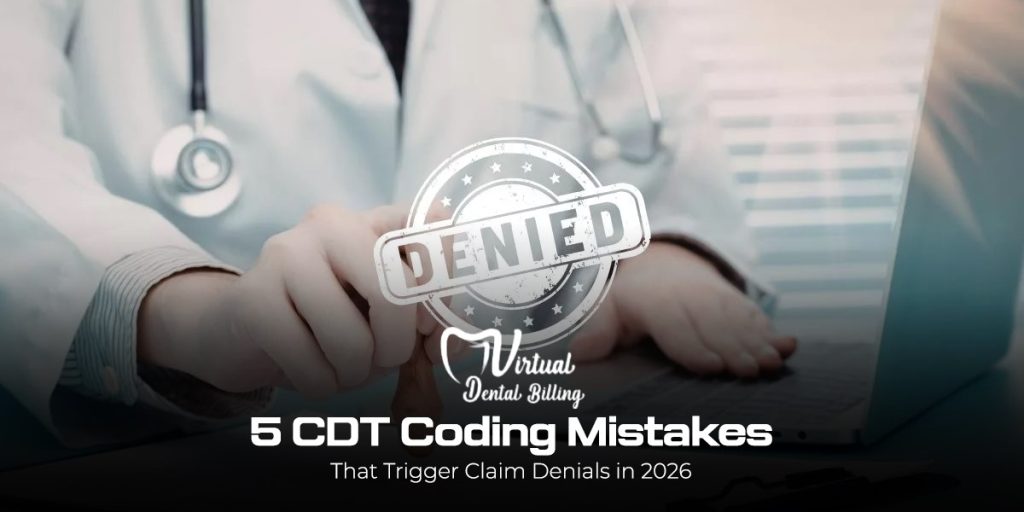
Dental claims often fail before the payer reviews the treatment value. And do you know the biggest CDT coding mistakes that are very simple but create high-impact claims? Due to these mistakes, the claim looks unclear, unsupported, or outdated. In 2026, these five CDT Coding Mistakes that trigger the most risk include old codes, weak clinical notes, missing attachments, payer rule gaps, and wrong code selection.
Current Dental Terminology: the ADA code set that dental teams use to report dental services and procedures on insurance claims.
This topic matters more in 2026 because CDT codes changed again. The ADA reports 60 CDT 2026 changes, which include 31 new codes, 14 revisions, 6 deletions, and 9 editorial changes. Those changes took effect on January 1, 2026, so the offices that still use old codes can face avoidable claim problems as well as denials.
The ADA also announced that denials and delayed payments usually happen because of common coding errors. Its guidance tells dental teams to read the full code name and descriptor, then code for the work done. That sounds simple, but only a single wrong code or dHow Does the Wrong CDT Code Hurt Claim Paymentigit choice turns a clean claim into a payer question.
Let’s suppose a crown claim with the wrong material code, a perio claim without charting, or an oral surgery claim without the right narrative creates the same problem. The payer does not see enough proof to match the code with the treatment. So the claim slows down, is denied, or comes back for more information.
CDT coding mistakes affect claims and payment posting, denial follow-up, patient balance accuracy, and aging reports. And the most important thing is that one denied claim sits in A/R for 30, 60, or 90 days; then the dental decoders team spends more time fixing work that should have gone out clean the first time.
This guide will break down the 5 coding mistakes dental offices should watch in 2026, where we clearly define the denial trigger, a real office example, and a simple fix before claim submission.
Why Do Old CDT Codes Trigger Denials in 2026?
Old CDT codes trigger denials because payers match the service date with the correct code year. CDT 2026 started on January 1, 2026, with 31 new codes, 14 revisions, 6 deletions, and 9 editorial changes. So one outdated code turns a claim into an invalid, unclear, or unsupported request.
CDT code changes 2026: This means the yearly ADA code updates that dental teams must use when reporting services after the new code year starts.
The first mistake happens when the billing team uses last year’s CDT list. This issue looks small at first. However, the payer system reads the code, checks the service date, then flags the claim when the code no longer fits the 2026 manual.
Deleted CDT code: This means the ADA removed the code from the current CDT set, so the office should not use it for new service dates in that code year.
The ADA notes that CDT 2026 includes six deleted codes, which creates a direct risk for claims sent after January 1, 2026. One example listed by ADA News is D1352, preventive resin restoration in a moderate to high caries risk patient, permanent tooth.
Old Code Denial Path
| Coding Issue | What the Payer Sees | Claim Result |
|---|---|---|
| Deleted CDT Code | Code no longer matches the current CDT year | Claim rejects or denies |
| Old Descriptor | Service detail does not match 2026 wording | Payer asks for review |
| Wrong Replacement Code | Treatment and code do not line up | Claim delays or pays wrong |
| Software Not Updated | Claim form pulls last year’s code list | Multiple claims fail |
Simple Office Example
Let’s quote this case as an example. The hygienist completes treatment, the chart looks fine, and the claim goes out the same day. Then the payer denies it because the code came from the old fee schedule template.
The dentist did the work on this, as the patient had coverage, but due to the wrong code implementation, the code list caused the problem.
That is why CDT coding mistakes hurt clean claims. The issue does not start with treatment. It starts when the code, descriptor, note, and payer rule fail to match.
Step-by-Step Fix Before Claim Submission
- Check the service date first.
The date tells the billing team which CDT year applies. - Match the code with the 2026 descriptor.
The ADA tells teams to read the full code name and descriptor, then code for the work done. - Review deleted codes before billing.
Deleted codes need special care because the payer system often flags them fast. - Update the practice management software.
Old code libraries create repeat denials across many claims. - Train the front desk and billing team in January.
The first month of the new CDT year creates the highest risk for old-code habits.
2026 CDT Code Update Checklist
- Review all CDT codes 2026 changes before January claims go out.
- Remove deleted codes from templates.
- Update fee schedules linked to procedure codes.
- Check revised CDT codes before crown, perio, implant, anesthesia, and testing claims.
- Compare each selected code with the clinical note.
- Save ADA code update notes for billing team training.
- Audit the first 25 to 50 claims sent in January.
- Track every denial tied to old or revised codes.
Old codes create instant denials because payer systems look for the current CDT year first. Therefore, the safest claim process starts with the review of code year, not claim follow-up. This one gesture protects payment, reduces rework, and keeps dental claim denials from growing into 30, 60, or 90-day A/R.
How Does the Wrong CDT Code Hurt Claim Payment?
Wrong CDT code selection hurts payment procedures because the payer reads the code as the claim story. The dentist does the work, but the payer can only see the code, note, tooth details, X-ray, and plan rule. When those parts don’t match, dental claim denials start.
Code selection: it refers to choosing the CDT code that best matches the dental billing service the dentist performed and wrote in the chart.
This mistake happens in busy offices more than people think. One team member picks the code from habit. The claim goes out fast. Then the payer sends it back because the code does not match the proof inside the file.
Let’s understand with an example: suppose a dentist treats a fractured tooth, but mentions only “crown fix” on the note. When he attaches the X-ray that shows damage, but the claim does not explain the fracture, material, or reason for the crown. So the payer sees a gap and asks for more details.
The same issue happens with perio, fillings, extractions, implants, and exams. Perio claims need charting. Fillings need the right tooth and surface details. Extractions need the right tooth condition. Exams need the right visit type and frequency check.
How Should the Office Check the CDT Code Before Submission?
The office should check the code, note, proof, and payer rule before the claim leaves the system. This four-part process helps the team catch dental coding errors early. It also supports accurate CDT coding because every claim tells the same story from chart to payer.
- Start with the treatment note.
The note should explain what the dentist did, why the service was needed, and which tooth, surface, arch, or quadrant applies. - Match the CDT code with the full descriptor.
Short code names often hide key details, so the team should read the full wording before choosing the code. - Check the proof that supports the code.
X-rays, intraoral photos, perio charting, narratives, and clinical notes should support the service billed. - Review the payer rule before sending.
One plan rejects a code without a photo, while another plan asks for perio charting or a longer narrative. - Send risky claims for a second review.
High-dollar claims, surgical claims, crown claims, implant claims, and perio claims deserve one extra look before submission.
Simple Claim Check Process
Use this process before sending claims that often deny:
- Read the clinical note first.
The note should make the treatment clear without forcing the biller to guess. - Pick the CDT code after reading the descriptor.
The selected code should match the work, not the closest habit-based option. - Add the proof before the payer asks.
Crown claims often need X-rays or photos, while perio claims often need charting. - Check the plan rule.
Frequency limits, age limits, waiting periods, and downgrades change the claim result. - Review the claim one last time.
The final check should confirm code, tooth number, surfaces, provider, attachments, and narrative.
What This Looks Like in a Real Office
To let you fully understand, here is again a simple and easy example. The dentist completes scaling and root planing. The biller selects the period code. Then the claim goes out without pocket depths or bleeding notes.
The payer does not know the full clinical reason. It only sees a perio code with weak support. So the payer asks for charting or denies the claim for lack of documentation.
Now compare that with a cleaner claim. The note explains the diagnosis. The period chart shows pocket depths. The claim includes the right quadrant. The attachment supports the code. That claim has a much better chance of moving forward without delay.
Quick Fix for This CDT Coding Mistake
The fix is not hard, but it needs a system. The office should not wait for the payer to ask for proof. The team should build proof into the claim before submission.
Use this quick review:
- Does the CDT code match the work completed?
- Does the clinical note explain the reason?
- Does the claim include tooth, surface, quadrant, or arch details?
- Does the payer need an X-ray, photo, chart, or narrative?
- Does the plan have a frequency limit?
- Does the selected code match the 2026 CDT descriptor?
- Does the claim need review before submission?
Wrong code selection creates one of the most common CDT coding mistakes because it hides inside normal billing work. The treatment might look right. The chart might look complete to the office. Yet the payer needs the code, note, proof, and plan rule to match before payment moves forward.
Simple Fix for This CDT Coding Mistake
The best fix is simple: document the clinical reason first, then match the note with the CDT code before claim submission. This helps the payer see the diagnosis, treatment need, tooth details, and proof in one clear path.
Follow this process before sending the claim:
- Write the reason for treatment.
The note should explain the problem, such as decay, fracture, infection, bone loss, pain, or failed restoration. - Add the exact treatment details.
The record should include tooth number, surface, quadrant, arch, or site when the CDT code needs it. - Match the note with the CDT descriptor.
The selected code should fit the service that the dentist completed and documented. - Attach proof before the payer asks.
X-rays, photos, perio charts, and short narratives help support high-risk claims. - Review the claim as one full story.
The code, note, attachment, and payer rule should all point to the same treatment.
Strong clinical notes support accurate CDT coding because they remove guesswork. They also help the billing team respond faster when the payer asks for records.
Weak notes create one of the most common CDT coding mistakes because the office remembers the case, but the payer only reads the claim file. So the note should explain the full reason before the claim leaves the office.
What Checklist Helps Prevent CDT Coding Mistakes?
The best way to prevent CDT coding mistakes is to check the claim before it leaves the office. The team should review the code, clinical note, attachment, payer rule, and service date together. This simple review helps reduce dental claim denials and keeps payment from getting stuck in A/R.
Use this final checklist before claim submission:
- Check the CDT code year.
The service date should match the correct CDT code set for 2026. - Read the full CDT descriptor.
Short code names miss details that change how the payer reads the claim. - Match the code with the clinical note.
The note should explain the diagnosis, treatment reason, tooth details, and service performed. - Add the right claim attachments.
X-rays, photos, period charts, and narratives should support the billed code. - Review payer-specific rules.
Frequency limits, waiting periods, age limits, and downgrades change payment results. - Check high-risk claims twice.
Crowns, implants, perio treatment, oral surgery, endo, and high-fee procedures need extra review. - Track denials by code and payer.
Repeat denial patterns show which codes need team training. - Update templates after CDT changes.
Old fee schedules, saved procedure buttons, and claim templates often carry old coding errors.
Final Wrap-Up: CDT Coding Mistakes That Trigger Denials
CDT coding mistakes trigger claim denials when the code, note, proof, and payer rule do not match. In 2026, this risk grows because CDT updates include new codes, revised wording, deleted codes, and editorial changes. One small coding habit from last year may delay payment this year.
The five biggest risks stay clear:
- Old or deleted CDT codes.
These create fast rejection when the service date falls under the 2026 code year. - Wrong code selection.
This makes the claim tell the wrong story, even when the dentist performed the right treatment. - Weak clinical notes.
These leave the payer without enough reason to support the billed service. - Missing attachments.
These slow crowns, perio, implant, oral surgery, and endo claims because the payer needs proof. - Ignored payer rules.
These create denials tied to frequency limits, plan exclusions, age limits, and downgrades.
The cleanest claim tells one clear story. The CDT code states the service. The clinical note explains the reason. The attachment proves the need. The payer rule confirms the benefit path.
For this reason, dental teams should not treat coding as a last step. Coding starts in the chart, continues through claim review, and ends when the payer receives a clean, supported claim.
When offices build this habit, fewer claims bounce back. Billing teams spend less time on rework. Patients get cleaner estimates. Practice owners see fewer unpaid claims sitting in 30, 60, and 90-day A/R.
Virtual Dental Billing helps dental practices review claims with sharper coding checks, cleaner documentation support, denial follow-up, and payment accuracy. With the right billing team behind the process, the full revenue cycle stays cleaner from the start.