

Though it may look pristine on the screen, a dental claim can emerge unpaid. There is a difference of one digit between the two subscriber IDs. However, the one crown claim does not have an X-ray. One SRP claim has inadequate perio charting. There is only one extraction code that does not match the clinical presentation. This is what makes tiny teddy bears a delayed cash.
In 2026, AI-powered claim scrubbing will prevent denials by screening claims INSTEAD of after they are denied. It assists dental staff to uncover lost attachments, incorrect patient data, insufficient documentation, obsolete codes, benefit risks, and payer-specific problems all before the claim is submitted.
This becomes more important in 2026 with a narrowing down of the payer review. Zentist’s 2026 dental RCM report revealed that 78% of practices experienced more denials or payer scrutiny during the last 12 months, and 71% cited real-time insurance verification as their biggest challenge. According to the same report, 58% of practices are implementing or are likely to implement AI and automation solutions in 2026.
There’s a layer more: code accuracy. Thirty-one new codes, 12 revised codes, and six deleted codes in CDT 2026 add more potential claim issues for previous billing practices since the code set’s effective date, January 1, 2026.
That’s where AI claim scrubbing can be helpful. Does not stand in for expert billers. It provides them with a more favourable review pathway, allowing them to save time on higher-risk reviews, utilise judgement on a payer, improve documentation, and prevent any dental claims from being denied.
Virtual Dental Billing’s objective: Identify repeat claim problems as soon as possible with smart tools, and then review repeat claims with expert dental billers for collection protection.
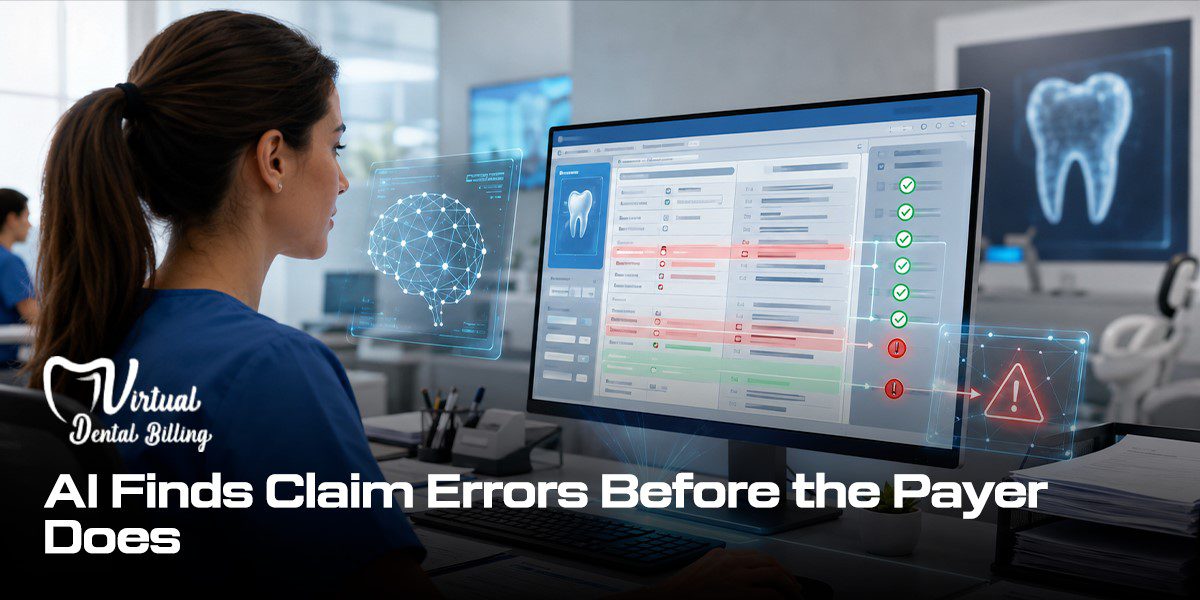
1. AI Finds Claim Errors Before the Payer Does
AI-powered claim scrubbing is beneficial for reducing claim denials in two ways: it identifies simple claim denials before they get submitted. These are the seemingly insignificant errors that ban or stall requests, end up triggering rejections, generate more follow-up for the billing team, and result in corrected claims.
It is not the fun part of billing, but truthfully, it is the part that leaves a lot of money stuck.
No one cares when the front desk is backed up, the schedule is booked solid, or the treatment note is late! The payer can reject if the claim is not entered with the correct subscriber ID, missing tooth detail, incorrect provider detail, or insufficient patient detail.
That means that the claim goes unduly paid by the time the office reviews it.
What AI Can Catch Before Submission
There is a powerful argument for developing an AI-driven scrubbing process for claims that are produced after simple but expensive claims details are reviewed, including:
- Information on insurance plans, subscriber ID, and group number.
- Data: Patient name, date of birth, relationship to subscriber.
- Provider NPI, provider tax ID, location, and rendering provider information.
- Date of service, procedure code, tooth number, surface and quadrant.
- Failure to include attachments such as X-rays, perio charting, intraoral photos, narrative, etc.
- Add claims for items that are not part of the patient record or treatment note.
- One mismatch error can bust the claim at this stage before going to real review.
These checks matter because one mismatch can stop the claim before it reaches real review.
Why This Reduces Denials
The dental claim scrubbing software will provide the billing team with the ability to identify the types of dental claims that payers quickly turn their noses up at. This equates to reduced re-claimation of open work for simple fix-ups and reduced time the teams spend reopening clean work the first time.
Imagine a claim to the crown. It could very well be that the code is correct. The patient can be active. More than likely, the provider is in network. However, that is a weak claim if the X-ray is absent or the clinical note has a different tooth number than what is indicated on the X-ray.
This is where automated claim review comes in handy. Does not “think” like a payer in all cases, but it will be able to identify gaps and focus on them prior to the payer “actively” using the gaps against the claim.
Clean billing is where clean billing begins for Virtual Dental Billing. AI can identify what’s missing, and experienced billers can ensure that the medical claim narrative is complete enough to submit.
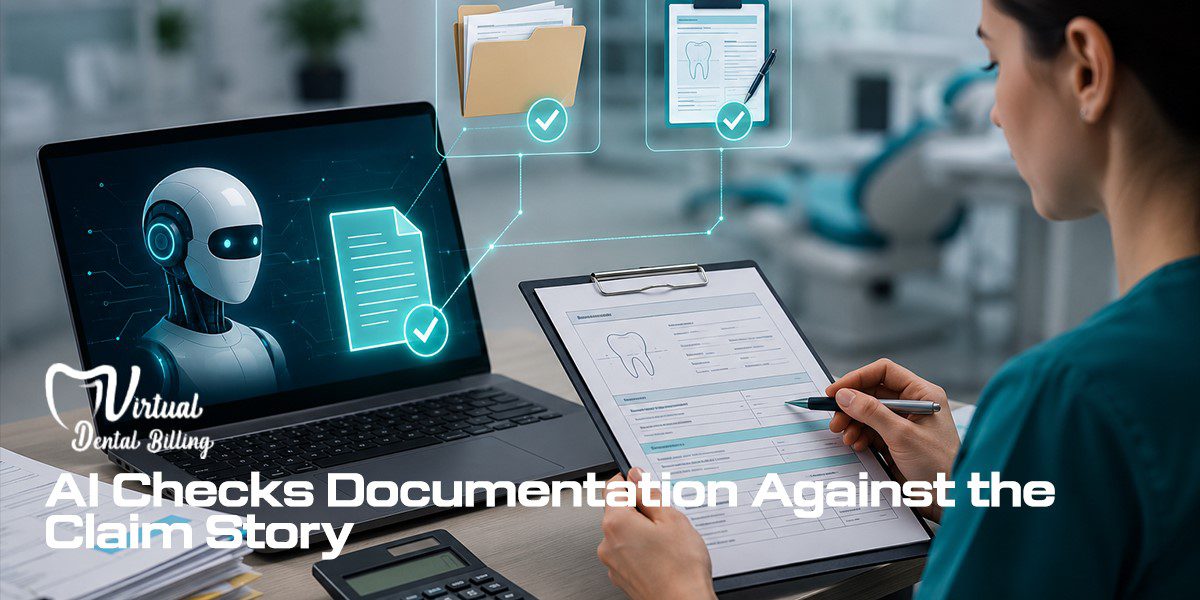
2. AI Checks Documentation Against the Claim Story
The second way in which AI-enabled claim scrubbing cuts down denials is that it can verify that the paper records align with the claim, prior to submission to the payer. A claim can be in the correct sequence with the correct patient information (and the correct code), but if the note or X-ray (or perio chart or narrative) does not demonstrate the service, payment may still be delayed.
This is where many dentists lose many dental claims.
The claim is submitted via the billing team. There is no real problem with the code. Treatment is finished. The provider filled out something in the Chart. However, the payer requires further substantiation and/or refuses to cover due to insufficient documentation of medical necessity.
For this reason, AI claim scrubbing does not just need to verify fields. It ought to examine why the claim is so.
What the Claim Story Must Prove
There’s more to a clean dental claim than a code. It requires the assistance of the entire record.
For example:
- There is a need to include an X-ray, number, clinical reason, and previous crown history in a crown claim.
- Perio charts, bleeding points, bone loss, and quadrant details might be required to support an SRP claim.
- Missing tooth information, prior authorization status, and benefit rules may be required for an implant claim.
- Radiographs, diagnosis, and tooth condition can be required for an extraction claim.
- Plan limits, age requirements, case start date, and remaining lifetime maximum may be necessary when filing an ortho claim.
Facing the challenge with the billing team is where the power of AI dental claims processing lies in making them wait for others to realize the validity of the documentation. The weak documentation problem faced by the billing team is the place where AI dental claims processing can help them realize it even before the payer.
How AI Helps Review Documentation
Dental billing automation is powerful enough to identify issues such as:
- A medical note with the same CDT code is not displayed.
- No such attachment could be found, or the supported service does not exist.
- The procedure has too few pages for the narrative.
- The claim should be referred to perio charting, with just a brief note attached.
- Typically, the payer will request additional documentation on this service type.
- This will give the biller an opportunity to correct the claim before it’s submitted.
However, final revisions should remain in human style. AI can recognize a weak claim, while an expert biller can identify the claim to boost by integrating the right narrative, attachments, and validation records from the perspective of the payers.
This is where the expertise of a dental billing service can benefit Virtual Dental Billing. The aim is not merely for speedy submission. The aim is to get a claim submitted with minimal opportunities for the payer to withhold, postpone, or ask for supplemental information.
3. AI Sends High-Risk Claims to Expert Review First
The third manner in which AI-driven claim scrubbing helps avoid claim denials is by flagging claims that are more prone to denial before they get lost in the regular flow of claims. Rather than processing all claims equally, AI can identify claims that may be at a higher risk of needing expert review due to various factors such as the presence of higher-risk payers, procedures, benefit rules, or a documentation pattern.
It’s here that claim scrubbing goes beyond a simple checklist. If a dentist requires a filling, that should not be reviewed the same way he/she would review a surgical extraction. Cleaning and claiming for an implant is not the same thing. Do not put a $90 x-ray claim and a $2,000 crown/bridge claim in the same claim priority queue.
Automating Revenue Cycle Management is one reason why you need to make the billing team smarter. It can order claims by risk (not date)!
Which Claims Need Expert Review First?
When the scrubbing system detects certain warning signals, it can send the claim to an expert for review, e.g: These are some of the procedures that require more than a decent amount of money, like crowns, implants, bridges, surgical extraction, or ortho cases.
- Claims associated with payers who require more documentation.
- Services that have frequency restrictions (crowns, exams, X-rays, perio maintenance).
- Claims that may have COB issues.
- Responses to procedures which might require authorisation or pre-treatment estimates.
- Claims where the total on the note, code, and attachment do not agree.
- Denial patterns that are repeated by the same payer, provider, or procedure.
This provides a good starting point to begin with for the biller. By first considering claims that are more likely to impact cash flow, the team does not need to work through all claims the same way.
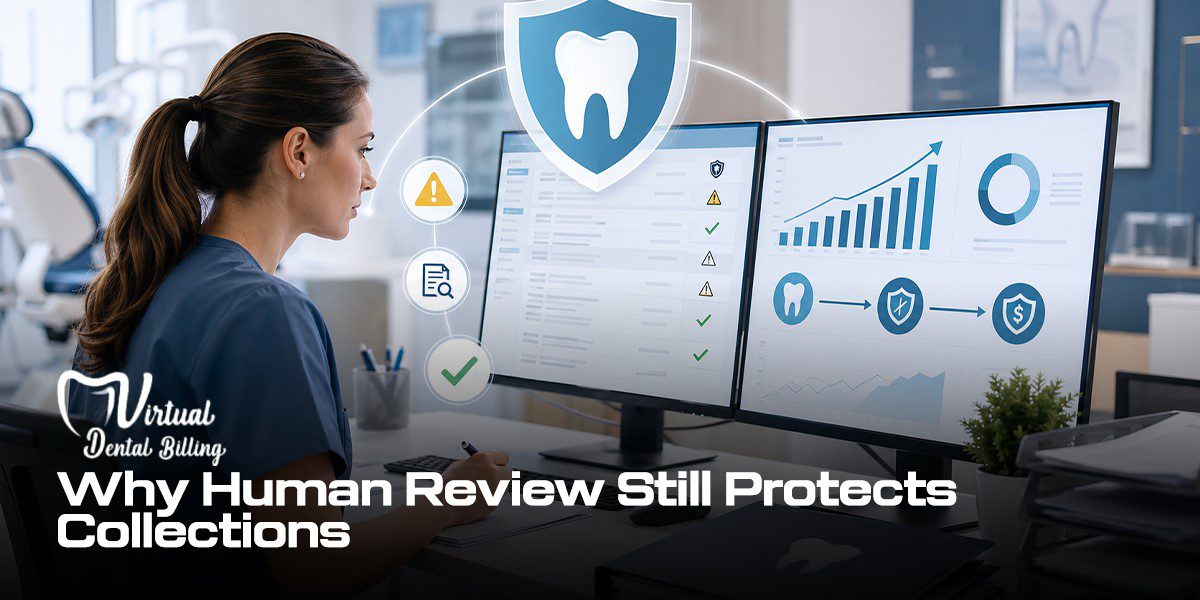
Why Human Review Still Protects Collections
AI can help determine the tier of risk; however, it cannot be used for every payer decision. Even a training biller will have to make a call at the time of payment on what to do next. Does the moral deserve to be featured in a stronger story? Do the attachments need changing? If the team looks at previous versions, should they be made public? Is there a specific form, image type, or benefit note that a payer needs? This is where dental claim denial prevention comes to fruition.
In this way, a textured implant claim might appear to be prepared but the payer might still have to have gaps of missing tooth history, bone graft specifics, prior authorization status, or plan exclusions confirmed prior to sending the claim. The risk can be identified by AI. An expert biller would know what to do with that warning.
This is the most powerful application of AI dental claims processing for Virtual Dental Billing. Do not delay the organization of risk by relying on the software – let the competent billers organize, correct, clean, and safeguard the risk before the payer has the reason to reject it.
Why AI-Powered Claim Scrubbing Still Needs Expert Billers
While AI-enabled claim scrubbing can detect claim risks sooner, it cannot eliminate subjective, human, and possibly judgmental decisions that come from the real-world experience of dental billing. While software can alert to missing details, code risks, and payer patterns, it is up to an expert biller to determine the steps for correcting a claim before it becomes a denial. This is an area that is missed by many practices.
There may be a statement “attachment missing” in a scrubber. However, when the procedure is discussed with a trained biller, the question is asked, “Which attachment does this payer require for this procedure?” That difference matters.
A payer may require a bitewing for one claim, a periapical X-ray for another, and a full narrative for a crown replacement. The payer might request that the SRP includes bone loss documentation, pocket depths, perio charting, quadrants, and bleeding points. The payer will search for surgical notes, positioning of the tooth, information about the anesthesia used, and medical necessity supporting a CPT code submitted as an OMS claim. This is not simple automation. That’s the aspect of bill-making etiquette.
What AI Can Flag but Not Fully Fix
Even robust dental claim scrubbing software can be a bit overwhelmed by problems such as:
- A narrative in which the x-ray does not fit in.
- An SRP that has perio charting, but does not document all 4 quadrants.
- A claim for an implant for which a plan has a missing tooth provision.
- A secondary claim requiring manual review for coordination of benefits.
- There is a surgical extraction claim, and the code is in need of greater clinical support.
This is the place where automated claim review is able to assist, yet expert billers safeguard collections.
Where Virtual Dental Billing Makes the Difference
The objective of Virtual Dental Billing is to not let AI make all the decisions. The aim is to take advantage of dental billing automation and discover typical risks early, thereby presenting the opportunity for professional billers to review claims and make decisions based on the payer’s guidelines. This is what makes AI Dental Claims Processing risk-free.
This software accelerates the initial check. The expert biller backs up the final bill. Combined, they can provide a cleaner roadmap to avoid dental claims being denied, to pay accurately, and to eliminate unnecessary delays.
Quick Checklist: What AI-Powered Claim Scrubbing Should Catch Before Submission
A good AI-powered claim scrubbing process should not only check if a claim form is filled out. It should help the billing team find the small issues that usually turn into denials, payer delays, payment holds, and corrected claims.
Think of this checklist as the final safety check before the claim leaves the practice.
Patient and Insurance Details
- Patient name matches the insurance record.
- Date of birth is correct.
- Subscriber ID has no missing or extra digits.
- Group number matches the active plan.
- Patient relationship to subscriber is correct.
- Primary and secondary insurance are listed in the right order.
Procedure and CDT Code Details
- The CDT code matches the treatment completed.
- Tooth number, surface, arch, or quadrant is included where needed.
- The code is active for the correct date of service.
- Deleted or outdated codes are flagged before submission.
- The clinical note supports the billed procedure.
Documentation and Attachment Review
- Crown claims include the right X-ray and reason for treatment.
- SRP claims include perio charting, bone loss proof, and quadrant details.
- Implant claims include missing tooth history and benefit-risk review.
- OMS claims include surgical notes, radiographs, and medical necessity support.
- Narratives explain the reason for treatment in clear payer language.
Benefit and Payer Risk Review
- Frequency limits are checked before submission.
- Waiting periods are reviewed for major services.
- Missing tooth clauses are checked for implants, bridges, and dentures.
- Prior authorization or pre-treatment estimate status is reviewed.
- Annual maximum and deductible details are checked.
- Coordination of benefits issues are flagged before the claim goes out.
This is where dental claim denial prevention becomes more practical. The software catches the routine risks, then the biller reviews the claims that need deeper payer judgment.
For Virtual Dental Billing, this checklist is exactly where AI support and expert review should meet. Clean claims do not happen by luck. They happen when every weak point gets checked before the payer has a reason to push back.