
Your dental practice may have a packed appointment schedule, patients coming in throughout the day, and a team working hard to complete every treatment. Still, when you check your monthly collections, the money received may not match what your practice expected to collect.
So, where does that missing revenue go?
Sometimes, the problem starts with small dental billing errors that nobody notices. For example, an insurance claim may remain unpaid, a payment might be posted incorrectly, or an old patient balance may never receive proper follow-up.
Over time, these problems can create dental billing money leaks, where billing mistakes, missed follow-ups, and payment delays affect your practice’s cash flow.
However, not every unpaid claim means the money is permanently lost. Some claims need corrections, while others may be subject to insurance coverage limits.
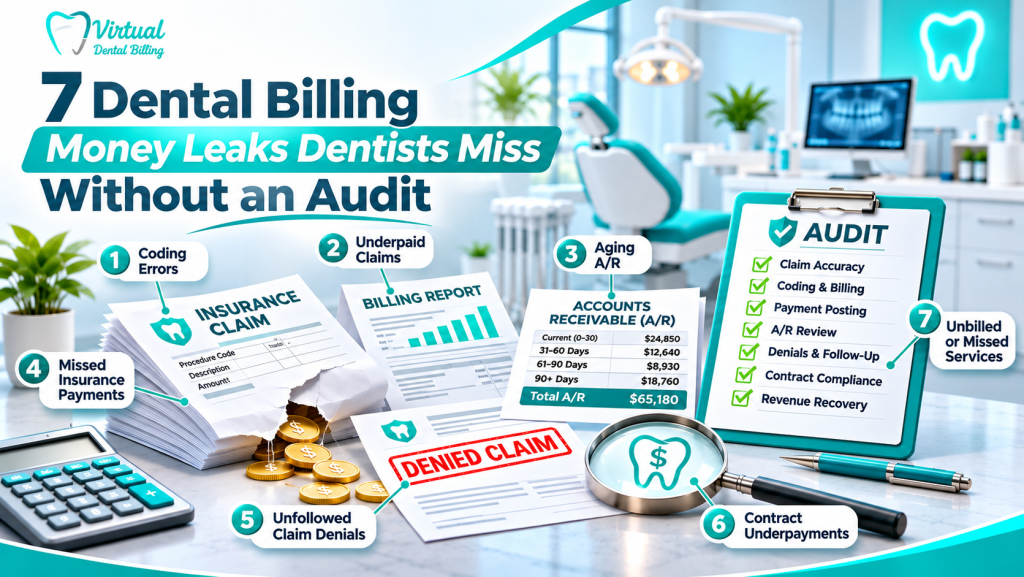
This is why a dental billing audit matters. By reviewing insurance claims, payment records, and outstanding balances, your practice can identify where revenue is getting delayed, overlooked, or potentially lost.
So, which billing problems should you look for first? Let’s explore seven hidden revenue leaks and how to spot them before they create bigger financial problems.
1. Unverified Insurance Benefits Before Treatment
Your front desk may confirm that a patient has active dental insurance before scheduling treatment. However, having an active policy does not always mean the insurance company will pay for every procedure.
For example, suppose a patient visits your practice for a dental crown. Your team checks the insurance status and estimates the patient’s payment. However, after treatment, the claim is processed with little or no insurance payment because the plan has a waiting period or the patient has already reached their annual benefit limit.
Now, the patient owes more than expected, and your billing team has to explain the difference.
This is how incomplete dental insurance verification can create a hidden revenue leak. The insurance limitation itself is not lost revenue. Instead, the problem begins when an incorrect estimate leads to delayed payments, unexpected patient balances, or missed collection follow-ups.
What Should Your Team Verify Before Treatment?
To prevent these billing problems, your team should check more than whether a patient’s insurance is active. Important details include:
- Eligibility: Is the patient’s coverage active on the treatment date?
- Annual maximum: How much insurance benefit is still available?
- Deductible: How much must the patient pay before certain benefits apply?
- Frequency limitations: Has the patient already used the benefit for this procedure?
- Waiting periods: Does the plan require the patient to wait before certain treatments are covered?
- Treatment coverage: Is the recommended procedure covered, and are any exclusions or authorization requirements involved?
Even after these details are confirmed, the final insurance payment can change. The American Dental Association’s guidance on pre-authorizations explains that a predetermination is generally an estimate, not a guarantee of payment.
How Can a Dental Billing Audit Catch This Leak?
Start by comparing previous insurance verification records with the final Explanation of Benefits (EOB), which shows how the insurance company processed the claim.
Next, look for repeated differences between estimated insurance payments and actual reimbursements. These patterns can reveal missed benefit limitations, outdated coverage details, or gaps in patient communication.
For better results, verify eligibility on the date of service, document the payer’s response, and clearly explain estimated patient costs before treatment.
A consistent dental insurance verification process helps your practice reduce billing surprises, improve payment estimates, and identify potential revenue gaps before they become harder to manage.
2. Incorrect Dental Codes and Missing Clinical Documentation
Even when your team verifies insurance correctly, dental billing errors can still happen after treatment. One common problem is submitting the wrong procedure code or leaving out clinical records that the insurance company needs to review the claim.
Every dental procedure is reported using a Current Dental Terminology (CDT) code. These codes tell the insurance company what treatment was performed. However, when the code does not match the actual procedure, the claim may be delayed, questioned, or denied.
For example, suppose your dentist performs scaling and root planing (SRP) on three teeth in one quadrant. Your billing team mistakenly submits D4341, which represents treatment involving four or more teeth per quadrant, instead of D4342, which applies to one to three teeth per quadrant.
Even though the treatment was completed, the incorrect code creates a problem that may require a corrected claim. Meanwhile, your practice is still waiting for payment.
According to the American Dental Association’s dental coding guidance, dentists should select CDT codes based on the procedures actually performed, not the amount of insurance reimbursement they expect to receive.
How Does Missing Documentation Affect Dental Insurance Claims?
Correct coding is only one part of accurate dental claim submission. Insurance companies may also need supporting clinical records to determine whether a procedure meets the patient’s benefit requirements.
For instance, periodontal claims may require:
- Periodontal charts showing pocket depths and other clinical findings.
- Diagnostic X-rays showing relevant bone loss when required.
- Clinical notes explaining the diagnosis and treatment performed.
- Treatment details identifying the affected teeth or quadrants.
Without the required information, an insurance company may request additional records before processing the claim.
Consequently, your billing team spends extra time gathering documents, responding to payer requests, and following up on the same claim.
How Can a Dental Billing Audit Identify This Revenue Leak?
Start by reviewing claims that were denied, delayed, or returned for additional documentation.
Next, compare the submitted CDT codes with the patient’s treatment records. Check whether the correct teeth, quadrants, procedure dates, and supporting attachments were included.
Most importantly, look for repeated errors. If the same procedure keeps receiving documentation requests, your team may need a better claim preparation process rather than another round of corrections.
This is where consistent dental insurance billing services can help by checking claim information and required attachments before submission.
Remember, missing documentation does not automatically mean lost revenue. However, unresolved claims can delay collections, increase administrative work, and put recoverable payments at risk when filing or appeal deadlines are missed.
3. Insurance Claims That Were Submitted but Never Accepted
Once your billing team submits a dental insurance claim, it may seem like the work is done. However, clicking the submit button does not always mean the insurance company has received the claim or accepted it for processing.
Before reaching the insurer, electronic claims usually pass through a dental claims clearinghouse, which checks them for missing or incorrect information.
For example, suppose your team submits 40 dental claims at the end of the day. While 36 move forward, the clearinghouse rejects four because of incorrect patient details, missing information, or invalid payer IDs.
If nobody reviews those rejections, the four claims may remain unpaid even though your practice management software shows that they were sent.
This is where dental billing revenue leakage can begin. The treatments have already been completed, but the related claims cannot move toward payment until someone identifies and corrects the errors.
What Is the Difference Between a Rejected and a Denied Dental Claim?
A rejected dental claim fails an initial review by the clearinghouse or payer and does not enter the insurer’s normal claim processing system. In contrast, a denied dental claim has been accepted and reviewed by the insurer, but payment was refused for one or more reasons.
This distinction matters because each problem requires a different response.
For a rejected claim, your billing team generally needs to correct the information and resubmit it. Meanwhile, a denied claim requires reviewing the insurer’s decision to determine whether a correction, reconsideration, or appeal is appropriate.
How Can a Dental Billing Audit Catch Missing or Rejected Claims?
Start by comparing completed treatments and submitted claims with the clearinghouse and payer acknowledgment reports.
Then, check for:
- Unsubmitted claims: Treatments that were completed but never billed.
- Clearinghouse rejections: Claims that failed initial validation and need correction.
- Payer rejections: Claims the insurer refused to accept for processing.
- Missing acknowledgments: Claims sent without clear confirmation of their current status.
- Unresolved resubmissions: Corrected claims that still have no confirmed acceptance.
Next, assign responsibility for correcting each claim and track whether the payer eventually accepts it.
Through a structured dental revenue cycle management process, practices can connect treatment records, claim submissions, and payer responses instead of treating each step separately.
Most importantly, a rejected claim is not automatically lost revenue. However, leaving it unresolved can delay collections and may put payment at risk if the payer’s timely filing deadline passes.
By reviewing claim acknowledgments regularly, your practice can catch these problems before they turn into a growing list of unpaid balances.
4. Unpaid Dental Claims That Keep Getting Older
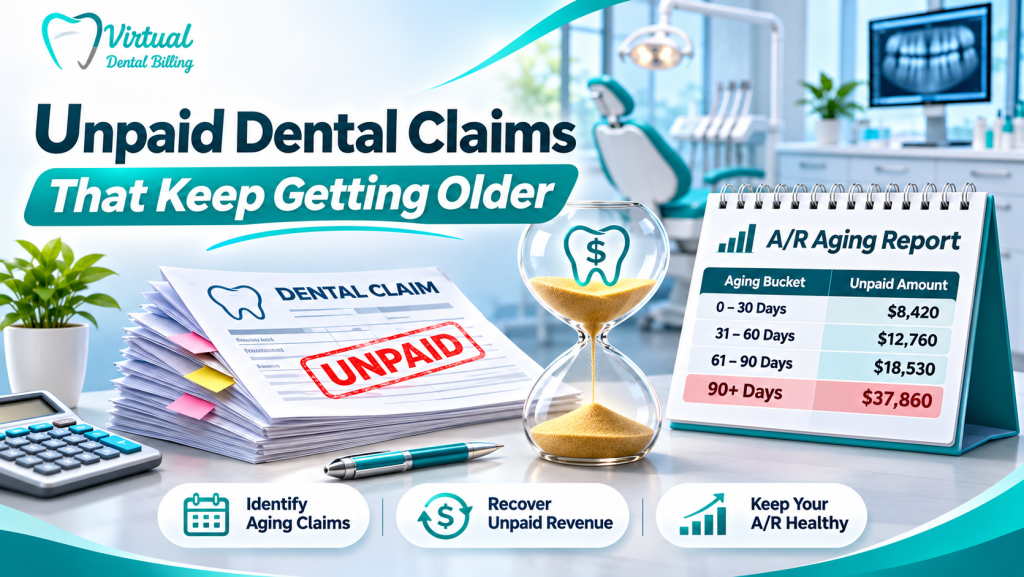
Even when a dental insurance claim is submitted correctly, payment may not arrive on time. Sometimes, the insurance company needs additional documents, while other claims remain pending because of processing delays or unresolved denials.
However, the real problem begins when nobody follows up on these unpaid claims.
These outstanding balances become part of your dental accounts receivable (A/R), which is the money your practice is still waiting to collect from insurance companies or patients.
For example, suppose your practice has an $850 insurance claim that has remained unpaid for 75 days. Your billing team submitted it correctly, but the insurer requested additional clinical records. Since nobody checked the claim status, the request went unnoticed.
Meanwhile, your practice has already provided the treatment, but the expected payment remains outstanding.
When similar claims accumulate, dental A/R aging increases and your practice may struggle to maintain steady cash flow.
Why Do Old Dental Insurance Claims Become Revenue Leaks?
The longer a claim remains unresolved, the more important it becomes to understand why payment is still pending.
According to the American Dental Association (ADA), practices should regularly monitor overdue accounts and aim to collect payments promptly. Older outstanding balances can indicate problems with billing or collection processes.
To identify these problems, dental practices commonly organize unpaid balances into aging categories:
- 0–30 days: Recently submitted claims that may still be processing.
- 31–60 days: Outstanding claims that need a closer status review.
- 61–90 days: Older claims that may require additional documentation, corrections, or payer follow-up.
- Over 90 days: Long-overdue balances that need careful investigation and recovery planning.
Still, claim age alone does not determine whether payment is recoverable. The insurer’s rules, claim history, filing deadlines, and reason for nonpayment also matter.
How Can a Dental Billing Audit Identify Overdue Claims?
Start by reviewing your dental insurance aging report to identify claims that have remained unpaid for 30, 60, or 90 days.
Next, check the payer’s claim status, previous follow-up notes, and any requests for missing information. This helps your team understand whether the claim is pending, denied, under review, or already processed.
Most importantly, prioritize claims based on their age, outstanding amount, filing or appeal deadlines, and recovery potential.
Through consistent dental accounts receivable management, your practice can track unpaid claims, address billing problems, and improve insurance follow-ups before recoverable balances become harder to collect.
Ultimately, a dental billing audit does more than show how much money is outstanding. It helps reveal why that money has not been collected and what your team should do next.
5. Payment Posting Errors That Hide Missing Revenue
Receiving an insurance payment does not always mean the money has been recorded correctly in your dental practice management software. Sometimes, the insurance company pays the claim, but your billing team posts the wrong amount, applies the payment to another patient, or misses an adjustment.
These small dental payment posting errors can make your financial reports inaccurate and hide problems with your collections.
For example, suppose an insurance company deposits $1,200 into your practice’s bank account for two dental claims. However, your billing team records only $750 in the patient accounts, leaving $450 unposted.
The money has already reached your bank, but your billing software still shows an outstanding balance.
Consequently, your team may waste time following up on a claim that has already been paid. Even worse, an incorrect patient balance could lead to an unnecessary billing statement.
Over time, repeated posting mistakes make it difficult to understand how much your practice has collected and how much is still owed.
How Do EOB and ERA Errors Affect Dental Payment Posting?
To understand these errors, your billing team needs to review the payment details provided by the insurance company.
An Explanation of Benefits (EOB) shows how the insurer processed a claim, including the allowed amount, insurance payment, adjustments, and patient responsibility.
Meanwhile, an Electronic Remittance Advice (ERA) provides payment and adjustment information electronically, allowing your billing software to process insurance payments.
According to the American Dental Association’s guidance on EOB statements, reviewing these payment details helps dental offices confirm correct reimbursements and explain patient balances accurately.
However, problems can still occur when:
- Insurance payments are applied to the wrong patient or procedure.
- Contractual adjustments are posted incorrectly or entered twice.
- Patient responsibility is recorded differently from the insurer’s payment details.
- Electronic payments reach
5. Payment Posting Errors That Hide Missing Revenue
Receiving an insurance payment does not always mean the money has been recorded correctly in your dental practice management software. Sometimes, the insurance company pays the claim, but your billing team posts the wrong amount, applies the payment to another patient, or misses an adjustment.
These small dental payment posting errors can make your financial reports inaccurate and hide problems with your collections.
For example, suppose an insurance company deposits $1,200 into your practice’s bank account for two dental claims. However, your billing team records only $750 in the patient accounts, leaving $450 unposted.
The money has already reached your bank, but your billing software still shows an outstanding balance.
Consequently, your team may waste time following up on a claim that has already been paid. Even worse, an incorrect patient balance could lead to an unnecessary billing statement.
Over time, repeated posting mistakes make it difficult to understand how much your practice has collected and how much is still owed.
How Do EOB and ERA Errors Affect Dental Payment Posting?
To understand these errors, your billing team needs to review the payment details provided by the insurance company.
An Explanation of Benefits (EOB) shows how the insurer processed a claim, including the allowed amount, insurance payment, adjustments, and patient responsibility.
Meanwhile, an Electronic Remittance Advice (ERA) provides payment and adjustment information electronically, allowing your billing software to process insurance payments.
According to the American Dental Association’s guidance on EOB statements, reviewing these payment details helps dental offices confirm correct reimbursements and explain patient balances accurately.
However, problems can still occur when:
- Insurance payments are applied to the wrong patient or procedure.
- Contractual adjustments are posted incorrectly or entered twice.
- Patient responsibility is recorded differently from the insurer’s payment details.
- Electronic payments reach the bank but remain unmatched in the billing system.
- Duplicate payment entries make collections appear higher than the money actually received.
Although these errors may not always represent lost revenue, they can hide genuine underpayments, create incorrect balances, and make collection reports unreliable.
How Can a Dental Billing Audit Catch Payment Posting Errors?
Start by comparing your insurance payment posting reports with the corresponding EOBs, ERAs, and bank deposits.
Next, review any differences between the amount received and the amount recorded in your practice management software.
For example, if your bank shows a $1,200 insurance deposit but your billing system records only $750, trace the payment details to identify where the remaining $450 should have been posted.
This process is called EFT reconciliation, which means matching electronic insurance deposits with their corresponding claims and payment records.
For better accuracy, your team should also check adjustments, patient balances, duplicate entries, and unmatched payments before closing the billing period.
Through regular dental EFT reconciliation services, your practice can identify posting mistakes, maintain accurate financial records, and better understand its actual collections.
Ultimately, a dental billing audit helps you separate money that has already been received from payments that are genuinely missing. With accurate payment posting, your team can focus on collecting outstanding revenue instead of chasing balances created by billing errors.
6. Outdated PPO Fee Schedules and Unnoticed Insurance Underpayments
Your dental practice may submit claims correctly, receive insurance payments on time, and still collect less than expected. Sometimes, the problem is not a denied claim or a billing mistake. Instead, it comes from outdated PPO fee schedules or reimbursement rates that nobody has reviewed.
A Preferred Provider Organization (PPO) is a dental insurance network where participating dentists agree to specific fees for covered treatments. These negotiated amounts help determine how much the insurance company and patient are responsible for paying.
However, when your billing software contains outdated rates, your team may not notice that a claim was processed using a different amount than the current contract allows.
For example, suppose your practice has a contracted fee of $180 for a procedure, but the insurance company’s Explanation of Benefits (EOB) shows an allowed amount of only $160.
That $20 difference may seem small. Still, if the same issue affects several claims, the total amount worth investigating can grow.
Keep in mind that a lower payment does not always mean the insurer owes more money. Patient deductibles, coinsurance, plan limitations, and network agreements can all affect reimbursement.
Why Do PPO Fee Schedule Errors Cause Dental Revenue Leakage?
One reason is that dental practices sometimes continue using old PPO reimbursement rates without comparing them with their latest insurance contracts.
Meanwhile, insurance networks may change their fee arrangements, and some plans use leased networks that allow another insurer to access previously negotiated rates.
According to the American Dental Association’s guidance on dental insurance benefits, practices should review EOB statements to understand allowed fees, insurance payments, patient responsibility, and claim adjustments.
Without these checks, your team may overlook several problems:
- Outdated contracted rates: Your billing software may not reflect the currently applicable PPO fee schedule.
- Incorrect allowable amounts: The payer may process a claim using a fee that does not match the applicable contract.
- Unreviewed write-offs: Staff may accept or record adjustments without confirming whether they are required.
- Leased network confusion: Different network arrangements may affect which contracted fee applies to a claim.
- Missed payment discrepancies: Potential underpayments may remain unnoticed when nobody compares reimbursement records.
Over time, these issues can make dental revenue leakage harder to detect, especially when your practice handles a large number of PPO claims.
How Can a Dental Billing Audit Identify PPO Underpayments?
Start by collecting your current PPO contracts, fee schedules, and recent insurance payment reports.
Next, select frequently performed procedures and compare the agreed fees with the allowed amounts shown on their EOBs.
For example, if your contract lists $180 but the insurer allows $160, confirm which network agreement applies before deciding whether the difference is an actual underpayment.
Then, review the insurer’s payment, patient responsibility, and contractual adjustments to identify any remaining amount that should have been collected.
Most importantly, separate genuine payment errors from valid insurance discounts. This helps your team avoid incorrect patient billing and focus on amounts that may be recoverable.
Through regular dental PPO negotiation and contract reviews, your practice can evaluate existing reimbursement rates, identify unfavorable contract terms, and explore opportunities to negotiate better agreements.
Ultimately, a dental billing audit helps dentists understand whether lower collections come from valid contractual discounts, outdated fee schedules, or possible insurance underpayments. With that information, your practice can make better billing decisions instead of accepting every payment without review.
7. Patient Balances and Write-Offs That Go Unreviewed
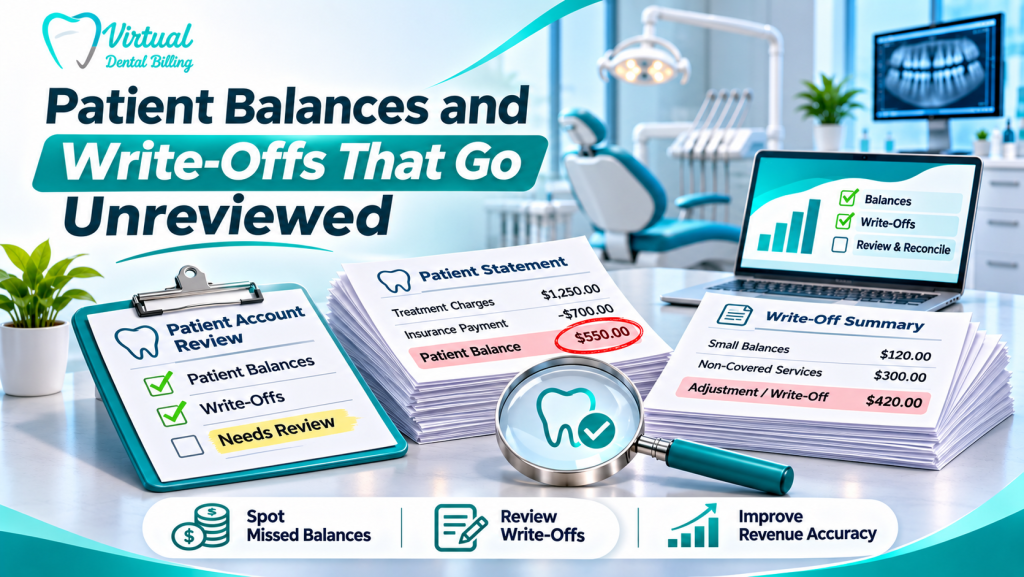
Even after an insurance company pays its share of a dental claim, your practice may still have money left to collect. This remaining amount is called the patient balance, and it can become a hidden revenue leak when billing statements, payment reminders, or account adjustments are overlooked.
For example, suppose a patient receives a dental crown and pays $60 at the time of treatment. However, once the insurance company processes the claim, the final Explanation of Benefits (EOB) shows that the patient is responsible for $100.
Now, your practice still needs to collect the remaining $40.
If your billing team forgets to update the account or send a statement, that balance may remain unpaid for months. Meanwhile, the patient might not even know that another payment is due.
Although $40 may seem like a small amount, repeated uncollected patient balances can affect your practice’s overall collections and cash flow.
How Do Incorrect Dental Write-Offs Affect Practice Revenue?
Not every unpaid amount should be collected from a patient. Sometimes, your practice must reduce a charge because of an agreement with an insurance company. This reduction is known as a contractual write-off.
For example, suppose your practice charges $500 for a procedure, but your PPO agreement allows only $400. If the insurer pays $300 and the patient’s responsibility is $100, the remaining $100 represents a contractual adjustment under this simplified example.
However, problems begin when your billing team applies the wrong adjustment, writes off an amount twice, or removes a valid balance without reviewing the account.
Consequently, your financial reports may show less money owed than your practice is actually entitled to collect.
The American Dental Association (ADA) explains that write-offs involving multiple dental benefit plans should not be finalized until the relevant plans have paid. Otherwise, incorrect adjustments can create misleading patient balances.
You can learn more through the ADA’s guidance on coordination of benefits and write-offs.
How Can a Dental Billing Audit Identify Uncollected Patient Balances?
Start by reviewing your patient accounts receivable aging report to find balances that have remained unpaid after insurance processing.
Next, compare those balances with the final EOB, patient payments, and adjustment history. This helps your team distinguish money that is genuinely owed from amounts that should be adjusted under insurance contracts.
During the review, pay close attention to:
- Unpaid patient balances: Valid amounts remaining after insurance payments.
- Missing billing statements: Outstanding balances that were never communicated to patients.
- Incorrect write-offs: Adjustments that do not match the applicable insurance agreement.
- Unposted patient payments: Money received but not recorded against the correct account.
- Missed payment follow-ups: Overdue balances without documented reminders or collection activity.
If your front desk is already busy with appointments and patient calls, keeping track of every outstanding balance can become difficult. Having a clear system for statements and follow-ups helps prevent smaller payments from being forgotten.
Before requesting payment, your team should also confirm that the balance is correct and explain any differences to the patient. This simple habit can reduce billing confusion, prevent unnecessary disputes, and make the payment process easier for everyone.
How Often Should Dentists Review Their Billing Process?
Dental practices should check billing activity daily, review unresolved claims weekly, and evaluate overall collection performance monthly. More detailed reviews can then help identify recurring problems that routine checks might miss.
However, the right schedule depends on your practice’s size, claim volume, and how often billing problems occur.
For example, a practice handling hundreds of insurance claims each month may need more frequent follow-ups than a smaller office with fewer submissions.
Daily Reviews: Catch Small Mistakes Early
Before closing each day, your billing team should confirm that completed treatments were recorded correctly and the related claims were submitted.
During this check, staff can also review rejected claims, payment entries, and any differences between daily collections and recorded transactions.
This helps prevent simple mistakes from remaining unnoticed for several days.
Weekly Reviews: Follow Up on Pending Payments
Throughout the week, some insurance claims may remain unpaid because the insurer needs additional information or has not finished processing them.
For this reason, your team should review pending claims, check payer responses, and follow up when action is needed.
Claims approaching filing or appeal deadlines should receive attention sooner rather than waiting for the next scheduled review.
Monthly Reviews: Understand Your Collection Performance
By the end of each month, individual billing mistakes may begin to reveal larger patterns.
For instance, you might notice that one insurance company regularly delays payments or that patient balances are increasing despite steady appointment volumes.
Comparing collections, outstanding balances, and claim aging reports can help your team understand whether these issues are improving or getting worse.
Periodic Audits: Look Beyond Daily Billing Tasks
While routine checks focus on current work, a more detailed review examines how well the entire process is functioning.
Every quarter can be a useful starting point for evaluating billing trends, recurring errors, and previous corrective actions.
The American Dental Association’s practice performance guidance also recommends reassessing selected key performance indicators at least quarterly.
Still, there is no single review schedule that fits every dental office. Practices experiencing frequent denials, growing unpaid balances, or repeated posting errors may benefit from more detailed checks.
By making these reviews part of your regular workflow, your team can spot problems earlier instead of discovering them only when monthly collections fall below expectations.
__________________________________________________________
SEO Meta Title
59 characters Copy
7 Dental Billing Money Leaks Dentists Miss Without an Audit
SEO Meta Description
159 characters Copy
Could billing mistakes be reducing your collections? Explore 7 overlooked money leaks, from unpaid claims to posting errors, and see what an audit can uncover.
SEO URL Slug
/dental-billing-money-leaks/
Primary Keyword: dental billing money leaks