
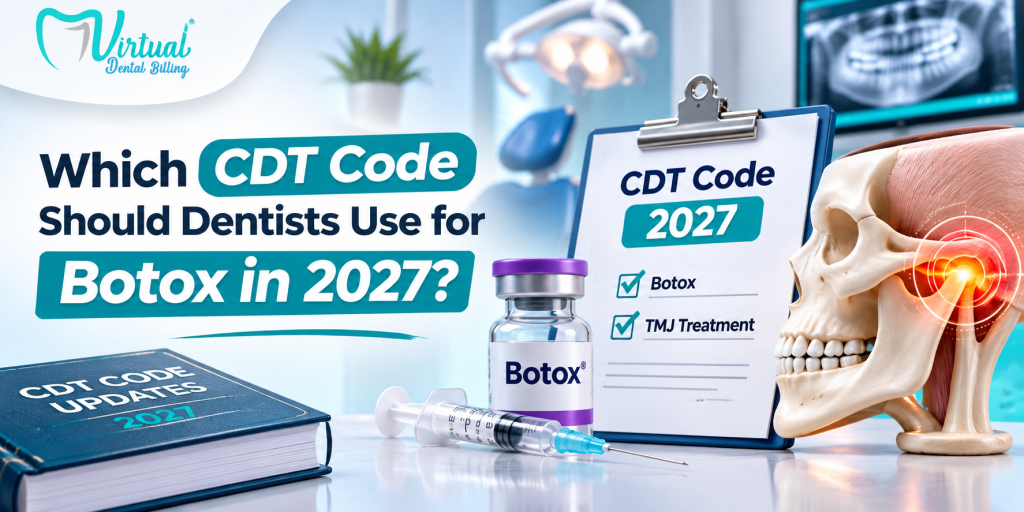
Your dental practice offers a Botox injection to an individual who is suffering from chronic JCP. One question that often arises when it’s time to file the insurance claim is whether dentists can bill Botox for TMJ in 2027 and if insurance will cover that.
So let’s first get back to the meaning of TMJ. The lower jaw is connected to the skull by the temporomandibular joint (TMJ), which permits you to chew, talk, and open your mouth wide. A disorder of this joint or the muscles that support it is known as temporomandibular disorders (TMDs). Some of these factors result in pain and the inability to move the jaw freely and easily.
To relax certain jaw muscles, some dentists apply Botox injections for TMD, but the effectiveness of this is yet to be determined.
The new 2027 CDT (code changes) offer another set of dental coding choices. Changes related to neuromodulators and therapeutic chemodenervation procedures have been approved by the American Dental Association (ADA) and will go into effect on January 1, 2027.
Getting a procedure code doesn’t mean that the insurance will pay for it, though. Denial remains subject to the diagnosis, treatment documentation, and the different coverage policies of payers.
Let’s take a look at the implications of these changes for dentists and what practices can do to ensure they are billing correctly.
What Changed in the 2027 CDT Codes for Botox and TMJ?
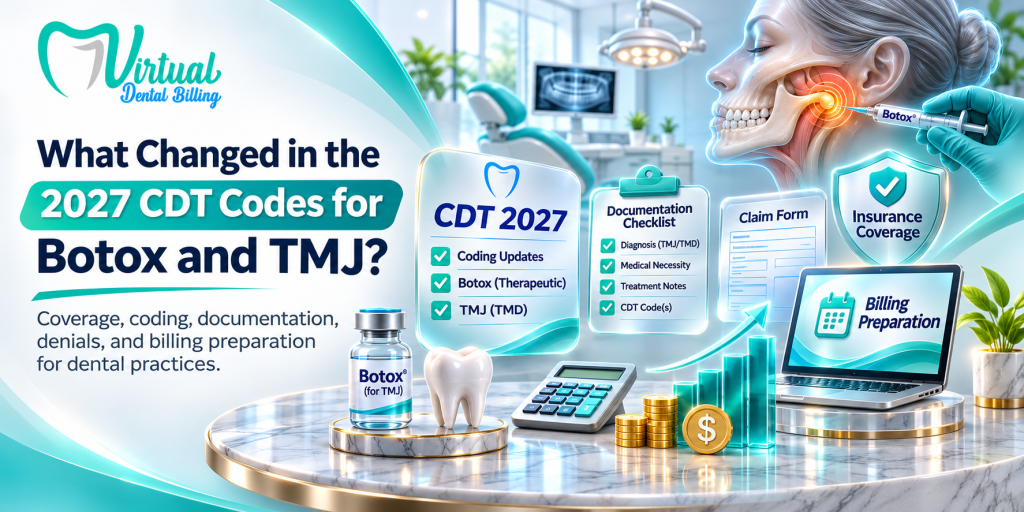
The biggest change in CDT 2027 for Botox billing is how certain injection procedures are described and categorized. The American Dental Association (ADA) has approved a revision to the existing neuromodulator administration code, along with new codes that distinguish therapeutic chemodenervation from cosmetic procedures.
But what does that mean for a dental practice treating patients with jaw-related pain?
First, it’s important to understand the terminology. Botox is a brand of botulinum toxin, a substance that temporarily reduces muscle activity by blocking nerve signals. When used to relax targeted muscles, the procedure may be described as chemodenervation.
For example, a dentist may consider injections for a patient experiencing persistent jaw muscle pain associated with a temporomandibular disorder. In such a case, the clinical purpose differs from injections performed solely to reduce facial wrinkles.
That’s where the 2027 dental coding updates become relevant.
Key CDT 2027 Changes Dentists Should Know
According to the ADA, the approved updates include:
- Revised neuromodulator administration code: Changes to the existing code for reporting neuromodulator administration.
- New chemodenervation codes: Separate reporting options intended to distinguish therapeutic procedures from cosmetic treatments.
- Additional orofacial pain management codes: New codes covering certain nerve blocks, trigger-point muscle injections, and other pain-management procedures.
These updates are part of 67 changes to CDT 2027, including 28 new codes and 33 revisions, effective January 1, 2027.
Why Do These Changes Matter for TMJ Billing?
The most significant difference in the CDT 2027 for billing Botox is the varied description and classification of particular procedures or injections. The American Dental Association (ADA) has updated the current code for the administration of neuromodulators and added new codes that clarify the difference between chemodenervation used for therapeutic purposes and cosmetic purposes.
If this is so, what does it imply for a dental practice that sees patients with jaw pain? First, it is quite important to know the terms used. Botox is a specific brand of a substance called botulinum toxin, a chemical that temporarily stops muscles from moving when it blocks nerve signals. If it is employed for the purpose of muscle or muscle group relaxation, it can be called chemodenervation.
For instance, if a dentist encounters patients who are having chronic jaw muscle pain with TMJ, the dentist might want to try an injection for them. One such instance is if you are injecting for anything besides diminishing wrinkles in the face.
Here’s where the dental coding updates of 2027 come into play.
Key CDT 2027 Changes Dentists Should Know
The updated provisions include, but are not limited to: the following, per the ADA:
- Revised neuromodulator administration code: revision of existing coding of neuromodulator administration.
- New chemodenervation codes: New codes that allow separate reporting for therapeutic indications versus cosmetic indications.
- Additional orofacial pain management codes: New codes for some nerve blocks, trigger-point muscle injections, and other pain management procedures.
These changes are included in 67 revisions and new codes that will go into effect on January 1, 2027 for CDT 2027.
Previously, coding teams could face uncertainty when selecting a procedure code for certain therapeutic injections. The updated terminology is intended to describe different services more precisely.
Consider two patients receiving botulinum toxin injections. One seeks cosmetic treatment for facial wrinkles, while the other receives treatment intended to address a diagnosed muscle-related condition.
Although the same type of medication may be involved, the purpose of treatment is different. Under the updated coding framework, that distinction matters when selecting a code that accurately describes the service provided.
However, Botox billing for TMJ disorders still requires careful code selection. A new therapeutic code does not automatically mean every TMJ-related injection qualifies for that code or is covered by insurance.
Dental practices must use the official CDT 2027 descriptors to confirm which code applies to the documented procedure, rather than choosing a code based on the diagnosis alone.
Can Dentists Legally Administer and Bill Botox for TMJ?
Yes, dentists may administer and bill Botox for TMJ-related conditions, but only when the treatment is permitted under their state’s dental practice laws and falls within their professional scope of practice.
In the United States, each state has its own dental board that determines which procedures licensed dentists can perform. As a result, a treatment allowed in one state may have additional restrictions in another.
For example, North Carolina’s Board of Dental Examiners recognizes that a properly trained general dentist may use Botox to treat a dental condition when sufficient scientific evidence supports its use as part of the standard of care. However, the board takes a different position on injections performed purely for cosmetic purposes.
This distinction matters because Botox for TMJ treatment is not automatically permitted simply because a dentist holds a dental license.
What Should Dentists Check Before Offering Botox?
Before providing injections for jaw-related conditions, dentists should confirm three important requirements:
- State regulations: Verify that the intended treatment falls within the scope permitted by the state dental board.
- Professional training: Ensure the dentist has appropriate education, clinical competency, and any additional qualifications required by the state.
- Clinical justification: Establish a documented diagnosis, evaluate whether the treatment is appropriate, and obtain informed patient consent.
Another important consideration is that Botox is not FDA-approved specifically for treating temporomandibular disorders. This is known as off-label use, meaning a medication is being used for a condition that is not listed among its FDA-approved indications.
Off-label prescribing is not automatically illegal, but dentists must still comply with applicable regulations and professional standards.
Does Legal Permission Mean Insurance Will Pay?
Just because a dentist is legally allowed to administer Botox doesn’t mean the patient’s insurance will cover the treatment.
For example, a patient may visit a dental practice for Botox injections to manage jaw muscle pain associated with a temporomandibular disorder (TMD). Although the dentist is qualified and authorized to perform the procedure, the patient’s insurance plan may exclude this treatment from its covered benefits.
In other words, billing Botox for TMJ and receiving payment are two different things. A practice can submit a correctly coded claim, but reimbursement still depends on the insurer’s coverage rules.
That’s why dental teams should confirm the patient’s benefits before treatment and explain any possible out-of-pocket costs.
While state regulations determine whether a dentist can legally provide the service, insurance policies determine whether the treatment qualifies for coverage.
Which CDT Code Should Dentists Use for Botox in 2027?
For Botox treatment of TMJ-related muscle conditions, D9132 is the new 2027 CDT code that dental billing teams should review for therapeutic chemodenervation of the head, neck, or supporting muscles.
However, selecting the correct code isn’t as simple as identifying the medication used. The procedure’s purpose, injection site, and clinical documentation must match the applicable code description.
Understanding the New Botox-Related CDT Codes
The 2027 CDT code updates distinguish therapeutic injections from cosmetic neuromodulator procedures.
Here’s how the relevant codes differ:
| CDT Code | Procedure Category | When to Consider It |
| D9132 | Therapeutic chemodenervation of head, neck, or supporting muscles | When reporting a qualifying therapeutic muscle injection |
| D9127 | Therapeutic chemodenervation of a salivary gland | For qualifying therapeutic salivary gland procedures |
| D9913 | Neuromodulator administration for cosmetic purposes | For cosmetic treatment rather than therapeutic muscle treatment |
These categories serve different purposes. For instance, a Botox injection intended to manage a diagnosed jaw muscle condition should not automatically be reported under a cosmetic procedure code.
Likewise, D9127 is intended for salivary gland treatment, not simply any injection performed near the jaw.
Before using these codes, practices should consult the official CDT 2027 descriptors and confirm that the documented service meets the code requirements.
How to Choose the Appropriate Code for a TMJ-Related Procedure
Consider a patient diagnosed with a temporomandibular disorder involving persistent jaw muscle pain. After a clinical evaluation, the dentist determines that botulinum toxin injections are an appropriate treatment option.
When preparing the claim, the billing team should review:
- Treatment purpose: Was the injection performed for a documented therapeutic condition or a cosmetic concern?
- Anatomical location: Which muscles or structures received the injection?
- Procedure documentation: Do the treatment notes support the selected code’s description?
- Billing requirements: Does the payer require additional diagnosis information, authorization, or supporting records?
For a qualifying therapeutic muscle procedure, D9132 may be appropriate. However, the final selection must reflect the actual treatment provided.
Should Dentists Use CDT or CPT Codes?
This depends on the claim and the insurer’s reporting requirements.
CDT codes describe dental procedures, while CPT codes are commonly used to report medical procedures and services.
For example, a dental claim may use an applicable CDT code, whereas a medical insurer may require CPT coding for the same type of therapeutic injection.
Rather than assuming one code will work for every claim, dental practices should confirm the appropriate coding system with the payer before submission.
Getting this distinction right can help prevent avoidable claim rejections and unnecessary billing corrections.
Does Dental or Medical Insurance Cover Botox for TMJ?
Insurance coverage for Botox for TMJ is not guaranteed under either dental or medical plans. Although some insurance policies cover certain treatments for temporomandibular disorders (TMDs), they may specifically exclude botulinum toxin injections.
For example, Aetna’s medical policy classifies botulinum toxin injections for TMD as experimental, investigational, or unproven. This means a patient could have benefits for other TMJ treatments but still receive no coverage for Botox injections.
So, how can dental practices determine which insurance plan to check?
Dental Insurance vs. Medical Insurance for TMJ Botox
The answer depends on the patient’s benefits and the services covered under each policy.
| Dental Insurance | Medical Insurance |
| May cover certain dental or TMJ-related services, depending on the plan | May cover certain medically necessary treatments for jaw disorders |
| Uses CDT codes for dental procedure reporting | Typically uses CPT/HCPCS codes and ICD-10-CM diagnosis codes |
| May exclude therapeutic Botox injections | May classify Botox for TMD as investigational or exclude it |
However, medical insurance coverage for TMJ Botox should never be assumed simply because the patient has a medical diagnosis. The insurer must also recognize the specific treatment as eligible under the patient’s policy.
What Should Dental Practices Verify Before Treatment?
Before submitting a Botox for TMJ insurance claim, the billing team should check:
- Covered benefits: Does the patient’s plan specifically cover botulinum toxin injections for the diagnosed condition?
- Medical necessity: What clinical criteria, if any, must the treatment meet?
- Prior authorization: Is approval required before the procedure, and is the requested treatment eligible for authorization?
- Billing requirements: Which procedure codes, diagnosis codes, and supporting records does the payer require?
- Patient responsibility: What costs could the patient owe if coverage is unavailable or the claim is denied?
These checks help practices identify potential coverage limitations before treatment rather than discovering them after submitting the claim.
What If Insurance Does Not Cover the Procedure?
If the insurer excludes Botox treatment for TMD, the practice should explain the coverage limitation and provide a clear estimate of the patient’s potential out-of-pocket costs.
The billing team should also document the benefit verification results and follow applicable payer contracts and patient financial responsibility rules.
Ultimately, accurate coding supports proper claim reporting, but Botox reimbursement for TMJ depends on the patient’s actual coverage policy, not merely the availability
Documentation Requirements for Botox Claims in 2027

Even when a dentist selects the appropriate procedure code, incomplete clinical records can create problems during claim review. That’s why Botox billing documentation should clearly explain the patient’s condition, the reason for treatment, and what was actually performed.
For patients receiving injections for temporomandibular disorders (TMDs), a diagnosis alone may not provide enough information. The clinical notes should also explain how the condition affects the patient and why the dentist recommended the procedure.
What Should Dental Practices Document?
To support accurate Botox for TMJ billing, practices should maintain the following information in the patient’s record:
- Patient symptoms and diagnosis: Record the patient’s complaints, relevant examination findings, diagnosis, and how the condition affects everyday activities such as chewing or opening the mouth.
- Treatment history: Document previous treatments, the patient’s response, and why Botox was considered. For example, note whether conservative treatments were attempted and their outcomes.
- Clinical justification: Explain the purpose of the injections and the dentist’s clinical reasoning. This is particularly important when a payer requests evidence of medical necessity for Botox treatment.
- Injection details: Include the medication name, dose administered, injection sites, treatment date, and the clinician who performed the procedure. Record discarded medication when applicable
Frequently Asked Questions
Can dentists bill Botox for TMJ in 2027?
Yes, dentists can submit Botox claims for TMJ-related treatment when the procedure falls within their legally permitted scope of practice and is accurately documented. However, submitting a claim does not guarantee payment because insurers may exclude botulinum toxin injections for temporomandibular disorders (TMDs).
Is there a new CDT code for Botox in 2027?
Yes. CDT 2027 introduces new chemodenervation codes that distinguish therapeutic procedures from cosmetic treatments, along with a revision to an existing neuromodulator administration code. Dentists should consult the official ADA code descriptions to identify the appropriate code for the service performed.
Is Botox FDA-approved for TMJ disorders?
No. Botox is not FDA-approved specifically for temporomandibular disorders. Its use for TMD is considered off-label, and research has not established conclusive evidence of its effectiveness for these conditions. Dentists should consider current clinical evidence and applicable professional standards before recommending treatment.
Can dental insurance cover Botox injections for jaw pain?
Coverage depends on the patient’s dental plan and the insurer’s treatment policies. Some plans exclude Botox injections for TMJ-related pain, even when the treatment is recommended by a dentist. Dental practices should verify the specific benefit rather than assuming coverage based on the patient’s diagnosis.
Does medical insurance cover Botox for TMJ?
Medical insurance may cover certain TMD treatments, but that does not automatically include Botox injections. Some insurers classify botulinum toxin treatment for TMD as investigational or unproven. Coverage must be confirmed using the patient’s specific policy and the insurer’s current clinical guidelines.
Can dentists use 2027 CDT codes before January 1, 2027?
No. CDT 2027 changes take effect on January 1, 2027. For services performed before that date, practices should use the applicable code set based on the date of service and payer requirements.
What happens if a Botox claim for TMJ is denied?
First, review the insurer’s stated reason for denial. If the problem involves incorrect information or coding, determine whether a corrected claim is needed. If the insurer denied coverage, review the policy and available appeal rights before deciding how to proceed.
Does a new CDT code guarantee Botox reimbursement?
No. A new CDT code identifies a reportable procedure; it does not establish insurance coverage. Reimbursement depends on the patient’s benefits, applicable payer policies, and whether the submitted claim meets the insurer’s requirements.