
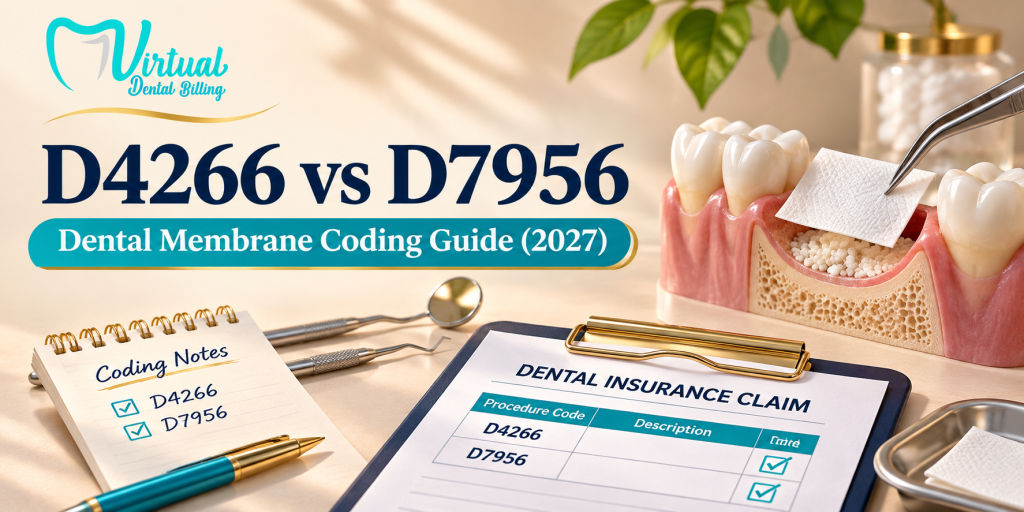
The key difference between D4266 and D7956 is the treatment site. The D4266 dental code applies when a resorbable barrier membrane is placed around a retained natural tooth, while the D7956 dental code applies to regenerative procedures in an edentulous area, including an extraction site. Although both codes involve guided tissue regeneration (GTR), reporting the wrong procedure can result in dental claim denials, delayed insurance reimbursement, and unnecessary administrative work. Understanding the correct dental membrane code, clinical documentation requirements, and payer-specific guidelines can help dental practices submit accurate claims and avoid costly billing errors.
What Is the Difference Between D4266 and D7956?
The D4266 vs D7956 dental code difference depends on whether the regenerative procedure supports an existing natural tooth or treats an area where a tooth is missing. Both codes involve resorbable barrier membranes and are reported per treatment site.
Dental professionals must identify the anatomical location and purpose of the procedure before selecting the appropriate code.
D4266 Dental Code: Definition and Clinical Applications
The D4266 dental code falls under the periodontics category of CDT codes. It describes the placement of a resorbable barrier to support periodontal tissue regeneration around natural teeth.
Common clinical applications include:
- Treating periodontal bone defects around natural teeth.
- Supporting regeneration of lost periodontal attachment.
- Protecting regenerative sites from unwanted soft tissue growth.
- Managing selected intrabony defects associated with periodontal disease.
Since the membrane is resorbable, it gradually breaks down in the body without normally requiring surgical removal.
D7956 Dental Code: Definition and Clinical Applications
The D7956 dental code falls under the oral and maxillofacial surgery category. It describes resorbable barrier placement in an edentulous area where regenerative treatment is performed.
Common clinical applications include:
- Protecting bone graft material within an extraction socket.
- Supporting ridge preservation following tooth removal.
- Supporting ridge augmentation at missing tooth sites.
- Preparing an edentulous site for future implant placement.
Dentists should not automatically report D7956 whenever a membrane or collagen material is placed following an extraction. The documented clinical purpose must support regenerative treatment rather than routine wound protection or bleeding control.
D4266 vs D7956: Side-by-Side Comparison
The distinction between these procedures is supported by Aetna’s Guided Tissue Regeneration Clinical Policy, which identifies separate procedure codes for regenerative barriers around natural teeth, edentulous areas, and dental implants.
| Feature | D4266 | D7956 |
| CDT category | Periodontics | Oral and maxillofacial surgery |
| Treatment location | Retained natural tooth | Edentulous area |
| Membrane type | Resorbable | Resorbable |
| Reporting unit | Per site | Per site |
| Clinical objective | Periodontal regeneration | Regeneration at a missing tooth site |
| Common application | Periodontal bone defects | Ridge preservation or augmentation |
| Separate membrane removal | Normally not required | Normally not required |
| Insurance coverage | Plan-specific | Plan-specific |
The correct dental membrane code should reflect the treatment actually performed, regardless of which code offers better insurance reimbursement.
How Do Dental Barrier Membranes Work?
Dental barrier membranes create a protective layer between fast-growing soft tissues and the area where bone or periodontal tissue needs to regenerate. This separation helps maintain space for slower-growing cells involved in tissue and bone formation.
Depending on the clinical application, dentists use barrier membranes to support periodontal treatment, bone grafting, ridge augmentation, and dental implant procedures.
Guided Tissue Regeneration (GTR) vs Guided Bone Regeneration (GBR)
Guided tissue regeneration (GTR) focuses on restoring periodontal structures damaged by periodontal disease, including alveolar bone, cementum, and the periodontal ligament. In contrast, guided bone regeneration (GBR) primarily focuses on rebuilding lost or insufficient bone.
Research published in a scientific review of biomaterials and regenerative membranes explains how barrier membranes limit unwanted cell migration and create a favorable environment for tissue and bone regeneration. Although both techniques use barrier membranes, their treatment objectives differ.
| Feature | GTR | GBR |
| Full name | Guided tissue regeneration | Guided bone regeneration |
| Primary objective | Restore periodontal supporting structures | Regenerate bone |
| Common treatment site | Natural teeth | Edentulous and implant sites |
| Target tissue | Bone, cementum, and periodontal ligament | Bone |
| Common applications | Periodontal defects | Ridge augmentation and implant site development |
Understanding this clinical distinction helps dental billers interpret procedure notes. The terms GTR and GBR alone do not determine the correct CDT code.
Resorbable vs Non-Resorbable Dental Membranes
Dental barrier membranes fall into two main categories based on how their materials behave during healing.
- Resorbable membranes: Usually made from collagen or biodegradable synthetic materials, these membranes gradually break down within the body.
- Non-resorbable membranes: Commonly made from materials such as polytetrafluoroethylene (PTFE) or titanium mesh, these barriers generally require removal after healing.
| Feature | Resorbable membrane | Non-resorbable membrane |
| Common materials | Collagen and biodegradable polymers | PTFE and titanium mesh |
| Natural breakdown | Yes | No |
| Surgical removal | Generally unnecessary | Generally required |
| Space maintenance | Depends on material and support | Often provides greater structural stability |
| Natural tooth code | D4266 | D4267 |
| Edentulous area code | D7956 | D7957 |
| Implant-related code | D6106 | D6107 |
Selecting the correct resorbable membrane dental code or non-resorbable membrane dental code requires accurate clinical documentation of the material used, treatment location, and regenerative purpose.
Relying solely on a product name can lead to dental coding errors and incorrect insurance claims.
How to Choose the Correct Dental Membrane Code
Choosing the correct dental membrane code requires reviewing three factors: the treatment site, the type of barrier used, and the purpose of the regenerative procedure.
Dental billers should determine whether the membrane was placed around a natural tooth, within an edentulous area, or in connection with a dental implant.
D4266 vs D4267: Membranes Around Natural Teeth
The primary difference between D4266 vs D4267 is whether the barrier membrane dissolves naturally or requires removal.
| Feature | D4266 | D4267 |
| Membrane type | Resorbable | Non-resorbable |
| Treatment site | Natural tooth | Natural tooth |
| Reporting unit | Per site | Per site |
| Membrane removal | Generally unnecessary | Included in the procedure description |
Clinical example: If a periodontist places a resorbable collagen membrane to treat a periodontal bone defect around tooth #19, D4266 may apply. If a non-resorbable barrier is used for the same regenerative procedure, the D4267 dental code may be appropriate.
D7956 vs D7957: Membranes in Edentulous Areas
The difference between D7956 vs D7957 relates to the membrane material used during regenerative treatment at a missing tooth site.
| Feature | D7956 | D7957 |
| Membrane type | Resorbable | Non-resorbable |
| Treatment area | Edentulous site | Edentulous site |
| Reporting unit | Per site | Per site |
| Membrane removal | Generally unnecessary | Generally required |
Clinical example: When an oral surgeon places a resorbable membrane over a bone graft at an edentulous site, D7956 may apply. If a non-resorbable PTFE membrane is used instead, the D7957 dental code may be appropriate.
D7956 vs D6106: Edentulous Sites vs Dental Implants
The main difference between D7956 vs D6106 is whether the regenerative procedure treats an edentulous area or is associated with a dental implant.
| Feature | D7956 | D6106 |
| Treatment site | Edentulous area | Implant-related site |
| Membrane type | Resorbable | Resorbable |
| Reporting unit | Per site | Per implant |
| Common application | Ridge development | Implant-associated regeneration |
Preparing an edentulous ridge for future implant placement does not automatically justify the D6106 dental code. The actual procedure and its relationship to the implant determine code selection.
D6106 vs D6107: Dental Implant Barrier Membrane Codes
When regenerative treatment involves a dental implant, the membrane material helps determine which dental implant barrier membrane code to report.
- D6106 dental code: Resorbable barrier placement associated with an implant.
- D6107 dental code: Non-resorbable barrier placement associated with an implant.
Both codes are reported per implant rather than per edentulous site.
Clinical documentation should identify the implant location, membrane material, regenerative purpose, and any associated peri-implant defect.
D4286: Dental Code for Membrane Removal
The D4286 dental code describes the removal of a non-resorbable barrier membrane. Removing a membrane does not automatically qualify for separate reimbursement.
D4267 specifically includes membrane removal. Under Cigna’s 2026 DPPO Dental Coverage Determination Guidelines, membrane removal is treated as part of the original D4267, D6107, or D7957 service for benefit determination. Other insurance companies may apply different claim bundling policies.
Before submitting D4286, dental billers should review the original procedure, treating provider, removal date, applicable CDT coding guidelines, and payer-specific restrictions to determine whether separate reporting and reimbursement are appropriate.
What Is the Dental Code for a Membrane After Tooth Extraction?
The dental code for a membrane after tooth extraction is D7956 when a resorbable barrier is placed to support regeneration at an extraction site. If a non-resorbable barrier is used for the same regenerative purpose, D7957 may apply. When the material is placed only to control bleeding or stabilize a blood clot, D7922 is the more appropriate code.
When Should Dentists Report D7956?
Dentists should report D7956 when the clinical procedure involves placing a resorbable regenerative barrier at an edentulous site.
Common situations include:
- Protecting graft material during socket preservation.
- Supporting bone regeneration following tooth extraction.
- Managing bone defects at an edentulous site.
- Preserving ridge dimensions for future implant placement.
Clinical example: An oral surgeon extracts tooth #30, places bone graft material to preserve the ridge, and covers the graft with a resorbable collagen membrane. D7956 may be reported for the barrier placement when the documented procedure meets the code requirements. Separate reimbursement depends on the patient’s insurance policy.
D7922 vs D7956: Collagen Plug vs Barrier Membrane
The main difference between D7922 vs D7956 is the clinical purpose of the material. D7922 addresses bleeding control and clot stabilization, while D7956 supports regenerative treatment.
The American Dental Association’s Guide to Reporting Placement of Wound Dressing Materials explains that collagen products used as wound dressings serve a different clinical purpose from regenerative barrier membranes.
| Feature | D7922 | D7956 |
| Primary purpose | Bleeding control and clot stabilization | Tissue or bone regeneration |
| Common material | Collagen plug or hemostatic dressing | Resorbable barrier membrane |
| Treatment location | Extraction socket | Edentulous area |
| Regenerative barrier placement | Not required | Required |
| Bone graft placement | Not required | Depends on the clinical procedure |
| Insurance reimbursement | Plan-specific | Plan-specific |
Reporting D7956 for a collagen plug used solely to control bleeding is a dental coding error that may result in claim denial or payment recovery.
How to Select the Correct Collagen Membrane Dental Code
There is no single collagen membrane dental code that applies to every clinical situation. Collagen is a material, not a procedure. Its intended function and treatment location determine the appropriate CDT code.
| Clinical application | Applicable CDT code |
| Collagen plug used for bleeding control after extraction | D7922 |
| Resorbable collagen barrier around a natural tooth | D4266 |
| Resorbable collagen barrier at an edentulous site | D7956 |
| Resorbable collagen barrier for implant-associated regeneration | D6106 |
Dental billers should request clarification whenever the clinical notes only mention collagen placement without explaining its function. Clear clinical documentation helps distinguish routine wound management from regenerative treatment and supports accurate dental insurance claims.
How to Bill Bone Graft and Membrane Procedures Together
Dental practices can report bone grafting and barrier membrane placement separately when both procedures are performed and meet the applicable CDT coding guidelines. However, separate reporting does not guarantee separate insurance reimbursement. Dental billers must review the clinical purpose, treatment location, procedure timing, and payer-specific guidelines before submitting claims.
D7950 vs D7953 Dental Code: Ridge Augmentation vs Ridge Preservation
The primary difference between D7950 and D7953 is whether the procedure rebuilds an existing alveolar ridge or preserves ridge dimensions immediately after tooth extraction or implant removal.
The D7950 dental code applies to ridge augmentation or reconstruction intended to increase bone height, width, or volume. The D7953 dental code applies to bone graft placement at the time of tooth extraction or implant removal to preserve ridge integrity.
| Feature | D7950 | D7953 |
| Procedure | Ridge augmentation or reconstruction | Ridge preservation |
| Primary purpose | Rebuild insufficient bone | Preserve existing ridge dimensions |
| Treatment timing | Based on reconstructive needs | At extraction or implant removal |
| Reporting method | By report | Per site |
| Obtaining graft material | Included | Not included |
| Barrier membrane | Reported separately | Reported separately |
The ADA’s 2026 Guide to Graft Material Collection Procedure Reporting confirms that barrier membrane placement should be reported separately when performed with D7950 or D7953.
Can D7953 and D7956 Be Billed Together?
Yes, D7953 and D7956 can be billed together when a dentist performs ridge preservation and places a resorbable regenerative barrier at the same extraction site.
Each code represents a distinct procedure:
- D7953: Bone graft placement for ridge preservation.
- D7956: Resorbable regenerative barrier placement at an edentulous site.
Despite correct coding, some insurance companies apply bundling restrictions. For example, Cigna’s 2026 DPPO coverage guidelines do not allow a separate benefit for D7956 or D7957 when performed with another allowable bone graft procedure at the same site on the same service date.
Proper dental insurance verification helps practices identify these limitations before treatment and communicate potential out-of-pocket expenses to patients.
Is a Membrane Included in a Bone Graft?
Barrier membrane placement is not automatically included in every bone graft procedure under CDT reporting guidelines. Several graft codes allow separate membrane reporting when the procedure is performed and documented.
| Bone graft code | Clinical application | Potential membrane codes |
| D4263 | First graft site around a natural tooth in a quadrant | D4266 or D4267 |
| D4264 | Additional graft site around a natural tooth in the same quadrant | D4266 or D4267 |
| D7950 | Ridge augmentation | D7956 or D7957 |
| D7953 | Ridge preservation | D7956 or D7957 |
| D6103 | Repair of a peri-implant bone defect | D6106 or D6107 |
| D6104 | Bone graft during implant placement | D6106 or D6107 |
Selecting the correct dental code for bone graft and membrane requires matching both procedures to the documented treatment. Insurance bundling policies affect benefit determination but do not change the clinical service performed.
Clinical Coding Examples for Bone Grafts and Membranes
The following examples demonstrate how dental practices may report bone graft and membrane procedures in different clinical situations.
| Clinical scenario | Bone graft code | Membrane code |
| Tooth extraction with socket preservation and a resorbable membrane | D7953 | D7956 |
| Socket preservation with a non-resorbable membrane | D7953 | D7957 |
| Healed edentulous ridge augmentation with a collagen barrier | D7950 | D7956 |
| Periodontal bone graft at the first site in a quadrant with a resorbable barrier | D4263 | D4266 |
| Bone graft during implant placement with a resorbable barrier | D6104 | D6106 |
| Peri-implant bone defect repair with a non-resorbable barrier | D6103 | D6107 |
These examples are consistent with the American Academy of Periodontology’s bone graft coding guidance. Actual code selection depends on the complete clinical procedure and supporting documentation.
periospectives
Dental billers should avoid changing procedure codes simply to bypass payer restrictions. Accurate oral surgery billing requires reporting the services performed and addressing reimbursement disputes through appropriate claim review and appeals.
Does Dental Insurance Cover D4266 and D7956?
Dental insurance may cover D4266 and D7956, depending on the patient’s benefit plan, clinical necessity, treatment history, and applicable coverage limitations. Some insurance plans provide benefits for regenerative procedures, while others exclude membrane placement or consider it part of another surgical service.
Correct CDT coding alone does not guarantee insurance reimbursement.
D4266 Dental Code Insurance Coverage
Insurance companies may cover D4266 when periodontal regeneration is clinically necessary to restore supporting tissues around a natural tooth.
Payers may evaluate the following factors:
- Periodontal diagnosis and severity of bone loss.
- Prognosis of the affected tooth.
- Previous periodontal treatment.
- Radiographic evidence of bone defects.
- Frequency limitations and benefit exclusions.
For example, the 2027 UnitedHealthcare Federal Dental Plan brochure lists a 36-month frequency limitation for D4266. This restriction applies to that specific plan and should not be treated as a universal insurance rule.
D7956 Dental Code Insurance Coverage and Reimbursement
D7956 dental code reimbursement often depends on whether the patient’s insurance plan covers bone regeneration, dental implants, and related surgical procedures.
Under Cigna’s 2026 DPPO coverage guidelines, D7956 may qualify for benefits when the treatment meets applicable implant coverage and regenerative procedure requirements. Separate payment is not allowed when another eligible bone graft procedure is performed at the same site on the same date.
Before estimating reimbursement, dental billers should verify:
- Coverage for D7956 under the patient’s specific plan.
- Implant-related benefit exclusions.
- Contracted fee schedules.
- Remaining annual maximum and deductible.
- Coinsurance and patient financial responsibility.
- Predetermination or prior authorization requirements.
There is no universal reimbursement rate for D7956 because contracted fees and benefit structures vary among insurance plans.
Guided Tissue Regeneration Insurance Coverage and Payer Limitations
Guided tissue regeneration insurance coverage depends on both clinical eligibility and the patient’s contractual benefits. Even when a procedure meets medical necessity criteria, the insurance plan may exclude payment.
Aetna’s Guided Tissue Regeneration Clinical Policy, reviewed on July 27, 2026, explains that individual benefit plans determine coverage, exclusions, and payment limitations.
| Coverage factor | Potential impact on reimbursement |
| Medical necessity | Claims may be denied if clinical criteria are not met. |
| Frequency limitations | Repeat procedures may not qualify for benefits. |
| Annual maximum | Payment may be reduced or unavailable. |
| Implant exclusions | Implant-related regenerative procedures may not be covered. |
| Provider network status | Contracted fees and patient costs may differ. |
| Waiting periods | Coverage may not be available immediately. |
Completing dental insurance verification and requesting a pretreatment estimate when appropriate can help practices establish realistic payment expectations. Neither process guarantees final claim payment.
What Documentation Is Required for D4266 and D7956 Claims?
Successful D4266 and D7956 claims require clinical records that establish the treatment location, membrane type, regenerative purpose, and medical necessity. Dental insurance companies may request radiographs, periodontal charting, surgical notes, and supporting narratives to determine whether the procedure qualifies for benefits.
D4266 Dental Code Documentation Requirements
The documentation for D4266 should demonstrate why periodontal regeneration was necessary around the affected natural tooth.
UnitedHealthcare’s Dental Claim Review Guidelines identify preoperative radiographs, six-point periodontal charting, and a narrative explaining treatment necessity as documentation requirements for D4266.
Dental Review Guideline
Dental practices should maintain the following records:
- Affected tooth number and treatment site.
- Periodontal diagnosis and tooth prognosis.
- Six-point periodontal charting.
- Clinical attachment loss and probing depths.
- Dated preoperative radiographs.
- Previous periodontal treatment history, when relevant.
- Resorbable membrane material and surgical notes.
- Narrative explaining the necessity of regenerative treatment.
Incomplete periodontal records may prevent insurance reviewers from determining whether the procedure satisfies their clinical coverage criteria.
D7956 Clinical Documentation Requirements
Documentation for the D7956 dental code should explain why a resorbable barrier was necessary at an edentulous site and how it supports the intended regenerative treatment.
Aetna’s Dental and Oral Surgery Claim Documentation Guidelines identify dated preoperative full-mouth radiographs or panoramic imaging and identification of each treated site as documentation requirements for D7956 and D7957.
Dental practices should maintain the following information:
- Extraction date and missing tooth number.
- Location and characteristics of the bone defect.
- Clinical purpose of membrane placement.
- Type of resorbable barrier used.
- Bone graft material, if applicable.
- Detailed surgical or operative notes.
- Planned implant or prosthetic restoration, when applicable.
The surgical notes should clearly distinguish regenerative barrier placement from routine socket dressing or bleeding control.
| Documentation | D4266 | D7956 |
| Preoperative radiographs | Required by many payers | Required by many payers |
| Periodontal charting | Commonly required | When relevant |
| Tooth or site identification | Natural tooth | Edentulous site |
| Membrane material | Resorbable | Resorbable |
| Surgical notes | Recommended | Recommended |
| Narrative of necessity | Payer-specific | Payer-specific |
| Future restorative treatment plan | When applicable | When applicable |
Sample Dental Claim Narratives for Membrane Procedures
Well-written dental claim narratives help insurance reviewers understand the clinical condition, treatment performed, and reason for membrane placement.
Sample narrative for D4266:
Tooth #19 presented with a 7 mm periodontal pocket and a vertical bone defect following initial periodontal therapy. Guided tissue regeneration was performed using a resorbable collagen barrier to support periodontal attachment and bone regeneration. Preoperative radiographs and periodontal charting are attached.
Sample narrative for D7956:
Following extraction of tooth #30, ridge preservation was performed using bone graft material. A resorbable collagen barrier was placed over the graft to limit soft tissue migration and support bone regeneration for future implant placement. Supporting radiographs and surgical notes are attached.
These narratives are illustrative examples, not universal templates. Dental billers must customize each narrative using the patient’s actual clinical findings and treatment records.
Accurate clinical documentation supports claim review, reduces unnecessary requests for additional information, and provides evidence when appealing denied claims.
Why Do Dental Membrane Claims Get Denied?
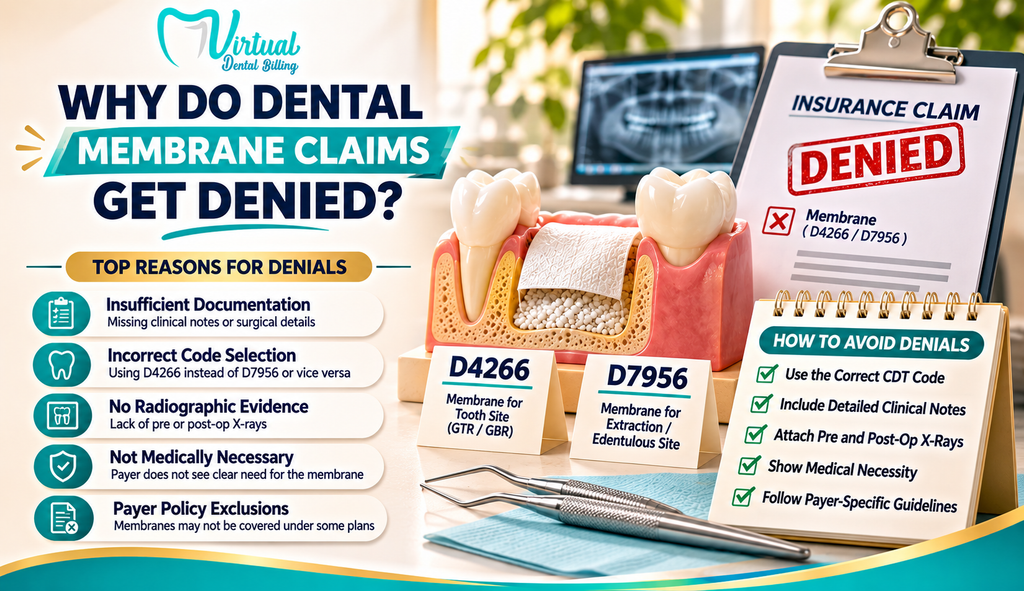
Dental membrane claims may get denied because of incorrect CDT codes, incomplete clinical records, benefit exclusions, or payer bundling restrictions. Identifying the actual denial reason helps dental billers determine whether to correct the claim, submit additional documentation, or file an appeal.
Common D7956 Dental Code Denial Reasons
Understanding D7956 dental code denial reasons can help dental practices prevent avoidable revenue loss and payment delays.
| Denial reason | How to prevent it |
| Incorrect CDT code | Match the code to the treatment site and membrane type. |
| Missing clinical documentation | Include relevant radiographs, surgical notes, and supporting narratives. |
| Implant-related benefit exclusions | Verify implant and regenerative procedure coverage before treatment. |
| Bone graft bundling | Review the payer’s policy for procedures performed at the same site. |
| Insufficient medical necessity | Document the bone defect and regenerative purpose. |
| Duplicate billing | Review previously submitted claims and service dates. |
| Frequency limitations | Check treatment history and applicable plan restrictions. |
Not every denied claim indicates a coding error. Properly reported procedures may still be excluded under the patient’s insurance contract.
Incorrect Treatment Site and Membrane Selection
One avoidable dental coding error is reporting a periodontal membrane code for an extraction site where the natural tooth has already been removed.
UnitedHealthcare’s guidance on reducing CDT coding denials identifies incorrect combinations of periodontal and edentulous-site procedure codes as a potential cause of claim denials.
ams-uhcdental-prod.optum.com
For example, reporting D4266 instead of D7956 for resorbable regenerative barrier placement within an extraction socket may trigger a coding review.
Dental billers should verify the actual surgical procedure with the treating dentist before submitting a corrected claim.
Claim Bundling and Medical Necessity Issues
Claim bundling occurs when an insurance company considers membrane placement part of another covered procedure rather than a separately payable service.
For example, Cigna’s 2026 DPPO Dental Coverage Determination Guidelines exclude separate benefits for D7956 and D7957 when another eligible bone graft procedure is performed at the same location on the same service date.
When a membrane claim is denied, dental billers should:
- Review the explanation of benefits (EOB) and denial reason.
- Determine whether the denial involves coding, coverage, or medical necessity.
- Review the applicable payer policy and provider contract.
- Gather additional clinical documentation when necessary.
- Submit a corrected claim or appeal within the payer’s deadline, when appropriate.
Dental practices should never change an accurate procedure code simply to obtain payment. Effective dental claim denial management requires identifying the underlying problem, supporting the services performed with accurate records, and following payer-specific appeal procedures.
Dental Membrane Billing Guidelines for 2027
Accurate dental membrane billing in 2027 requires dental practices to follow current CDT coding guidelines, maintain complete treatment records, and review patient-specific insurance benefits. Establishing a standardized billing workflow can help practices reduce coding errors, prevent avoidable claim denials, and improve collections.
Pre-Submission Dental Claim Checklist
Dental billers should complete the following checks before submitting membrane-related dental insurance claims.
| Billing checkpoint | Required action |
| CDT code verification | Confirm the procedure code using the CDT 2027 manual. |
| Treatment site | Identify the natural tooth, edentulous area, or implant site. |
| Membrane material | Confirm whether the barrier is resorbable or non-resorbable. |
| Insurance eligibility | Verify active patient coverage on the service date. |
| Benefit limitations | Review exclusions, frequency restrictions, and bundling policies. |
| Clinical documentation | Gather applicable radiographs, periodontal charts, and surgical notes. |
| Procedure combinations | Review associated bone graft and membrane codes. |
| Claim submission | Check patient details, tooth numbers, service dates, and required attachments. |
| Payment review | Compare insurance payments with contracted fees and applicable benefits. |
The American Dental Association’s Code Maintenance Committee confirms that CDT 2027 is effective from January 1 through December 31, 2027. Dental practices should update their billing software and procedure code libraries before the new coding year begins.
How to Prevent Dental Membrane Coding Errors
Dental practices can improve billing accuracy by implementing the following best practices:
- Conduct regular billing audits: Identify incorrect procedure combinations, documentation gaps, and recurring claim denials.
- Train clinical and billing teams: Ensure staff understand the differences between periodontal, edentulous, and implant-related membrane codes.
- Maintain payer-specific records: Track insurance company policies, coverage restrictions, and documentation requirements.
- Improve clinical communication: Ask treating dentists to clarify incomplete or unclear surgical notes.
- Monitor reimbursement patterns: Identify recurring underpayments, bundling issues, and unexpected benefit reductions.
- Update billing protocols annually: Incorporate new CDT codes and changes to insurance policies.
The ADA’s six golden rules of dental coding emphasize accurate procedure reporting and explain that the existence of a CDT code does not guarantee insurance coverage or reimbursement.
Following these dental membrane billing guidelines for 2027 can help practices strengthen revenue cycle management, reduce administrative costs, and maintain accurate insurance claim reporting.
How Can Virtual Dental Billing Help Manage D4266 and D7956 Claims?
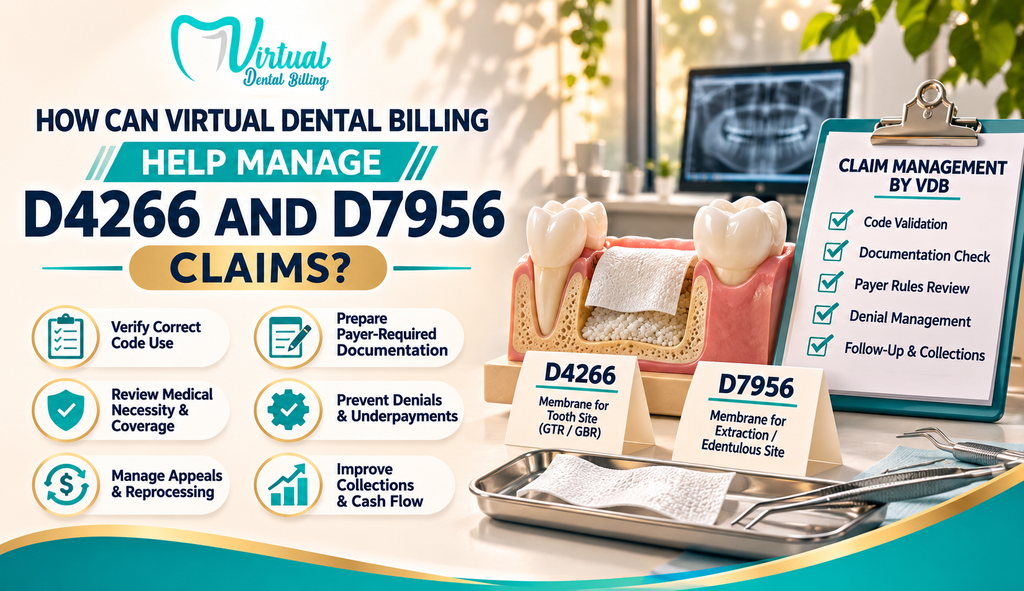
Virtual Dental Billing helps dental practices manage D4266, D7956, and related regenerative procedure claims by improving coding accuracy, reviewing clinical documentation, and identifying insurance payment restrictions before claim submission.
Our experienced dental billing team supports general dentists, periodontists, and oral surgeons through the following services:
- Dental coding assistance: Review membrane and bone graft procedure codes against documented clinical services.
- Dental insurance verification: Identify coverage exclusions, frequency limitations, and payer-specific bundling policies.
- Clinical documentation review: Identify missing radiographs, periodontal charts, surgical notes, and supporting narratives.
- Dental claims processing: Submit accurate claims with applicable supporting documentation.
- Denial management and appeals: Investigate rejected or denied membrane claims and prepare appropriate corrections or appeals.
- Dental payment posting: Review insurance payments, contractual adjustments, and potential underpayments.
- Dental accounts receivable management: Follow up on outstanding claims and unresolved insurance balances.
- Oral surgery billing: Manage complex claims involving bone grafting, ridge preservation, regenerative membranes, and implant procedures.
With professional dental billing services, your practice can reduce administrative burdens, prevent avoidable billing errors, and focus more on patient care.
Contact Virtual Dental Billing today to simplify your dental membrane billing process, strengthen revenue cycle management, and improve your practice’s collections in 2027.
Frequently Asked Questions (FAQs)
What Is the ADA Code for a Membrane With a Bone Graft?
The correct ADA code for a membrane with a bone graft depends on the treatment location and membrane type. D4266 applies to resorbable barriers around natural teeth, D7956 applies to edentulous areas, and D6106 applies to implant-related regenerative procedures.
Can D4266 Be Billed With a Tooth Extraction?
D4266 should not be reported for regenerative barrier placement in the socket of an extracted tooth. It may be reported on the same service date if a separate, qualifying regenerative procedure is performed around a retained natural tooth.
What Is the Dental Code for a Non-Resorbable Membrane?
The non-resorbable membrane dental code is D4267 for natural teeth, D7957 for edentulous areas, and D6107 for implant-related procedures.
Does D7956 Include Bone Graft Material?
No. D7956 describes resorbable regenerative barrier placement rather than bone graft placement. The appropriate bone graft dental code should be reported separately when the grafting procedure is performed and documented.
Can D7956 Be Reported Without a Bone Graft?
D7956 may be reported without a bone graft when the documented procedure independently meets the CDT requirements for regenerative barrier placement in an edentulous area. Insurance coverage depends on the patient’s plan and clinical circumstances.
Can D4266 and D7956 Be Billed on the Same Day?
Yes, both codes may be reported on the same day when distinct regenerative procedures are performed at separate qualifying treatment sites. Each procedure must have supporting clinical documentation.
Is D7956 Covered When Preparing a Site for a Dental Implant?
Some dental insurance plans cover D7956 during implant site preparation, while others exclude implant-related regenerative procedures or bundle them with bone grafting. Dental practices should verify individual plan benefits before treatment.
Can a Denied Dental Membrane Claim Be Appealed?
Yes. Dental practices can appeal denied membrane claims by submitting relevant clinical records, radiographs, surgical notes, and supporting narratives. Appeals must address the specific denial reason and comply with the insurance company’s submission deadline.