
Your dental hygienist completes a routine cleaning for a 12-year-old patient with permanent teeth. The office submits the claim using D1110, but the insurance company processes it under D1120 because its plan considers patients under 14 to be children. The treatment was documented correctly, yet the reimbursement changed.
This is where understanding D1110 vs D1120 becomes important for dental practices.
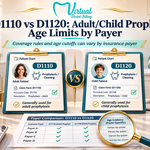
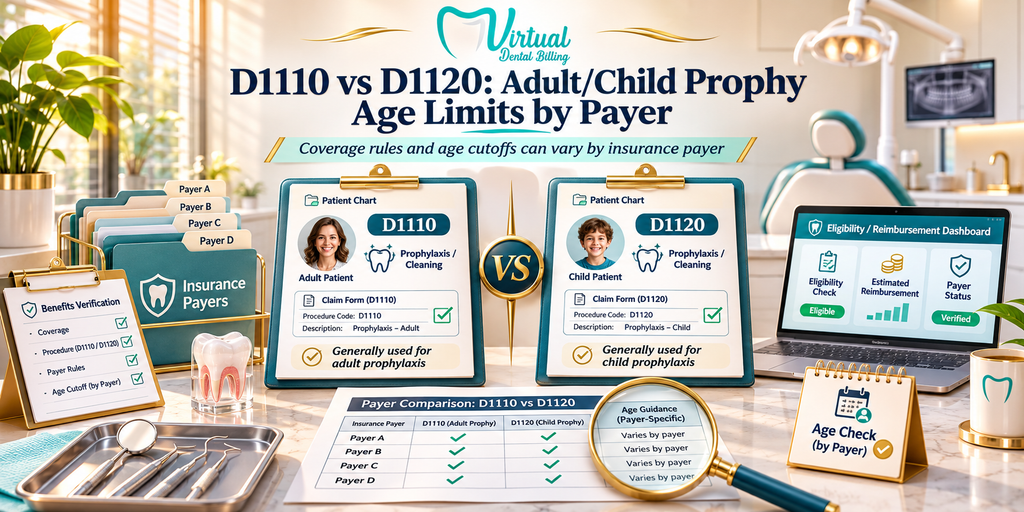
The D1110 dental code covers adult prophylaxis for permanent or transitional dentition, while the D1120 dental code applies to child prophylaxis involving primary or transitional dentition. These clinical code descriptions focus on the patient’s dentition rather than a fixed age.
However, dental insurers may apply their own reimbursement age limits. This means the D1110 age limit and D1120 age limit can differ between payers, creating confusion over coding, claim payments, and patient balances.
This guide explains how both dental prophylaxis codes differ, which payer-specific age rules matter, and how dental billing teams can handle adult and child cleaning claims accurately.
What Is the Difference Between D1110 and D1120 Dental Codes?
The main difference between D1110 vs D1120 is the type of dentition being treated, not simply the patient’s age. Both CDT codes describe dental prophylaxis, which involves removing plaque, calculus, and stains from tooth surfaces.
The D1110 dental code applies to adult prophylaxis involving permanent or transitional dentition. Meanwhile, the D1120 dental code applies to child prophylaxis involving primary or transitional dentition.
D1110 vs D1120: Quick Comparison
| Feature | D1110 | D1120 |
| Procedure name | Prophylaxis, adult | Prophylaxis, child |
| Dentition covered | Permanent and transitional | Primary and transitional |
| Common use | Cleaning involving adult dentition | Cleaning involving primary dentition |
| Fixed CDT age limit | None | None |
| Payer age restrictions | Vary by insurance plan | Vary by insurance plan |
Why Does Transitional Dentition Create Coding Confusion?
Transitional dentition, also called mixed dentition, occurs when a patient has both primary and permanent teeth.
For example, a 10-year-old may still have several baby teeth while permanent teeth are developing. Since both D1110 and D1120 include transitional dentition in their descriptions, the patient’s age alone cannot determine which code is appropriate.
The dentist must consider the patient’s clinical condition, stage of dental development, and the prophylaxis performed before selecting the code.
Does the CDT Code Set a Minimum Age for Adult Prophylaxis?
No. The American Dental Association explains that D1110 and D1120 do not have fixed age requirements in their CDT descriptions.
This means a patient younger than 18 can receive an adult prophylaxis when the procedure and clinical findings support D1110.
Still, the adult prophy age limit used for insurance reimbursement may differ from the clinical coding criteria. Dental practices should therefore distinguish between selecting the correct CDT code and determining how the payer will process the benefit.
Our dental insurance verification checklist explains how practices can check age restrictions and other plan limitations before treatment.
The key takeaway: D1110 and D1120 are selected based on the documented dental procedure and dentition, while insurance companies may use separate age-based rules to calculate reimbursement.
What Are the D1110 and D1120 Age Limits by Insurance Payer?
The D1110 age limit and D1120 age limit depend on the patient’s dental insurance plan. Although CDT codes do not establish a universal age cutoff for adult and child prophylaxis, insurers may use specific ages when determining reimbursement.
Some plans recognize adult cleaning benefits from age 12 or 13, while others use age 14. This is why dental offices should check the patient’s exact benefits before estimating coverage.
D1110 vs D1120 Age Limits by Payer: 2026–2027 Comparison
| Dental Payer or Program | D1110 Adult Prophy | D1120 Child Prophy |
| Delta Dental of Michigan, Indiana, and Ohio (commercial) | Age 14+ through 2026; changes to age 12+ on January 1, 2027 | Age 13 and under under the existing 2026 policy |
| Blue Cross Blue Shield Federal Employee Program (2026) | Age 14+ | Age 13 and under |
| Wisconsin Medicaid / ForwardHealth | Age 13+ | Through age 12 |
| EmblemHealth Federal Dental Plan (2026) | Listed as a covered adult prophylaxis service; age cutoff not specified in the cited benefit listing | Covered through age 12 |
What’s Changing for Delta Dental in 2027?
Delta Dental of Michigan, Indiana, and Ohio announced an important update to their adult prophylaxis age criteria.
Beginning January 1, 2027, the threshold for D1110 benefits under the affected commercial policies will decrease from age 14 to age 12.
For example, consider a 13-year-old patient receiving a cleaning:
- November 2026: The existing policy processes the patient under the child prophylaxis age category.
- January 2027: The updated policy recognizes the patient within the adult prophylaxis age category.
The treatment date matters because claims for services performed before January 1, 2027, remain subject to the previous policy.
Dental teams should review the official Delta Dental provider announcement before updating their billing workflows.
What Happens When the Patient’s Age Falls Between Two Categories?
Consider a 13-year-old patient with predominantly permanent teeth whose dentist documents adult prophylaxis under D1110.
The clinical procedure may support D1110, but the payer could apply a child prophylaxis benefit based on its age restrictions.
The American Dental Association explains that insurers should distinguish the procedure reported by the dentist from the benefit used to calculate payment.
In other words, a lower reimbursement does not necessarily mean the dentist selected the wrong CDT code.
When this happens, the billing team should review the explanation of benefits (EOB) and determine whether the payer applied a benefit limitation or incorrectly described the procedure.
Our guide to common dental claim denial reasons explains how dental practices can investigate coding-related payment problems.
The key takeaway: There is no universal D1110 vs D1120 age cutoff across US dental plans. Accurate clinical coding and payer-specific reimbursement rules must be reviewed separately, especially when a patient is approaching an age threshold or a payer announces a policy change.
Why Do Insurance Companies Downcode D1110 to D1120?
Insurance companies may downcode D1110 to D1120 when their dental benefit plans use age-based reimbursement rules. Even if the dentist correctly reports adult prophylaxis, the payer may calculate payment using the child prophylaxis benefit.
According to the American Dental Association, downcoding occurs when an insurer uses a different procedure code to determine a lower payment than the submitted code would normally receive.
How Does D1110 Downcoding Affect Reimbursement?
Consider a 12-year-old patient with adult dentition who receives prophylaxis under D1110.
The dentist submits D1110 based on the treatment performed. However, the patient’s insurance plan uses D1120 benefits for children younger than 14.
The claim may then be processed at the child prophylaxis reimbursement level.
For example:
| Claim Detail | Example |
| Procedure performed | Adult prophylaxis |
| Submitted CDT code | D1110 |
| Patient age | 12 years |
| Payer age cutoff | Adult benefit starts at 14 |
| Benefit applied | D1120 child prophylaxis |
| Possible result | Lower insurance reimbursement |
This is an illustrative scenario, not a universal payer rule.
When reimbursement is reduced, the practice should also check its provider contract before determining whether any difference can be billed to the patient.
Should Dentists Change D1110 to D1120 After Downcoding?
No. Dental offices should report the CDT code that accurately describes the treatment performed, rather than changing clinical coding solely to match the payer’s age-based payment policy.
For example, if D1110 correctly reflects the prophylaxis performed, the office should not automatically resubmit D1120 simply because the insurance company prefers that benefit category.
The important distinction is between:
- Procedure reporting: What treatment the dentist actually performed.
- Benefit determination: What the insurance plan agrees to reimburse.
This distinction protects accurate clinical records and prevents billing confusion.
Can Dental Offices Appeal a D1110 Downcoding Decision?
Yes. When the explanation of benefits (EOB) incorrectly suggests that the dentist selected the wrong code, the practice can request clarification or submit an appeal.
Before appealing, billing teams should:
- Review the EOB: Identify whether the payer applied an age-based benefit or disputed the reported procedure.
- Check the policy: Confirm the applicable D1110 and D1120 reimbursement rules.
- Review clinical records: Make sure the documented dentition and procedure support the submitted code.
- Contact the insurer: Request clarification or reconsideration when the payment explanation is incorrect.
An appeal may correct misleading claim information without increasing reimbursement if the lower payment is permitted by the patient’s plan.
Professional dental insurance billing services can help practices review payment differences, investigate claim adjustments, and coordinate payer follow-ups.
The key takeaway: D1110 downcoding does not automatically mean the original code was incorrect. Dental teams should distinguish clinical coding from insurance reimbursement and challenge unclear or inaccurate payment explanations when appropriate.
What Documentation Supports D1110 Instead of D1120?
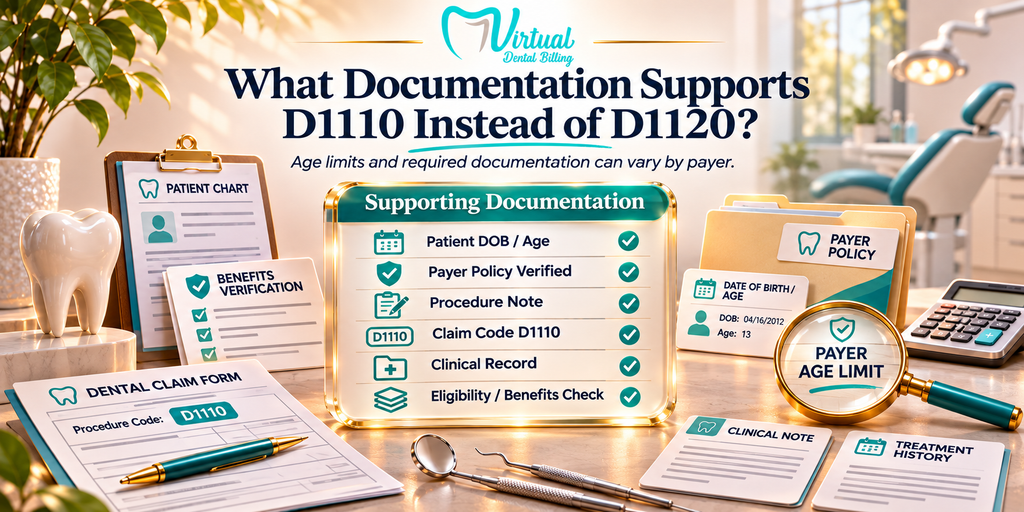
When a younger patient receives adult prophylaxis, the dental record should clearly support why the dentist selected the D1110 dental code instead of D1120.
According to the American Dental Association (ADA), D1110 vs D1120 code selection depends on the procedure performed and the patient’s dentition, not a fixed age. Clear documentation helps explain that decision when an insurance company questions the submitted code.
What Clinical Records Should Dental Teams Maintain?
Dental offices should keep records that accurately describe the patient’s teeth, oral condition, and completed treatment.
| Documentation | What It Should Show |
| Dentition findings | Whether the patient has primary, permanent, or transitional dentition |
| Clinical examination notes | Relevant oral health findings and the condition of the teeth and gums |
| Prophylaxis treatment notes | The cleaning performed, including removal of plaque, calculus, and stains as applicable |
| Provider documentation | Who performed the procedure and the date of service |
| Supporting clinical records | Relevant examination findings and other existing records that support code selection |
For patients with mixed dentition, notes should explain the clinical basis for the chosen procedure because both D1110 and D1120 include transitional dentition.
Example: Documenting D1110 for a 13-Year-Old Patient
Consider a 13-year-old patient with predominantly permanent teeth who receives adult prophylaxis.
Sample clinical note (fictional example):
Patient age 13 presents with predominantly permanent dentition. Clinical examination findings documented. Adult prophylaxis completed, including removal of plaque, calculus, and stains from applicable tooth surfaces. D1110 selected based on the documented dentition and procedure performed.
This example shows how a clinical note can connect the patient’s dentition with the treatment provided.
However, dental teams should never copy clinical findings into a patient’s chart unless those findings were actually observed and documented.
When an insurer requests clarification, a concise explanation supported by the clinical record may help. Our guide to dental claim narratives explains how to connect treatment details with supporting evidence.
Can Clinical Documentation Override a Payer’s Age Limit?
Not necessarily.
Even when the dental record supports D1110 adult prophylaxis, the insurance company may calculate benefits using its own age-based reimbursement schedule.
For example, a payer might apply D1120 benefits to a 13-year-old despite the dentist correctly reporting D1110.
In such cases, supporting documentation can help establish that the original code accurately describes the procedure. It does not automatically increase the insurance payment.
Dental offices should also avoid attaching unnecessary radiographs or periodontal records unless the payer requests them or they are relevant to the review.
The key takeaway: Accurate clinical documentation protects the integrity of D1110 coding. It helps explain the treatment performed, but payer-specific age restrictions may still affect reimbursement.
What Common D1110 and D1120 Billing Mistakes Cause Claim Denials?
Even when dental offices understand D1110 vs D1120, simple billing errors can still cause claim denials, delayed payments, or incorrect reimbursements.
These problems often happen when billing teams overlook the patient’s treatment history, use outdated payer rules, or submit a code that does not match the clinical documentation.
1. Selecting a Prophylaxis Code Based Only on Age
One common mistake is automatically reporting D1120 for every child and D1110 for every adult without reviewing the patient’s dentition.
For example, a 12-year-old patient with predominantly permanent teeth may receive adult prophylaxis. Reporting D1120 simply because the patient is younger than 14 may not accurately describe the treatment performed.
How to avoid it: Select the CDT code based on the documented procedure and dentition. Review payer age rules separately when estimating reimbursement.
2. Using Outdated Payer Age Restrictions
Insurance companies may update their D1110 and D1120 age limits, making previously used billing rules unreliable.
For example, a practice might continue applying an age-14 adult prophylaxis threshold after a payer changes its reimbursement policy.
How to avoid it: Verify the patient’s age on the date of service and check the current plan-specific age restrictions. Update internal billing references whenever an insurer announces policy changes.
3. Overlooking Prophylaxis Frequency Limitations
Many dental insurance plans limit how frequently routine cleanings qualify for payment.
For example, some plans cover two cleanings per calendar year, while others use a rolling 12-month period. Certain policies may also count D1110, D1120, and other periodontal procedures toward a shared frequency limit.
This means a correctly coded cleaning can still be denied when the patient has already used the available benefit.
How to avoid it: Check previous cleaning dates, remaining benefits, and applicable frequency rules before scheduling treatment.
4. Reporting Incorrect or Conflicting Procedure Codes
Another problem occurs when the reported CDT code does not match the clinical procedure.
For example, routine prophylaxis and periodontal maintenance serve different purposes. Billing D1110 when the patient’s documented treatment supports another procedure may lead to inaccurate claims.
Similarly, submitting both D1110 and D1120 for a single routine cleaning can create duplicate or conflicting charges.
How to avoid it: Compare the treatment notes with the CDT descriptors and confirm that every reported procedure was actually performed.
5. Failing to Review Claim Adjustments
Not every payment difference appears as a complete denial.
An insurer may process D1110 using a D1120 benefit, apply a frequency limitation, or reduce the allowed amount under the patient’s plan.
If the billing team posts the payment without reviewing the explanation of benefits (EOB), these adjustments may go unnoticed.
How to avoid it: Compare the submitted code, processed benefit, allowed amount, and adjustment explanation before closing the claim.
Quick Guide to Preventing D1110 and D1120 Billing Errors
| Billing Mistake | Possible Result | Preventive Action |
| Age-only code selection | Incorrect clinical coding | Review dentition and treatment notes |
| Outdated payer rules | Unexpected benefit adjustments | Confirm current age restrictions |
| Missed frequency limits | Denied or reduced benefits | Check previous cleaning history |
| Conflicting CDT codes | Claim rejection or correction request | Validate procedures before submission |
| Unreviewed EOB adjustments | Incorrect payment posting | Reconcile the claim and payer response |
Dental practices can reduce these risks by using consistent verification procedures. Professional dental insurance verification services can help teams confirm current benefits, coverage restrictions, and treatment history before submitting claims.
The key takeaway: Accurate D1110 and D1120 dental billing depends on correct clinical coding, updated payer information, and careful payment review. Addressing these common mistakes helps practices prevent avoidable billing problems and protect their collections.
What Should Dental Offices Verify Before Billing D1110 or D1120?
Before submitting a D1110 or D1120 dental claim, dental offices should confirm that the reported procedure matches the clinical record and the patient’s insurance benefits have been reviewed.
Even when the correct CDT code is selected, an expired policy, exhausted cleaning benefit, or incorrect claim detail can affect reimbursement.
D1110 and D1120 Pre-Submission Billing Checklist
| What to Verify | What Dental Teams Should Check |
| Patient eligibility | Confirm active insurance coverage on the date of service. |
| Correct CDT code | Match D1110 or D1120 with the documented procedure and dentition. |
| Payer age restrictions | Check which adult or child prophylaxis benefit applies under the patient’s plan. |
| Cleaning frequency | Review previous prophylaxis dates and remaining preventive benefits. |
| Provider participation | Confirm the treating dentist’s network status and applicable contract. |
| Claim information | Check patient details, provider identifiers, date of service, and submitted code. |
| Patient responsibility | Review expected copayments, coinsurance, deductibles, and benefit limitations. |
How Can Billing Teams Estimate Prophylaxis Reimbursement?
Once the clinical team confirms the appropriate code, the billing coordinator should review the patient’s insurance benefits.
For example, consider a 13-year-old patient receiving adult prophylaxis under D1110.
Before estimating payment, the billing team should determine whether the insurer:
- Recognizes D1110 under its adult prophylaxis age rules.
- Applies a D1120 benefit based on the patient’s age.
- Has remaining cleaning benefits available.
- Uses a contracted fee schedule that affects the expected payment.
These checks help the office prepare a more realistic estimate and explain possible differences between the billed amount and insurance reimbursement.
Why Should Dental Offices Record Verification Results?
Insurance information can change between the verification date and claim processing.
Keeping a record of the verification date, payer response, applicable restrictions, and reference number helps billing teams investigate unexpected payment decisions later.
The American Dental Association recommends verifying eligibility on the date of service because insurers may make retroactive eligibility changes.
Dental practices can make these checks part of their regular dental revenue cycle management process, connecting insurance verification, clinical coding, claim submission, and payment review.
Remember: Insurance verification provides an estimate of available benefits, not a guarantee of payment. Final reimbursement depends on the patient’s coverage and the payer’s claim-processing rules.
The key takeaway: Accurate D1110 and D1120 billing starts with selecting the correct procedure code and continues through benefit verification, claim review, and clear patient cost estimates.
How Can Virtual Dental Billing Help Manage D1110 and D1120 Claims?
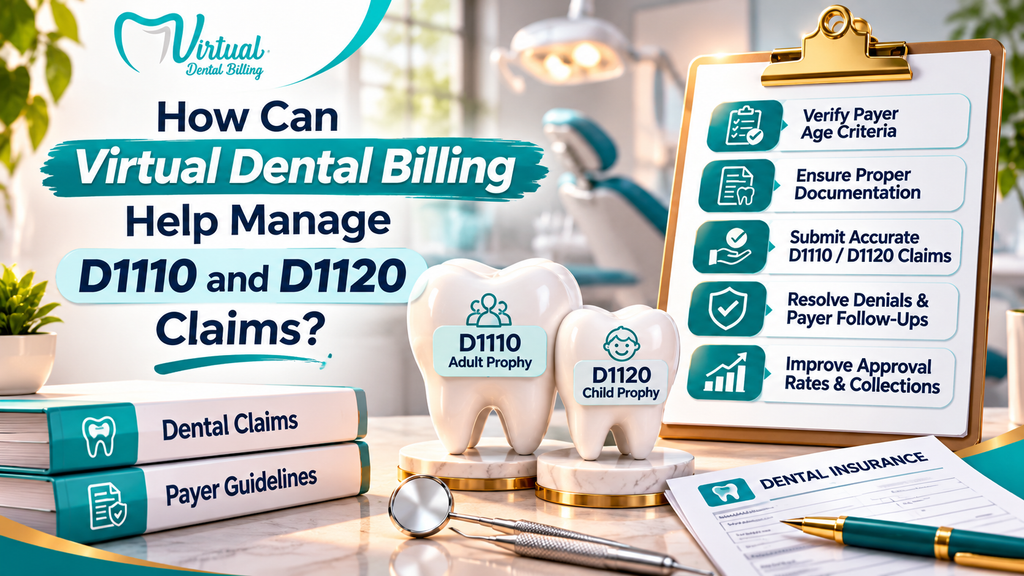
Managing D1110 and D1120 dental claims becomes challenging when insurance companies apply different age limits, cleaning frequency restrictions, and reimbursement policies. Even when the clinical team selects the correct CDT code, the billing staff may still need to investigate unexpected payment adjustments.
Virtual Dental Billing helps dental practices handle these administrative responsibilities through accurate claim reviews, insurance follow-ups, and payment reconciliation.
1. Reviewing Payer Age Limits and Claim Accuracy
Our billing team helps dental offices check insurance requirements before claims are submitted.
For D1110 and D1120, this includes reviewing the patient’s eligibility, payer-specific age restrictions, cleaning benefits, and applicable reimbursement rules.
We also help compare submitted claim information with the clinical documentation provided by the practice, reducing avoidable billing errors without changing the dentist’s clinical decisions.
2. Managing Downcoding and Payment Adjustments
When an insurer processes D1110 using a D1120 benefit, the explanation of benefits (EOB) may show a lower reimbursement than expected.
Our team helps practices investigate these differences by reviewing payer responses, applicable benefit rules, and contractual adjustments.
Through our EFT reconciliation services, we also help match insurance payments with the correct claims and patient accounts.
This supports accurate payment posting and helps prevent incorrect patient balances.
3. Following Up on Denied and Unpaid Prophylaxis Claims
Sometimes, a cleaning claim remains unpaid because of a frequency limitation, eligibility issue, or unresolved payer adjustment.
Our dental accounts receivable services support claim status reviews, insurance follow-ups, corrections, and appeals when appropriate.
Instead of allowing unresolved claims to remain in aging reports, our billing team helps identify the reason for nonpayment and determine the next action.
However, claims affected by valid plan exclusions or age-based payment limits may not qualify for additional reimbursement.
4. Supporting a More Consistent Dental Billing Workflow
At Virtual Dental Billing, we help dental practices manage insurance verification, claims processing, payment posting, and denial follow-up.
Our goal is to reduce administrative pressure on dental teams while improving billing accuracy and communication with insurance carriers.
Need help with D1110 and D1120 billing? Our dental billing specialists can support your practice with claim reviews, reimbursement tracking, and insurance follow-ups.
The key takeaway: Accurate D1110 vs D1120 billing requires both correct clinical coding and careful payer follow-up. Professional billing support can help dental offices identify payment differences, resolve preventable errors, and maintain more reliable collections.
Frequently Asked Questions
1. Can a 12-Year-Old Patient Receive D1110 Adult Prophylaxis?
Yes. The D1110 dental code can be appropriate for a 12-year-old when the documented dentition and treatment support adult prophylaxis. However, the insurance company may use a different age threshold when determining payment.
2. Is There an Official Age Cutoff for D1110 and D1120?
No. The CDT descriptions do not establish fixed ages for D1110 vs D1120. Code selection depends on dentition and the procedure performed. Insurance companies may use separate age limits for benefit calculations, so the applicable cutoff varies by plan.
3. Which Prophylaxis Code Applies to Mixed Dentition?
Both D1110 and D1120 include transitional, or mixed, dentition in their descriptions. The dentist should select the code that accurately represents the treatment performed and document the clinical findings supporting that decision.
4. Can D1110 and D1120 Be Billed Together?
Generally, dental practices should not report both codes for the same routine prophylaxis appointment. Doing so may duplicate the service. The claim should reflect the actual procedure performed, and any unusual circumstances must be supported by clinical documentation.
5. Can Dental Insurance Pay D1120 Benefits When D1110 Was Submitted?
Yes. Some dental plans calculate reimbursement using D1120 child prophylaxis benefits even when the dentist correctly reports D1110. This may happen when the patient falls below the payer’s adult prophylaxis age threshold. The submitted procedure and the benefit used for payment are not necessarily the same.
6. Can Dental Offices Charge Patients the Difference After D1110 Downcoding?
Not automatically. Patient responsibility depends on the dental insurance contract, benefit limitations, and applicable laws. Participating dentists may be prohibited from collecting amounts above the permitted fee. Billing teams should review the EOB and provider agreement before transferring any balance to the patient.
Conclusion: Accurate D1110 and D1120 Billing Starts With the Right Information
Understanding D1110 vs D1120 helps dental practices distinguish clinical coding requirements from insurance reimbursement rules.
While D1110 applies to adult prophylaxis and D1120 applies to child prophylaxis, neither code has a universal CDT age cutoff. Dental insurers may follow different age-based benefit policies, which can affect payments even when the original code accurately describes the treatment.
For dental teams, the priority is to document the procedure correctly, verify payer-specific age limits, and review unexpected claim adjustments before finalizing patient balances.
Virtual Dental Billing helps dental practices manage these challenges through insurance verification, claims processing, payment reconciliation, and denial follow-up.
With accurate coding and consistent billing support, dental offices can reduce preventable errors, improve payment accuracy, and keep their attention on patient care.