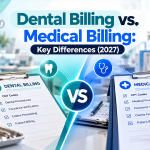

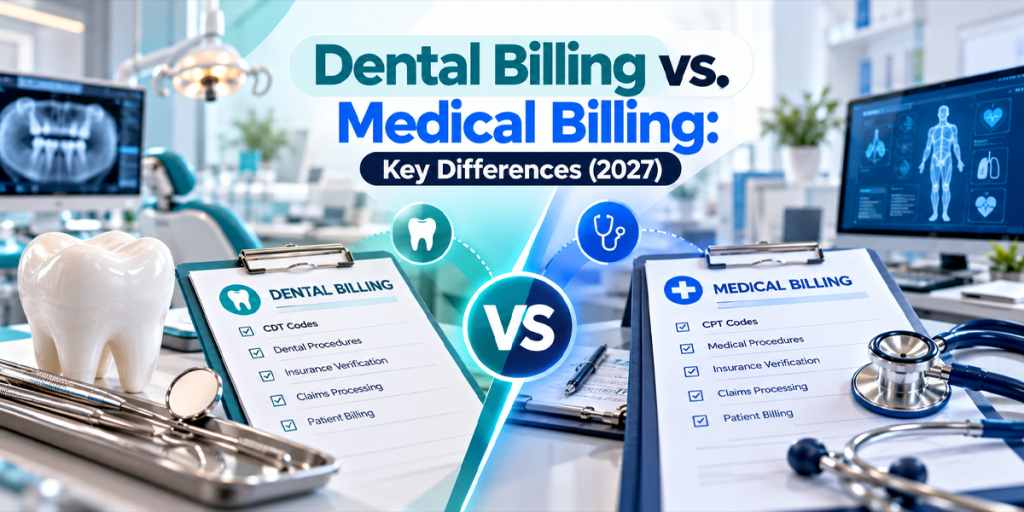
Dental billing and medical billing both turn healthcare services into insurance claims, but they use different codes, claim formats, and coverage rules. Dental claims commonly use CDT procedure codes and details such as the tooth or area treated. Professional medical claims commonly use CPT or HCPCS service codes with ICD-10-CM diagnosis codes. Dental offices may submit claims using the ADA Dental Claim Form or the electronic 837D transaction, while professional medical claims commonly use the CMS-1500 form or 837P transaction.
Knowing these differences helps billing teams choose the right claim path, include the required information, and explain coverage clearly. This guide compares the systems and explains when dental care may involve medical billing. It also covers the announced CDT 2027 updates, which the ADA says take effect January 1, 2027.
Dental Billing vs. Medical Billing: Quick Answer
Dental billing vs. medical billing differs in the codes used, the claim format, the details submitted, and the rules that determine coverage. Dental claims commonly report procedures with CDT codes. Professional medical claims commonly report services with CPT or HCPCS codes and diagnoses with ICD-10-CM codes.
| Difference | Dental billing | Medical billing |
| Main focus | Oral-health services and procedures | Professional healthcare services across many specialties |
| Codes | CDT procedure codes; ICD-10-CM diagnosis codes may also be needed | CPT or HCPCS service codes with ICD-10-CM diagnosis codes |
| Claim route | ADA Dental Claim Form or electronic 837D claim | CMS-1500 paper form or electronic 837P claim for professional services |
| Claim details | Tooth number, surface, or area of the mouth may be required for certain procedures | Diagnosis and service details support the medical claim |
| Coverage rules | Dental plans may have annual benefit limits, frequency limits, and exclusions | Coverage depends on the health plan’s terms and applicable medical policies |
The ADA Dental Claim Form includes fields for tooth numbers and oral areas, while CMS identifies the CMS-1500 and 837P as routes for professional claims. Dental benefit limits can vary by plan, and a valid CDT code does not guarantee coverage.
These are common pathways, not rules for every claim. Some dental services may qualify for medical coverage when they meet the payer’s requirements; CMS, for example, covers certain dental services when they are closely linked to covered medical services. Practical takeaway: check the plan’s rules and required claim details before choosing where to submit a claim.
Coding Systems: CDT vs. CPT, HCPCS, and ICD-10-CM
One major difference in dental billing vs. medical billing is how each claim describes the service and, when required, the diagnosis behind it.
| Code set | What it describes | How it fits |
| CDT | Dental procedures | Reports the dental service performed |
| CPT | Medical procedures and professional services | Reports many services on professional medical claims |
| HCPCS Level II | Certain products, supplies, and services | Covers items and services not described by CPT |
| ICD-10-CM | Diagnoses and health conditions | Explains the reason for care on medical claims |
Dental claims use CDT codes to report dental procedures. Details such as the tooth number or surface may also be required, depending on the service and claim instructions.
Professional medical claims commonly use CPT or HCPCS codes for services and ICD-10-CM codes for diagnoses. In simple terms, the service code describes what the provider did, while the diagnosis code explains why the care was needed.
Dental offices may need medical codes and diagnosis details when submitting a claim to a medical plan. The correct codes depend on the service performed, the clinical record, and the payer’s requirements. HIPAA also requires the CDT version that applies to the date of service; the ADA says CDT 2027 takes effect on January 1, 2027. Even a correctly coded procedure is not automatically covered, since benefit decisions depend on the plan.
Claim Forms and Electronic Submissions
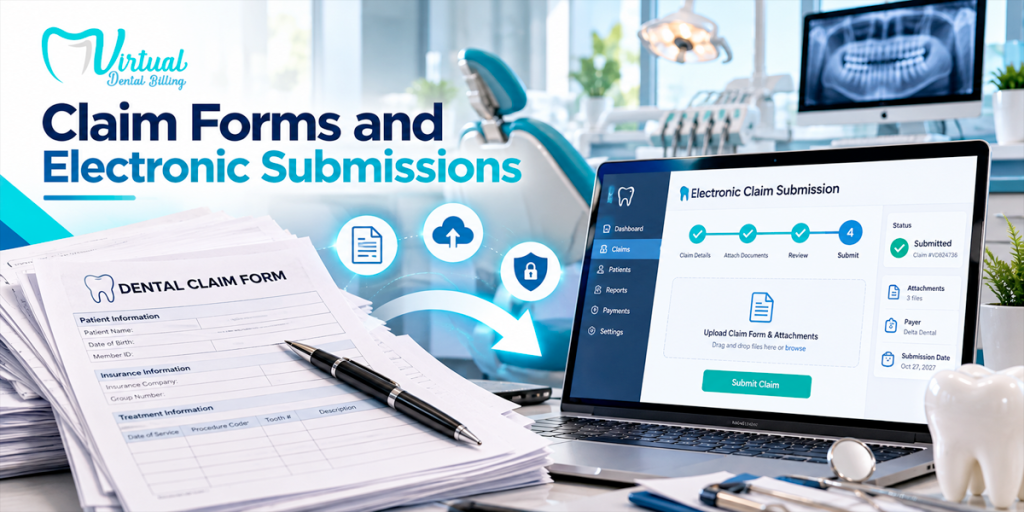
Dental billing and professional medical billing use different claim formats. For paper dental claims, offices commonly use the ADA Dental Claim Form. For electronic dental claims, they use the 837D transaction. The ADA describes its form as a common format for reporting dental services to a benefit plan.
By contrast, professional medical claims commonly use the CMS-1500 form on paper or the 837P transaction electronically. CMS identifies 837P as the electronic format for professional claims.
The form also affects which details the claim can report. For example, dental claims may need the tooth number, surface, or area of the mouth, depending on the procedure. The ADA form includes fields and instructions for these details.
Meanwhile, medical professional claims report service and diagnosis information to show what care was provided and why. Since payer requirements vary, staff should check the insurer’s instructions before submitting a claim. That way, they can choose the correct format and include the required details and supporting documents.
Coverage, Benefits, and Patient Costs
Dental benefits vs. medical insurance can lead to different patient costs because each plan follows its own coverage rules. Both types of plans may include deductibles or coinsurance, but dental plans often have additional limits that affect how much they pay.
Many dental plans set an annual maximum the most the plan will reimburse during a plan year. Frequency limits, exclusions, and other plan terms may also affect payment. These rules vary by plan, and having a valid CDT code does not automatically mean a procedure is covered.
By contrast, medical plans commonly describe cost-sharing through a deductible, copayment, or coinsurance. Many also set an out-of-pocket maximum for covered, in-network care. That maximum does not necessarily include premiums, out-of-network services, or care the plan does not cover.
The dental annual maximum and a medical plan’s out-of-pocket maximum do different jobs. The dental limit caps what the plan may reimburse; the medical limit caps certain costs the patient pays for covered care. Therefore, billing staff should check the specific plan, remaining benefits, and network terms before estimating the patient’s share.
Documentation and Claim Details
Dental claim documentation and medical claim documentation differ because each claim must describe the service in the detail its payer needs. Dental claims may require the tooth number, surface, or area of the mouth. The ADA claim form includes fields for those details, with instructions on when to use them.
By comparison, medical claims use diagnosis information to explain why care was needed. When dental services are submitted to a medical benefit plan, ICD-10-CM diagnosis codes are required. The claim and clinical record should support the service being reported.
For certain Medicare-covered dental services, CMS also requires documentation that supports medical necessity and links the dental service to a covered medical service. That rule applies to the Medicare pathway; other payers set their own requirements.
In both billing systems, the claim details should match the patient record and the service performed. Payers may request supporting items such as images, narratives, or other records, depending on the claim and plan. Therefore, staff should check the payer’s instructions and send the relevant documentation with the claim or when requested.

How Payment and Reimbursement Work: Step by Step
Both dental and medical billing move from claim submission to payer review, payment posting, and patient billing. The details differ, so follow these steps to see how dental reimbursement or medical reimbursement is calculated.
Step 1: Confirm which plan should receive the claim
First, identify whether the service should be submitted to a dental plan or a medical plan. Coverage depends on the patient’s specific benefits and the payer’s rules. For certain Medicare-covered dental services, the dental treatment must be linked to a covered medical service.
Step 2: Submit the claim with the provider’s fee
Next, report the service using the appropriate codes and submit the claim through the payer’s required route. For dental claims, the CDT code describes the procedure but does not set its price; the dentist reports the full fee. For Original Medicare physician services, CMS uses fee schedules.
Step 3: Let the payer review the claim
Then, the payer checks the claim against its coverage rules and the provider’s contract. The approved amount may differ from the provider’s fee. Dental reimbursement may also be affected by the plan’s annual maximum or exclusions.
Step 4: Post the payment and adjustment
Once the payer responds, staff compare the payment and adjustments with the EOB and the office account. If the provider has a network contract, its terms can affect the amount the office may collect for covered services.
Step 5: Calculate the patient’s share
Next, apply the plan’s rules to find the remaining patient responsibility. Dental benefits may be reduced by a deductible, coinsurance, or annual maximum. Medical plans may apply a deductible, copayment, or coinsurance to covered care.
Step 6: Explain the balance and follow up
Finally, send a clear statement for any balance due under the plan and provider agreement. If the payment or adjustment looks incorrect, review the EOB and follow the payer’s correction or appeal process.
Conclusion: Choose the Right Billing Support for Your Practice
Dental billing vs. medical billing comes down to more than code sets. Each process has its own claim formats, documentation needs, coverage rules, and payment terms. Following the payer’s requirements helps your team submit claims with the right details and calculate patient balances more clearly.
For 2027, dental teams should also use the CDT code version that applies to the date of service. The ADA says CDT 2027 takes effect on January 1, 2027.
When your team needs help managing the dental side, virtual dental billing can provide remote support with claim follow-up, payment posting, denied claims, and aging insurance balances. Explore Virtual Dental Billing’s services to see how that support could fit your practice’s workflow.