

Strong dental claim narratives clarify what the patient is in need of, why it is important, and which dental facts are relevant to the claim. The briefing of symptoms, tooth numbers, diagnosis, medical need, and supporting documentation allows insurers to review claims with less delay.
Many dental claims stall because the story has missing elements. Insurers need more than a CDT code or a short note such as “crown needed.” In addition to patient-specific facts, they require the facts to match the X-rays, photos, periodontal chart, and clinical notes.
Dentally written narratives for insurance claims link the patient’s condition to the treatment that is intended. For instance, the recurrent decay, fractured cusp, remaining tooth structure, and age of the existing filling should be recorded for “Tooth #19 needs a crown.”
Clear dental claim documentation also helps prevent requests for more records. Your team should check every detail before submission because one missing image, wrong tooth number, or vague statement may delay dental insurance claim approval.
What Is a Dental Claim Narrative?
Once the payer understands the treatment story, claim review becomes easier. This story is from a dental claim narrative, which translates the codes and fees that are listed on the claim form.
The purpose of the narrative is to describe the patient’s condition, symptoms, diagnosis, and treatment requirement. It also associates these facts with x-rays, intraoral photographs, periodontal charts, and clinical notes. Thus, the dentist’s selection of the procedure is seen, and medical necessity is supported from the records.
Our billing team builds each narrative from the patient’s actual clinical details. We review the tooth number, affected surfaces, prior treatment, current findings, and planned procedure. Next, we match those details with the correct CDT code and dental claim attachments. This process keeps the claim clear, accurate, and ready for payer review.
What Makes Dental Claim Narratives Strong?
Knowing the purpose of a narrative comes first. Next, your team needs to include the exact details an insurance reviewer expects.
Claim narratives in strong dental claims have five components: patient condition, clinical evidence, diagnosis, treatment reason, and matching attachments. These details are combined to demonstrate medical necessity and to show the payer the rationale for the procedure that is planned.
Five Parts of a Strong Dental Claim Narrative
- Patient condition: Describe the patient’s symptoms, pain level, treatment history and current concern.
- Clinical evidence: Document the number of the tooth, surfaces involved, probing depths, bone loss, fractures, decay, or remaining tooth structure.
- Diagnosis: Name the dental condition that supports the recommended care.
- Treatment reason: Justify the reason for the treatment procedure being selected, and why a simpler procedure would not give satisfactory function.
- Supporting records: Refer to X-rays, photos, periodontal charts, clinical notes, provided with claim.
Our billing team connects these five parts in a short, patient-specific narrative. Therefore, every statement supports the CDT code and matches the dental claim documentation. This structure helps reduce unclear submissions, repeated payer requests, and preventable dental claim denials.
Record the Patient’s Exact Condition
The five-part structure starts with the patient’s condition because every treatment decision begins there. Without this context, the payer sees a procedure code but doesn’t see the problem behind it.
Our billing team reviews the clinical notes and records the details that make each case different. These details include:
- Patient’s main concern
- Pain level and duration
- Tooth number and affected surfaces
- Swelling, sensitivity, bleeding, or limited function
- Prior treatment on the tooth
- Current condition of the restoration
- Date when symptoms began
Specific facts make dental claim narratives easier to review. In the case of “patient reports sharp pain when chewing on tooth #19 for 3 weeks”, this provides the payer with greater information than “patient has tooth pain.” This is a description of the symptom, its site, cause, and time.
Next, we connect the patient’s condition with the dentist’s findings. This link supports medical necessity and prepares the narrative for clinical evidence, diagnosis, and treatment reasoning. Therefore, the claim tells one clear and consistent patient story.
Add Measurable Clinical Evidence
Patient symptoms explain what the person feels. Next, clinical evidence shows what the dentist found during the exam. This connection turns a patient’s concern into a clear treatment reason.
Our billing team replaces vague terms with exact findings. Instead of writing “large cavity” or “bad gums,” we use details from the clinical notes, such as:
- Tooth number and affected surfaces
- Fracture or decay location
- Number of remaining tooth walls
- Pocket depths in millimeters
- Bleeding on probing
- Percentage of bone loss
- Tooth mobility
- Age of the current restoration
- Results from cold, heat, or percussion tests
For example, “Tooth #30 has deep decay” leaves room for questions. In contrast, “Tooth #30 has recurrent distal decay beneath an eight-year-old MOD filling, with fracture of the lingual cusp” gives the payer clear clinical evidence.
We then compare these findings with the X-rays, intraoral photos, and periodontal charts. Therefore, the written details and dental claim attachments support the same condition. This match helps the reviewer understand the extent of damage and the reason for treatment.
Explain Medical Necessity Clearly
Clinical evidence shows what the dentist found. Next, medical necessity explains why the patient needs the recommended procedure. Without this link, the payer sees the condition but may still question the treatment choice.
Our billing team connects each finding with a clear clinical reason. We explain how decay, fracture, bone loss, infection, or failed treatment affects the patient’s oral health and function. Then, we show why the selected procedure fits the condition.
For example, “Tooth #19 needs a crown” only names the treatment. Stronger wording explains that recurrent decay and a fractured cusp left too little sound tooth structure for another filling. Therefore, full coverage will protect the remaining structure and restore chewing function.
Clear dental billing narratives also address treatment options when the clinical notes support them. If a filling won’t provide enough strength, the narrative should explain why. This reasoning helps the payer connect the diagnosis, evidence, and procedure without guessing.
Match the Narrative With Supporting Records
Medical necessity explains why the treatment fits the patient’s condition. Next, supporting documentation must confirm every clinical detail in the narrative. When the written explanation and attached records tell different stories, the payer may request more information.
Our billing team reviews each attachment before claim submission. We check whether the records clearly show the correct patient, tooth, date of service, and treatment area. We also confirm that the narrative matches:
- Diagnostic X-rays
- Intraoral photographs
- Periodontal charts
- Clinical notes
- Previous treatment dates
- Tooth and surface numbers
- CDT codes on the claim
Different procedures need different dental claim attachments. Crown claims often need current X-rays and intraoral photos. SRP claims often need full periodontal charting and images that show bone loss. Root canal claims usually need pre-treatment and post-treatment radiographs.
This final match helps the payer review the claim without searching for missing facts. Therefore, accurate dental claim documentation supports faster decisions and reduces avoidable requests for added records.

Weak and Strong Dental Claim Narrative Examples
The right structure matters, but wording decides whether the payer understands the case. Vague notes leave gaps. In contrast, patient-specific dental claim narrative examples connect symptoms, clinical findings, medical need, and supporting records.
Our billing team never copies the same narrative across several patients. Instead, we build each statement from the dentist’s clinical notes and match it with the claim details. The examples below show how stronger wording gives the reviewer clearer information.
Crown Narrative Example
Weak narrative:
Tooth #19 needs a crown because the filling has failed.
This statement names the tooth and procedure, but it doesn’t describe the damage or explain why another filling won’t work.
Strong narrative:
Tooth #19 has recurrent decay beneath an eight-year-old MOD restoration. The lingual cusp has fractured, and less than 50% of sound coronal tooth structure remains. Another direct restoration won’t provide enough support. A full-coverage crown will protect the remaining structure and restore chewing function. Current PA, bitewing, and intraoral images accompany the claim.
This crown narrative for insurance gives the payer a clear path from the damaged tooth to the planned treatment. It also references the records that support each finding. Therefore, the reviewer receives the clinical facts needed to assess medical necessity.
Core Buildup Narrative Example
Crown claims often include a core buildup narrative, yet many submissions fail to explain why the buildup required separate work. Simply writing “buildup completed” doesn’t show how much tooth structure the patient lost or why the crown needed added support.
Weak narrative:
Core buildup completed on tooth #30 before crown placement.
This statement describes the procedure but leaves out the clinical findings and treatment reason.
Strong narrative:
Tooth #30 has recurrent decay beneath a large MOD restoration. After decay and the failed restoration came out, the tooth retained less than 50% of its coronal structure. The remaining structure couldn’t hold the planned crown without added support. The dentist placed a core buildup to replace the missing structure and provide retention for the crown. Pre-treatment X-rays and an intraoral photo support these findings.
This example connects the damage, remaining tooth structure, and purpose of the buildup. As a result, the dental insurance story is the reason that the dentist has to “build up” the tooth and not treat it as regular crown preparation.
Additionally, our billing team validates that the clinical notes, crown claim, CDT code, and images all present the same facts. This review strengthens dental claim documentation and helps prevent payer questions about the treatment.
SRP Narrative Example
Periodontal claims need more than a note that says “deep cleaning required.” Payers review pocket depths, bleeding, attachment loss, bone loss, and the number of affected teeth. Therefore, an SRP narrative for insurance must connect periodontal findings with the need for treatment.
Weak narrative:
Patient has gum disease and needs SRP in the lower-right quadrant.
This statement names the condition and treatment, but it gives the reviewer no measurable evidence.
Strong narrative:
Periodontal disease is present on teeth #28-31 in the lower right quadrant. Periodontal charting shows 5-7 mm pocket depths, bleeding on probing, and clinical attachment loss. Current radiographs show horizontal bone loss around the affected teeth. Scaling and root planing will remove subgingival calculus and bacterial deposits from the root surfaces. Full periodontal charting and diagnostic radiographs accompany the claim.
This stronger dental claim narrative links the diagnosis with measurable findings and matching records. Consequently, the payer sees which teeth need treatment and which clinical signs support medical necessity.
Our billing team also confirms that the quadrant, tooth count, periodontal chart, radiographs, and CDT code match before submission. This review helps reduce delays caused by missing or conflicting dental claim documentation.
Implant Narrative Example
Implant claims require a clear history of the missing tooth and the reason for replacement. Without extraction details, treatment dates, or functional concerns, the payer may struggle to connect the implant with the patient’s clinical need.
Weak narrative:
Implant placed at site #19 to replace a missing tooth.
This statement identifies the site and procedure, but it doesn’t explain why the patient lost the tooth or how the missing tooth affects oral function.
Strong narrative:
March 12, 2026: Tooth #19 was extracted because of a vertical fracture and recurrent infection. The healed area is now without a tooth that is necessary for chewing and proper positioning in the opposing arch. First, the dentist inserted an implant at site #19 that would support a single crown without compromising the health of the adjacent teeth to the space. Current radiographs, extraction records, and implant placement notes accompany the claim.
This dental insurance narrative for implants connects the extraction history, missing tooth, treatment choice, and expected function. Therefore, the payer receives a complete account instead of a procedure code without context.
Our billing team also checks the tooth history, service dates, implant site, CDT codes, and dental claim attachments before submission. This review helps prevent conflicts between the narrative and the clinical record.
Common Mistakes Behind Claim Delays and Denials
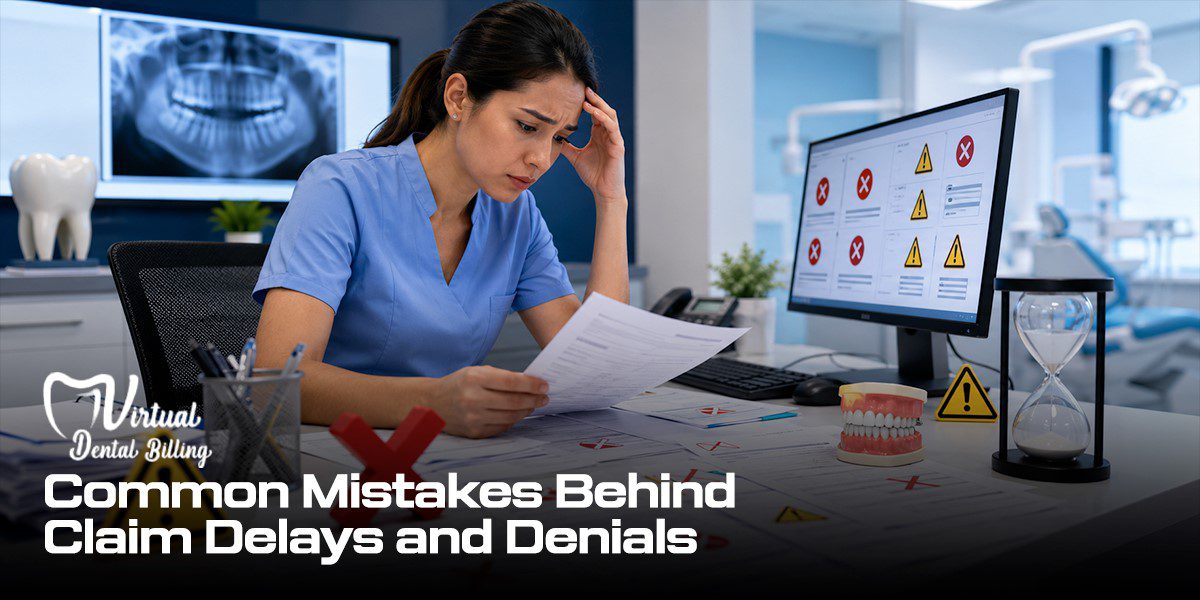
Even strong clinical care may face payment delays when the claim leaves room for questions. Small errors often break the connection between the procedure, narrative, and supporting records. Therefore, our billing team checks each claim for these common issues before submission.
Using Vague or Generic Wording
Statements such as “crown needed” or “patient has gum disease” don’t prove medical necessity. Instead, the narrative should include tooth numbers, symptoms, measurable findings, prior treatment, and the reason for the selected procedure.
Reusing the Same Narrative
Copying one narrative across several patients may create incorrect dates, tooth numbers, or clinical details. Each dental insurance narrative should reflect the patient’s actual condition and treatment history.
Submitting Mismatched Information
The narrative, CDT code, X-rays, and clinical notes must support the same procedure. For example, a claim may slow down when the narrative names tooth #19 while the attached image marks tooth #18. Our team compares every detail to prevent such conflicts.
Leaving Out Supporting Records
Missing X-rays, photos, or periodontal charts may stop the reviewer from confirming the clinical findings. Therefore, we attach the right dental claim documentation and confirm that each record clearly shows the patient, service date, and treatment area.
Writing Too Much or Too Little
Short narratives often leave out key facts, while long narratives may hide the main treatment reason. Strong dental claim narratives include enough detail to explain the condition, evidence, diagnosis, and treatment need without adding unrelated information.
Our pre-submission review connects every part of the claim before it reaches the payer. This step helps reduce avoidable dental claim denials, repeated record requests, and payment delays.
Dental Claim Narrative Submission Checklist
Fixing common errors before submission saves more time than correcting them after a payer responds. Therefore, our billing team uses a final checklist to confirm that every narrative, code, and attachment tells the same clinical story.
Patient and Treatment Details
- Confirm the patient’s name and date of service.
- Check the correct tooth number and surfaces.
- Record the patient’s symptoms and treatment history.
- Include the diagnosis and planned procedure.
Clinical Evidence
- Add exact findings from the clinical notes.
- Include measurements such as pocket depths or bone loss.
- Record the age and condition of existing restorations.
- Explain fractures, decay, infection, or missing tooth structure.
- Connect each finding with medical necessity.
Codes and Supporting Records
- Match the narrative with the correct CDT code.
- Attach clear X-rays, photos, or periodontal charts.
- Confirm that each attachment shows the correct treatment area.
- Label the records with the required patient and claim details.
- Reference the dental claim attachments inside the narrative.
Final Narrative Review
- Remove vague or repeated wording.
- Check dates, tooth numbers, and clinical facts.
- Keep the explanation short and patient-specific.
- Confirm that the records support every statement.
- Review payer requirements before sending the claim.
Our final review strengthens dental claim documentation and helps prevent missing information from slowing down payment. Consequently, each claim reaches the payer with clear facts, matching records, and a complete treatment reason.