
Often, the trouble with billing begins once the last patient has walked out the door. Claims still have to be reviewed, payers still adjust their rules, and AR is still growing old as the team gets tired.
Remote dental billing partner helps with claims, payment posting, follow-up, and reports from a dental billing partner that works remotely, making claims and follow-up on payment processing on track. That support is important because it has an impact on cash flow if you miss a code, miss an appeal, or wait more than 90 days to pay a claim.
Dental AR is the money due to the practice after treatment, claim submission, or after the patient has been billed. When AR grows, the practice works harder but collects less.
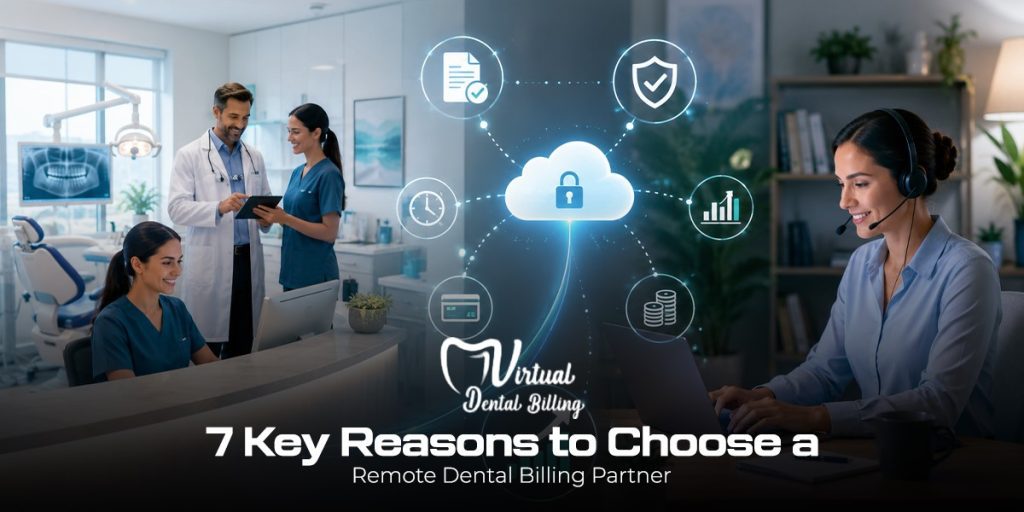
This guide breaks down 7 clear reasons to choose remote dental billing services instead of carrying every billing task in-house. It also shows how the right dental billing partner protects time, cash flow, and team focus.
Why Does a Remote Dental Billing Partner Reduce Claim Stress?
With remote dental billing partner support, the burden of claims is minimized by ensuring that trained billing teams review codes, benefits, notes, and payer rules before claims are sent out the door. This is important for 2026 because there are 60 changes in CDT codes that are listed in the ADA, and one bad decision in coding will lead to payment delays quickly.
Reason 1: Fewer Claim Errors Before Submission
Claim errors often start small. One missing tooth number, wrong CDT code, or weak note gives the payer a reason to delay payment.
Clean claims are the claims that include the exact code, patient data, provider details, attachments, and notes before submission.
With remote dental billing services, the billing partner checks the claim before it goes out. That extra review helps the office avoid repeat fixes, phone calls, and resubmissions.
For example, CDT 2026 includes 31 new codes and 14 code revisions. So a team that still uses old coding habits risks more payer pushback.
Remote dental billing partner support reduces claim stress because trained billing teams check codes, benefits, notes, and payer rules before claims leave the office. This matters in 2026 because the ADA lists 60 CDT code changes, so one old code choice creates payment delays fast.
Reason 2: Better Payer Follow-Up Without Office Overload
More than 2 or 3 touches of one claim, oftentimes, are necessary for the office to get a clear answer.
Follow-up of payers includes calling, checking portals, tracking claim status, and recording next steps until the payer pays or clarifies the denial.
The front desk can concentrate on calls, check-ins, and patients, since the follow-up is handled remotely by a dental billing partner. The billing partner maintains records of unpaid balances, missing EOBs, appeal dates, and open claims.
This support is particularly important at 30, 60, and 90 days. The older the claim, the more difficult it is to collect Dental AR, and as such, it should be done on a schedule, not as a spare-moment project.
Quick Claim Stress Checklist
- Check patient eligibility before treatment.
This step helps catch inactive coverage or plan limits early. - Match CDT codes with clinical notes.
This step helps the claim tell the same story as the chart. - Add needed X-rays or narratives before submission.
This step helps reduce payer requests for more details. - Track claims at 30, 60, and 90 days.
This step keeps unpaid claims from getting buried. - Review denials by reason each month.
This step shows patterns like coding gaps, missing notes, or payer rule changes.
What Does Remote Dental Billing Mean for Dental Teams, and How Does It Save Time?
Dental billing outsourcing allows dental practices to save time by eliminating the need to check, follow up on, post, and track claims from the front desk. Staff time is more important in 2026, as 4 of 10 dental practices attempt to hire assistants or hygienists every month, according to The ADA Health Policy Institute.
Reason 3: Less Front Desk Pressure During Busy Hours
Small billing tasks can be time leaks. One eligibility check, one claim note, and one payer call take minutes away from patient care.
Verification of the insurance is the process of verifying active coverage, plan benefits, waiting periods, deductibles, and missing benefit details prior to treatment.
If verification is performed by a remote dental billing partner, then the office team experiences less disruption in the billing process. At the front desk, it is all about scheduling, patient calls, check-ins, and treatment questions. The result feels simple. Staff stop switching between patients and payer portals all day.
Reason 4: Cleaner Payment Posting With Fewer Gaps
Billing work does not stop when the payer sends money. The office still needs correct posting, EOB review, adjustment checks, and patient balance updates.
Payment posting means entering insurance payments, patient payments, write-offs, and adjustments into the practice software.
With dental billing outsourcing, the partner reviews EOBs and posts payments with the right codes and balances. The team sees which claims got paid, which claims need follow-up, and which patient balances need attention.
This protects dental revenue cycle management because payment data drives every next step. For example, one wrong write-off changes AR totals, patient balances, and monthly reports.
Simple Time-Saving Workflow
- Verify insurance before the visit.
This helps the team find inactive coverage, plan limits, and missing benefit details early. - Review claims before submission.
This helps catch code, tooth number, provider, or attachment errors before payer review. - Post payments from EOBs daily.
This keeps insurance checks, write-offs, and patient balances current. - Work unpaid claims by age.
This keeps 30, 60, and 90-day claims from sitting without follow-up. - Share weekly billing notes with the office.
This helps the owner see payer issues, denial trends, and cash flow gaps.
Why Does Dental Billing Outsourcing Improve Cash Flow?
Dental billing outsourcing improves cash flow because unpaid claims get steady follow-up, cleaner posting, and faster correction. Cash flow weakens when claims sit past 30, 60, or 90 days. Practice Numbers treats AR over 90 days as a high-risk KPI, so a fixed billing system matters.
Reason 5: Faster Action on Aging AR
Time is against unpaid claims, and the money is lost. Each lapse provides the payer with more opportunities to delay, request specifics, or close the claim.
For the dental practice, accounts receivable are the unpaid amount from insurance claims, balances due from patients, or treatments rendered.
When you have a remote dental billing partner, there’s a rhythm to the follow-up of AR. The billing team reviews claims that are not paid and calls callers, reviews portals, logs EOBs and documents each action taken.
The goal stays clear: stop old claims from hiding inside reports. For this reason, 30, 60, and 90-day tracking gives the owner a cleaner view of money still sitting outside the bank.
Reason 6: Stronger Reports for Better Money Decisions
Cash flow improves when reports tell the truth. Reports lose value when write-offs, payments, denials, and patient balances sit in the wrong place.
Dental revenue cycle management means the full money path from insurance check to claim submission, payment posting, denial follow-up, and patient balance review.
With outsourced dental billing services, the partner gives the owner billing reports that show open claims, denial reasons, payer delays, and AR trends. That view helps the practice spot weak points before they turn into bigger losses.
Remote support also helps with coding changes. ADA lists 60 CDT 2026 changes, so updated reporting helps owners see where new code issues affect claim payment.
Cash Flow Comparison: In-House Billing vs Remote Partner
| Billing Area | In-House Team Only | Remote Dental Billing Partner |
|---|---|---|
| Claim follow-up | Staff fit it between calls and patients | The billing team follows a set 30, 60, 90-day rhythm |
| Payment posting | Office posts when time opens | Partner posts EOBs and tracks balance issues |
| Denial review | Team fixes denials after payer pushback | Partner tracks denial reasons and repeat patterns |
| AR reports | The owner sees totals without enough detail | Owner sees claim age, payer status, and next steps |
| Code updates | Staff learn changes while working | Billing partner checks updates and claim impact |
Cash Flow Warning Signs to Track
- Claims sit past 30 days with no payer note.
This shows the office needs a stronger follow-up schedule. - AR over 90 days keeps growing each month.
This shows old claims need focused work before collection drops. - Write-offs rise without clear reasons.
This shows that payment posting or contract review needs attention. - Denials repeat for the same payer.
This shows the team needs payer-specific claim checks. - Patient balances change after payment posting.
This shows that EOB review and adjustment tracking need tighter control.
Which Billing Tasks Should a Remote Dental Billing Partner Handle?
The right remote dental billing partner should handle the tasks that protect cash flow, claim quality, and patient balances. That includes verification, claim checks, coding support, submission, payment posting, denial work, AR follow-up, and reports. HHS names billing and claims processing as business associate functions under HIPAA.
Reason 7: One Partner Covers the Full Billing Path
Strong dental billing partner support does more than send claims. The partner follows the claim from eligibility to payment, then flags anything that blocks collection.
Full billing path means each money step from insurance checks to the final balance review.
This matters because billing breaks in stages. For example, weak verification hurts treatment estimates, poor claim notes trigger payer questions, and late posting hides patient balances.
With remote dental billing services, one trained team tracks each stage and keeps clean notes. That gives the office one clear view of claim status, payer action, and payment gaps.
Core Tasks to Give a Remote Partner
- Verify insurance before treatment.
This helps find coverage limits, waiting periods, deductibles, and plan gaps. - Review CDT codes and claim notes.
This helps match the clinical record with the claim before payer review. - Submit claims with the right details.
This helps reduce missing data, wrong provider details, and attachment requests. - Track unpaid claims by age.
This helps the team work on 30, 60, and 90-day claims with a set rhythm. - Post insurance payments from EOBs.
This helps keep write-offs, adjustments, and patient balances clean. - Work denials by reason.
This helps show repeat issues, such as payer rules, missing notes, or code mismatch. - Send weekly billing reports.
This helps the owner see cash flow, AR movement, and payer delays.
What Makes a Strong Partner?
Not every virtual dental billing company works the same way. The right one uses a clear system, shares reports, and keeps work easy to check.
Use this simple checklist before choosing a partner.
- Does the partner track 30, 60, and 90-day AR?
This shows the partner has a real follow-up rhythm. - Does the partner review denials by payer and reason?
This shows the partner looks for patterns, not one-time fixes. - Does the partner understand CDT updates?
This matters because code changes affect claims each year. - Does the partner work inside dental software?
This helps the office keep data, notes, and balances in one place. - Does the partner protect PHI through HIPAA rules?
This matters because billing work touches patient and claim data. - Does the partner send weekly reports?
This gives the owner proof of work and better money control.
Why Does the Right Remote Dental Billing Partner Matter in 2026?
Right remote dental billing partner support matters in 2026 because dental offices face code changes, staffing pressure, payer rules, and tighter cash flow goals at the same time. ADA lists 60 CDT 2026 changes, so billing teams need a clear system for claims, denials, posting, and AR follow-up.
2026 Brings More Billing Pressure
Dental billing gets harder when codes change and staff time stays limited. One claim issue spreads into payment delays, patient balance errors, and owner stress.
In reports, accounts receivable means money still unpaid after treatment, claim submission, or patient billing.
With dental billing outsourcing, the practice gets billing support without adding another full-time desk role. This matters because ADA HPI says 4 out of 10 dental practices try to hire assistants or hygienists in any given month.
Remote Support Helps With Code Updates
CDT changes affect claim accuracy each year. For 2026, ADA lists 31 new codes, 14 revisions, 6 deletions, and 9 editorial changes.
CDT coding means the dental code system that describes procedures on claims.
With remote dental billing services, the partner checks code changes, payer rules, and claim notes before submission. This helps the office reduce rework and catch issues before they turn into denials.
HIPAA Rules Still Matter With Remote Billing
Remote work still needs strong privacy control. Billing teams see claim data, patient names, plan details, and treatment notes.
PHI means protected health information, such as patient data used for treatment, billing, or health plan work.
HHS names billing and claims processing as business associate functions under HIPAA. For this reason, the right virtual dental billing company should use secure access, clear user roles, and written privacy terms.
2026 Partner Selection Checklist
- Check HIPAA handling first.
This helps protect patient data during billing, claims, and payment work. - Review CDT update knowledge.
This helps reduce errors tied to 2026 code additions, revisions, and deletions. - Ask for weekly billing reports.
This helps the owner see AR, denials, payer delays, and payment trends. - Look for 30, 60, and 90-day AR tracking.
This helps stop old claims from sitting without action. - Review software access rules.
This helps keep claim notes, payment records, and patient balances easy to trace. - Check denial tracking by payer.
This helps show which insurance plans create repeat claim problems.