

When Billing Starts Falling Behind Even Though the Practice Is Busy
Busy schedules can hide billing problems for weeks. Claims keep going out, patients keep checking in, and production may still look healthy. Meanwhile, the aging report may show claims that should have been followed up days earlier, payer requests waiting for a response, and claim denials sitting untouched while the front desk handles patient-facing work.
In many dental practices, the same team members answering phones, checking patients in, verifying benefits, posting payments, and handling treatment questions are also responsible for insurance follow-up. Busy days leave less uninterrupted time for billing, so follow-up gets delayed. Over time, those delays can turn into an AR backlog, unresolved denials, billing errors, and a heavier administrative load for staff.
Repeated delays usually point to a capacity problem. For that reason, billing needs to keep moving when someone is absent, patient volume rises, or several difficult claims need attention at once. When follow-up depends on spare time, older claims can remain untouched much longer than anyone intended.
So, Is It Time to Outsource Dental Billing?
Signs you need to outsource dental billing usually appear when billing problems begin affecting cash flow, staff capacity, and visibility into unpaid claims. In practice, common warning signs of billing problems include growing accounts receivable, recurring claim denials, frequent billing rework, staff turnover that interrupts follow-up, front-desk burnout, and unclear ownership of older claims.
Outsourcing becomes worth evaluating when the practice needs consistent follow-up, clearer accountability, and dedicated billing time that the current team struggles to protect. In some cases, practices outsource the full billing function. Others begin with one pressure point such as insurance follow-up, denial management, or AR cleanup.
1. Claim Denials Keep Coming Back for the Same Reasons
One denied claim can happen in any dental office. The real concern starts when the same type of claim denial keeps returning week after week. Maybe an X-ray was missing again, a CDT code did not match the procedure, subscriber information was outdated, or a payer asked for documentation that was never attached.
At first, these issues may look small. Still, every denial creates another round of work. Someone has to read the explanation, find the cause, correct the claim, gather the missing information, and send it back before the payer’s deadline. When several denied claims are sitting in the queue at once, that follow-up can quickly take time away from newer claims and patient-facing work.
The pattern matters even more than the individual denial. For example, if the same payer keeps rejecting periodontal claims because perio charts are missing, correcting one account only solves one case. The team also needs to find out why the attachment is being missed in the first place. The same applies to recurring eligibility errors, coding problems, coordination of benefits issues, and incomplete narratives.
ADA guidance also notes that common coding errors can lead to denied or delayed claims, while missing or lost attachments can create additional processing delays.
For practices seeing this problem regularly, reviewing the most common dental claim denial reasons can help separate one-off payer issues from problems happening inside the billing workflow. The most common causes often include incorrect patient details, verification gaps, coding errors, missing documentation, and timely filing issues.
What to check inside your practice
Look at the denied claims from the last few weeks and ask:
- Are the same denial reasons showing up repeatedly?
- Do claims often need missing X-rays, perio charts, or narratives after submission?
- Are eligibility or subscriber-detail errors being caught only after the payer responds?
- Does the team know who is responsible for correcting and resubmitting each denial?
- Are denied claims being worked quickly, or only when someone finds spare time?
Repeated denials usually give the practice useful clues about where the billing process is breaking down. Once those patterns become frequent enough to create a backlog, the practice may need dedicated denial follow-up instead of continuing to fit the work around other front-office responsibilities.
2. Accounts Receivable Keeps Aging Faster Than Your Team Can Work It
Every dental practice has open balances, so seeing money in accounts receivable is normal. Trouble starts when older balances keep growing because the team cannot get back to them consistently.
Usually, the aging report gives the first clear signal. More claims begin moving into the 30-, 60-, or 90-day columns, yet there is no obvious reason why they are still open. Some may be waiting on insurance. Others may need an attachment, a corrected claim, a payer call, or a payment that was received but never posted correctly.
Meanwhile, newer claims continue entering the system every day. That creates a difficult cycle. The team works on today’s billing first, older claims get pushed further down the list, and the AR backlog quietly becomes larger.
The American Dental Association recommends tracking both accounts receivable and insurance claim aging as practice KPIs. ADA guidance also points to a high balance of accounts over 90 days as one sign that collection policies or billing systems may need closer attention.
Pay attention to what is sitting inside the aging report
The total AR number only tells part of the story. What matters just as much is why those balances are still open.
For example, a 70-day-old claim may still be collectible but waiting on a payer response. Another account may show an insurance balance even though the payment was received and posted incorrectly. Some claims may have reached an older aging bucket because nobody followed up after the initial submission.
For that reason, regular accounts receivable follow-up should identify three things for every older balance: its current status, the reason it remains unpaid, and the next action needed to move it forward.
Practices that already have a significant buildup can also review their dental accounts receivable services to understand how aging claims can be sorted by payer, claim age, balance, denial reason, and filing deadline. That kind of prioritization becomes especially useful when the team is looking at hundreds of open balances and cannot work everything at once.
What to check in your AR report
Review the aging report and look for patterns such as:
- Insurance claims moving into older aging buckets without recent notes
- Large balances with no clear follow-up date
- Claims waiting on documents or payer responses for several weeks
- Payments that may have been received but are still showing as open
- Older accounts with no assigned owner or next action
- A growing amount of AR over 60 or 90 days
Once these patterns become routine, working AR only when the front desk has free time becomes difficult to sustain. Consistent follow-up needs its own place in the workflow, especially when new claims are arriving faster than older balances can be resolved.
3. Billing Errors and Rework Keep Increasing
Small billing mistakes are easy to overlook when the office is busy. One claim may go out with the wrong subscriber information, another may be missing an attachment, and a payment may be posted to the wrong balance. Each issue looks manageable on its own. Once the same mistakes start showing up every week, though, the team spends more time fixing old work instead of keeping new billing moving.
That extra work often shows up in places that are easy to miss. Someone may have to reopen a claim, check the chart, confirm the CDT code, call the payer, correct the patient record, or adjust a payment that was posted incorrectly. Meanwhile, the original task is still sitting in the queue.
Over time, this creates a second layer of billing work. Claims are submitted once, then touched again because something was incomplete or entered incorrectly. Billing errors begin taking time away from claim follow-up, payment posting, patient balances, and other work that already needs attention.
Coding is one area where accuracy matters from the start. The American Dental Association notes that common coding errors can lead to claim denials or delayed payments and recommends reviewing the full CDT nomenclature and descriptor before choosing a procedure code.
Still, coding is only one part of the picture. Rework can also come from incorrect insurance details, incomplete documentation, coordination of benefits problems, missed narratives, or payments that do not match the corresponding remittance. ADA guidance on EOBs also warns that incorrect write-off handling can leave the patient account with the wrong balance, especially when more than one plan is involved.
Watch for the same corrections showing up again
Frequent corrections usually point to a workflow issue somewhere before or after claim submission. For example, if claims regularly come back for missing documentation, the team may need a stronger claim-review step before anything is sent. If payment posting errors keep appearing, the problem may be in how EFT payments and remittance information are being matched.
In practice, these patterns are worth reviewing:
- Claims regularly need corrections after submission
- Missing narratives, X-rays, or supporting documents are added only after a payer asks for them
- Patient or subscriber information is repeatedly corrected
- Payments, adjustments, or write-offs need to be reversed and reposted
- The same coding questions keep coming back to the billing team
- Staff spend a noticeable part of the week fixing previous billing work
Once rework becomes part of the normal routine, the billing workload can grow without the practice seeing a matching increase in claim volume. The team is simply touching the same accounts more than once.
At that point, outsourcing may be worth considering if dedicated billing support can give claims a more consistent review before submission and a clearer process for posting, corrections, and follow-up. The goal is to reduce avoidable rework so older mistakes do not keep competing with the work arriving today.

4. Staff Turnover Interrupts Billing
Billing often becomes vulnerable when too much knowledge sits with one person. That employee may know which claims need follow-up, which payers require extra documentation, how adjustments are handled, and which accounts need attention first.
Then someone resigns, takes leave, or is out unexpectedly.
Suddenly, the rest of the team has to figure out where everything was left. Claims may still be in the system, but the history behind them is harder to follow. Meanwhile, new claims keep coming in, and older accounts continue aging.
This is where staff turnover can create a real billing gap. Even a short absence can slow follow-up when there is no clear backup process, shared documentation, or assigned owner for open claims.
Look for these warning signs
- Billing slows whenever one employee is away
- Only one person understands the full billing workflow
- Old claims have notes that other team members cannot easily follow
- New staff need weeks to understand unfinished billing work
- Follow-up stops while the office hires or trains a replacement
- Front-desk employees have to absorb billing duties on top of their regular work
Over time, these interruptions can add to the AR backlog and make already-old claims harder to recover.
Some practices manage this by building stronger internal coverage. Others use outside billing support so claim follow-up does not depend on one employee being available every day.
When staff turnover repeatedly affects collections or claim follow-up, outsourcing can give the practice a more stable billing process while the internal team stays focused on patients and daily operations.
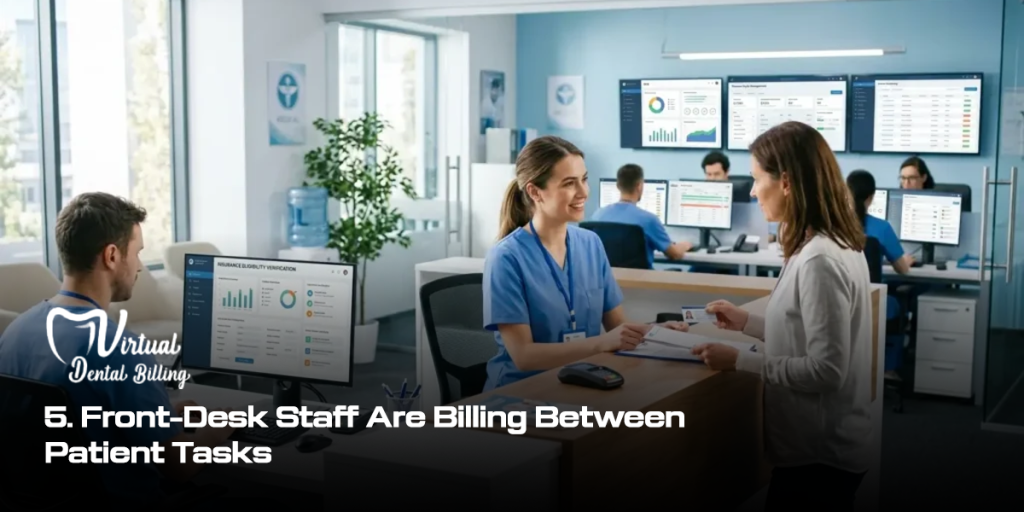
5. Front-Desk Staff Are Billing Between Patient Tasks
Front-desk teams often carry several responsibilities at once. Phones need answering, patients need to be checked in and out, benefits need verification, treatment questions come up, and payments still have to be posted.
Billing gets squeezed into the gaps between those tasks.
At first, that may seem manageable. Still, insurance follow-up needs focus. Payer calls can take time, claim notes need to be updated, missing documents have to be found, and older balances may require several steps before they move forward. When that work is interrupted throughout the day, small follow-up tasks are easy to leave unfinished.
Meanwhile, the unfinished work keeps returning. One claim needs another call. Another is waiting on an attachment. Someone else needs to check a patient balance before sending a statement. By the end of the week, the team may have touched dozens of accounts without fully resolving many of them.
That kind of constant task switching can also contribute to front-desk burnout, especially when billing responsibilities keep growing alongside patient-facing work.
Watch how billing fits into the day
These patterns can signal that the current setup is stretched too far:
- Insurance follow-up happens only between patients
- Payer calls are postponed during busy hours
- Older claims are reviewed only when the schedule is lighter
- Billing tasks are frequently started and then interrupted
- Front-desk employees regularly stay late to finish billing work
- Patient-facing responsibilities leave little protected time for follow-up
Once billing depends mainly on spare time, consistency becomes harder to maintain. Dedicated support can give follow-up its own place in the workflow, while the front-desk team keeps its attention on patients, scheduling, and daily office needs.
6. Practice Growth Is Outpacing Billing Capacity
Growth is usually a good sign for a dental practice. More patients, another provider, a second location, or expanded services can all increase production. The billing workload grows with it, though, and that increase is easy to underestimate.
More production usually means more claims, more eligibility checks, more payment posting, more patient balances, and more follow-up. If the billing team stays the same size, the extra volume has to fit into the same number of working hours.
At first, the pressure may show up only on busy weeks. Then claims start going out later, follow-up becomes less frequent, and older accounts take longer to review. Meanwhile, the team is still trying to keep up with the new work arriving every day.
This is where the dental billing outsourcing decision often becomes a capacity question. The practice may already have a solid billing process, but the current team may no longer have enough time to handle the volume consistently.
Growth can create pressure quickly when you:
- Add another dentist or hygienist
- Open a second location
- Increase patient volume
- Start offering new procedures or specialty services
- Join additional insurance networks
- Take on more claims without adding billing support
In some offices, hiring another in-house employee makes sense. In others, outsourcing part of the workload gives the practice more flexibility without adding another full-time billing position.
The key is to catch the gap early. If production keeps growing while claim follow-up, payment posting, and aging accounts keep falling behind, billing capacity may need to grow along with the practice.

7. No One Has a Clear View of What Is Still Unpaid
Billing can look busy without being easy to track. Claims are being submitted, payments are coming in, and follow-up is happening somewhere in the workflow. The problem starts when no one can quickly explain what is still unpaid, why it is unpaid, and who is responsible for the next step.
This usually becomes obvious during a simple question.
How much insurance AR is over 60 days? Which denial reasons are showing up most often? Which claims are waiting on payer responses? Who is following up on them?
If getting those answers requires several reports, multiple conversations, or digging through individual claim notes, visibility is already becoming a problem.
Meanwhile, older balances can sit longer because ownership is unclear. One employee may assume another person called the payer. Someone may leave a note without setting the next follow-up date. In other cases, the report exists, but nobody is reviewing it often enough to turn the numbers into action.
Billing reports should lead to a next step
Useful billing visibility should make it easy to see:
- How much AR is sitting in each aging bucket
- Which claims have had no recent follow-up
- Which denial reasons are repeating
- What is waiting on the payer, patient, or practice
- Who owns each unresolved account
- When the next action is due
Clear reporting also makes the question “is it time to outsource dental billing?” easier to answer. If the practice cannot consistently track unpaid claims or assign follow-up, outside support may help create clearer ownership and a more predictable workflow.
The numbers themselves are only useful when someone is responsible for acting on them. Once old claims begin moving between reports without a clear next step, the billing process needs closer attention.
Is It Time to Outsource Dental Billing? Use This Quick Checklist
By this point, the decision usually becomes clearer. One isolated issue may not mean the practice needs outside help, but several recurring problems happening at the same time are harder to ignore.
Use this checklist to look at the billing process as a whole:
- Are claim denials repeating for the same reasons?
- Is the AR backlog growing faster than the team can work it?
- Are billing errors creating regular rework?
- Does billing slow down when one employee is absent or leaves?
- Are front-desk employees fitting billing between patient-facing tasks?
- Has patient or claim volume increased without added billing capacity?
- Do older claims sometimes sit without a clear owner?
- Is it difficult to quickly explain AR aging, denial trends, or next follow-up steps?
- Are payer calls and insurance follow-up regularly pushed to another day?
- Is billing work spilling into overtime or adding to front-desk burnout?
If only one of these issues happens occasionally, improving the internal workflow may be enough. If several are happening every week, though, the practice may be dealing with a capacity or accountability problem rather than a temporary busy period.
That is where the dental billing outsourcing decision becomes more practical. Instead of asking whether outsourcing is generally better than keeping billing in-house, look at which part of the current process is consistently falling behind.
For one practice, that may be aging insurance claims. For another, it may be denial follow-up or payment posting. Some offices may need broader support across the full billing cycle.
The next step does not have to be all or nothing. In many cases, identifying the biggest bottleneck first makes it easier to decide what should stay in-house and what may be better handled by a dedicated billing team.