
Your dental practice is seeing more patients, but the paperwork keeps piling up. Insurance claims need attention, staff schedules are getting harder to manage, and financial reports are waiting for review. Meanwhile, your team is spending valuable time on administrative work instead of focusing entirely on patient care.
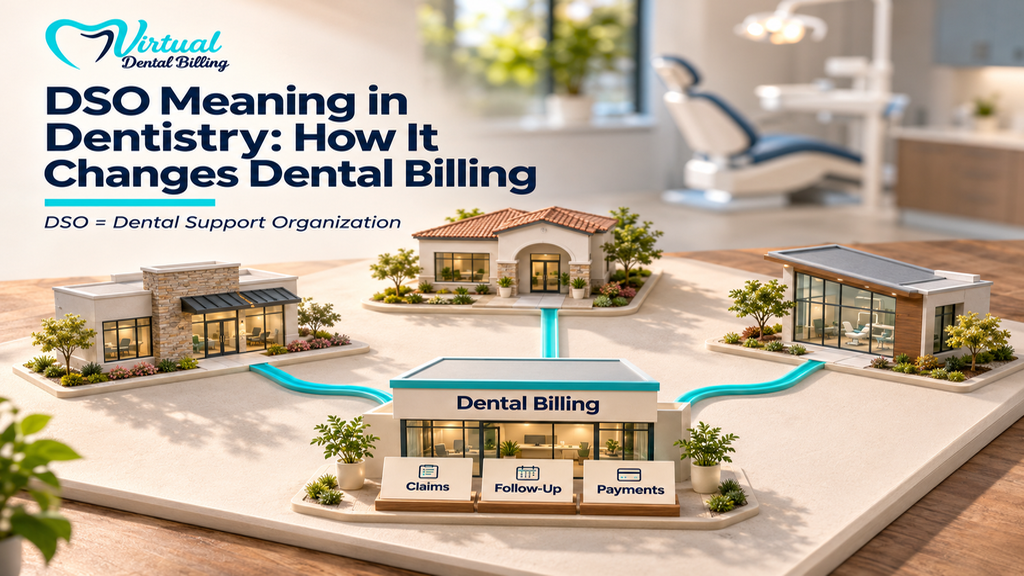
This is where understanding DSO meaning becomes important. In dentistry, DSO stands for Dental Support Organization, a company that helps dental practices manage nonclinical business operations, including insurance billing, staffing, and administrative support.
However, working with a DSO involves more than handing over paperwork. It can change how claims are processed, payments are tracked, and financial responsibilities are shared.
So, how does a DSO actually work, and what happens to your dental billing process when these responsibilities move beyond your office?
What Does DSO Mean for a Dental Practice?
When a dental practice works with a DSO, the biggest change is how its business responsibilities are managed. Instead of expecting the dentist and office staff to handle every administrative task, the practice can receive support from a separate management team.
However, this does not mean the DSO takes control of patient treatment. The DSO business model separates clinical care from nonclinical operations, allowing each team to focus on its responsibilities.
Who Makes the Clinical Decisions?
Licensed dentists remain responsible for clinical decisions, including diagnosing dental conditions, recommending treatment, and determining what care patients need.
For example, suppose a patient needs a dental implant. The dentist examines the patient, reviews the clinical findings, and decides whether the procedure is appropriate.
Meanwhile, the DSO’s administrative team may help coordinate insurance information, appointment-related tasks, and billing records.
The American Dental Association (ADA) explains that DSOs provide business support, while patient care remains under the supervision of licensed dentists.
This distinction matters because clinical independence must be protected, even when business operations are managed through an outside organization.
Which Business Responsibilities Can a DSO Handle?
While dentists focus on treatment, nonclinical dental support can cover several operational areas:
- Insurance administration: Coordinating eligibility checks, benefits information, and payer communication.
- Billing and collections: Supporting claim submission, payment posting, and outstanding balance follow-ups.
- Staff administration: Helping with payroll, recruitment, and other nonclinical staffing needs.
- Financial reporting: Organizing business records and monitoring practice-level performance.
- Purchasing and marketing: Coordinating supplies, vendors, and patient outreach activities.
However, not every DSO provides all these services. The responsibilities depend on the organization’s structure and its agreement with the dental practice.
For this reason, understanding what dental billing services should include can help practices distinguish core billing responsibilities from additional administrative support.
Consider the earlier implant example. Once treatment is completed and accurately documented, the billing team can prepare the insurance claim using the dentist’s clinical records. If the insurer requests additional information, the administrative team can coordinate the follow-up while the dentist remains responsible for clinical explanations.
The key difference is responsibility, not ownership. Working with a DSO does not automatically mean selling a dental practice. Some arrangements involve limited business support, while others create a closer management relationship.
Yet, separating responsibilities is only the beginning. How does a DSO actually connect these teams, manage daily operations, and keep information moving between the practice and its administrative staff?
How Does a Dental Support Organization Work?
Once a dental practice decides to work with a DSO, the next step is deciding how both organizations will operate together. The dentist cannot simply transfer administrative work and expect everything to run on its own.
Instead, both sides need a clear system that explains who manages each task, how information is shared, and who is responsible when something goes wrong.
How Does a DSO Management Agreement Work?
The relationship usually begins with a management services agreement (MSA), also called a business services agreement.
This contract outlines which services the DSO will provide, how the organization will be paid, and which responsibilities remain with the dental practice.
According to the American Dental Association’s guidance on DSO agreements, these contracts can involve important financial, employment, and operational responsibilities.
Before signing, dentists should understand:
- Service scope: Which tasks the DSO will manage and which remain with the practice.
- Management fees: How service charges are calculated and paid.
- Reporting access: What financial and operational information the practice can review.
- Contract termination: How either party can end the agreement and what obligations may remain.
Since agreements can affect business control and finances, the ADA recommends reviewing them with an experienced healthcare attorney.
How Do DSOs Manage Multiple Dental Locations?
Now imagine three dental offices operating in different cities. Each office has its own patients, appointments, and treatment records. However, managing separate administrative systems may make it harder to maintain consistent processes.
This is where centralized dental practice management can help.
Through a shared services model, a DSO may coordinate certain operations across its supported locations.
For example:
- Office teams: Record patient visits, collect treatment information, and communicate directly with patients.
- Central support teams: Coordinate assigned administrative requests using agreed procedures.
- Practice managers: Monitor outstanding work and resolve issues that require local attention.
- Group leadership: Review performance across locations while maintaining visibility into individual practices.
However, centralization does not always mean every office must use the same software or follow an identical workflow. The arrangement depends on the DSO’s systems, contracts, and the practices it supports.
How Does Information Move Between a Practice and Its DSO?
Consider a dental office that completes treatment but receives an insurance request for additional documentation.
Instead of leaving the request unanswered, the office and support team need a clear way to move it through the system.
The process may look like this:
- The dental office records the treatment and provides the required clinical information.
- The support team identifies the outstanding request and checks what documentation is missing.
- The dentist supplies or confirms clinical details when professional judgment is required.
- The assigned administrative team submits the response and records its status for follow-up.
This coordinated process helps both sides understand who owns the next action.
Still, having a shared system does not automatically guarantee accurate billing. When multiple offices use different documentation habits or reporting methods, errors can become harder to identify.
That leads to an important question: What actually changes in the dental billing process when a DSO manages administrative work across different practices?
What Happens to Dental Billing Under a DSO?
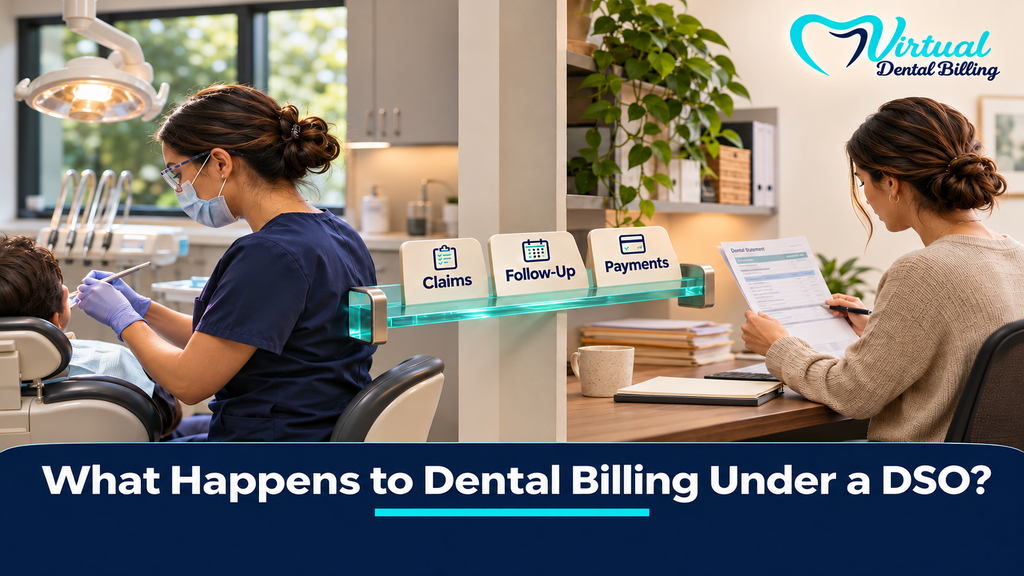
When several dental offices work under one support organization, tracking payments becomes more complicated. Each location treats different patients, deals with various insurance plans, and generates its own financial records. However, the DSO still needs a clear picture of how money moves across its supported practices.
This is where DSO dental billing differs from managing the accounts of a single dental office. Billing teams may use shared processes to handle insurance claims, track outstanding payments, and prepare financial reports while keeping each practice’s records separate.
How Are Insurance Claims Managed Across DSO Locations?
Consider three dental offices submitting insurance claims on the same day. One treats a patient who needs a crown, another performs periodontal treatment, and the third completes an implant procedure.
Although the treatments differ, every claim must contain accurate patient information, procedure codes, and supporting documentation.
With centralized dental billing, a DSO may establish consistent claim-review procedures across its locations.
These procedures can help teams:
- Check claim information: Confirm patient details, CDT codes, and payer information before submission.
- Review clinical attachments: Identify required X-rays, narratives, or treatment records.
- Monitor submission status: Track which claims were accepted, rejected, or returned for additional information.
- Maintain location records: Keep claims connected to the correct dentist, practice, and billing information.
According to the American Dental Association’s claim accuracy guidance, treating dentists remain responsible for the accuracy of claims submitted under their names, even when outside teams help prepare them.
For DSOs managing different payer requirements, structured dental insurance billing services can support claim preparation, submission tracking, and insurance follow-ups.
However, getting claims accepted is only one part of the process. The next challenge begins when insurance payments arrive.
How Do DSOs Track Payments and Collections?
Imagine the same insurance company sends payments for patients treated at several supported locations.
Without clear payment records, a billing team may struggle to determine which office should receive credit for each transaction.
This makes dental payment posting and reconciliation essential for reliable financial reporting.
Depending on its systems and agreements, a DSO may use the following controls:
- Payment matching: Connect insurance payments with the correct claims and patient accounts.
- EOB and ERA review: Compare allowed amounts, payer payments, adjustments, and patient responsibility.
- Deposit reconciliation: Match recorded insurance payments with actual bank deposits.
- Location-level reporting: Track production, adjustments, and collections separately for each supported practice.
The ADA’s explanation of benefits guidance explains why offices must carefully review payer payments and contractual adjustments.
Still, accurate posting does more than keep accounts organized. It helps DSO leadership understand whether payment problems are isolated to one location or appearing across several offices.
Why Does Revenue Cycle Management Matter for DSOs?
Suppose one dental office consistently receives payments on time, while another has a growing number of unpaid claims.
If leadership only reviews the group’s combined collections, the stronger office may hide the problems affecting the weaker one.
This is why DSO revenue cycle management needs both group-level visibility and practice-level accountability.
To identify problems early, billing managers can monitor:
- Accounts receivable aging: Which locations have the highest share of older unpaid balances?
- Denial patterns: Are similar claims being denied across several practices?
- Collection performance: Are payments keeping pace with adjusted production over time?
- Unresolved claims: Which payer requests are waiting for a documented next action?
These reports help managers determine where additional attention is needed instead of treating every office as though it faces the same problems.
For organizations reviewing their financial workflows, dental revenue cycle management services can provide support across claims tracking, payment posting, denial management, and receivables follow-up.
The real advantage of organized DSO billing is not simply having one team process more claims. It is being able to understand what happens to every payment, even when the organization supports multiple locations.
Yet, shared billing systems do not automatically make the DSO model better than independent practice management. Both approaches have advantages and responsibilities that dentists should understand before choosing how their business operates.
DSO vs. Independent Dental Practice: What’s Different?
Imagine two dentists running successful practices. Both treat patients, manage appointments, and receive insurance payments. However, one handles business decisions independently, while the other receives administrative support through a DSO.
Although both practices provide dental care, the way they manage business operations can be quite different.
The main difference between a DSO vs. private dental practice is how nonclinical responsibilities, business resources, and operational decisions are shared.
How Do Their Business Models Compare?
| Factor | Independent Dental Practice | DSO-Supported Practice |
| Business management | Owner manages or delegates operations | DSO supports agreed business functions |
| Administrative staffing | Practice hires or contracts its own team | May receive shared administrative support |
| Insurance billing | Managed internally or through a billing provider | May use a centralized or location-based team |
| Financial reporting | Primarily focused on individual practice performance | May include both location-level and group-level reports |
| Operating expenses | Practice pays its own staffing and management costs | Management fees and other costs depend on the agreement |
| Technology decisions | Owner generally selects practice systems | Some technology choices may be coordinated with the DSO |
| Clinical decisions | Licensed dentists control patient treatment | Licensed dentists retain clinical responsibility |
These are common business arrangements. Actual responsibilities depend on contracts, ownership structures, and state regulations.
Does Joining a DSO Mean Losing Practice Ownership?
Not necessarily. Dental practice ownership and DSO affiliation are not the same thing.
Some dentists continue owning their practices while purchasing administrative support through a management agreement. Others may enter employment, partnership, or ownership arrangements with different financial terms.
According to the American Dental Association’s guide to practice models, DSO-supported arrangements can offer different ownership paths and levels of business involvement.
Therefore, dentists should review their agreements carefully before assuming which decisions they will retain.
Why Does Financial Transparency Matter?
Now consider the dentist receiving centralized administrative support. Their billing team may handle claims across several locations, but the practice owner still needs to understand how their own office is performing.
This makes dental practice financial transparency especially important.
Before entering a DSO arrangement, dentists should clarify:
- Reporting access: Can they review their practice’s production, adjustments, and actual collections?
- Management expenses: How are administrative fees calculated and recorded?
- Financial responsibilities: Who investigates payment discrepancies and approves adjustments?
- Decision-making rights: Which financial and operational choices remain under their control?
The ADA also recommends reviewing DSO business service agreements with an experienced healthcare attorney because contract terms can create significant financial and operational obligations.
The key takeaway: Neither practice model automatically guarantees better billing results. What matters is whether the dentist understands the business arrangement, receives reliable financial information, and knows who is accountable for each responsibility.
However, these differences raise another question. Beyond administration and ownership, what practical benefits and limitations should dentists consider before joining a DSO?
What Are the Benefits and Limitations of a DSO?
Choosing a DSO-supported practice may create new opportunities for dentists, but it can also change how they experience their daily work.
For example, imagine a dentist who wants to introduce advanced dental technology but struggles with equipment costs and staff training. Joining a larger support network might make those resources easier to access. However, the dentist may also need to follow certain organizational policies.
This is why understanding the DSO advantages and disadvantages matters before making a long-term commitment.
What Benefits Can Dentists Expect From a DSO?
The main attraction of a DSO is access to resources that an individual practice might find difficult to arrange independently.
According to the American Dental Association’s DSO guidance, potential benefits include:
- Access to advanced technology: Larger support networks may provide equipment, software, and clinical tools that require significant investment.
- Professional development: Some organizations offer mentorship, continuing education, and leadership opportunities for dentists.
- Shared business resources: Group purchasing and established vendor relationships may help practices manage certain operating expenses.
- Career flexibility: Depending on the organization, dentists may have opportunities to work at different locations or pursue alternative career paths.
However, these benefits vary between organizations. Access to shared resources does not automatically guarantee lower costs or better financial performance.
What Challenges Should Dentists Consider?
While shared support can make certain tasks easier, working within a larger organization may also introduce restrictions.
Common DSO limitations include:
- Standardized business policies: Dentists may have less flexibility when choosing vendors, office systems, or administrative procedures.
- Insurance network arrangements: Some organizations operate under previously negotiated payer agreements that may not match every dentist’s preferences.
- Work schedule restrictions: Employment contracts may define working hours, vacation arrangements, and location assignments.
- Transition challenges: Moving to shared systems may require staff training, workflow adjustments, and coordination between offices.
For instance, a dentist accustomed to choosing their own scheduling software may need to adopt the system used across the supported group.
Although standardization can make administration easier, it may also require changes to familiar working methods.
How Can Dentists Evaluate These Trade-Offs?
Before making a decision, dentists should look beyond the list of promised benefits.
Consider three practical questions:
- Resources: Will the organization provide tools and training that address the practice’s actual needs?
- Flexibility: Which working arrangements and operational choices can the dentist negotiate?
- Accountability: How will the organization evaluate service quality and resolve problems?
Ultimately, DSO support is most valuable when the services provided match the needs of the dental practice.
Yet, even a well-structured organization can struggle when administrative processes become inconsistent across different locations.
This raises another important question: How can DSOs maintain billing accuracy as their network of supported practices grows?
How Can DSOs Maintain Billing Accuracy Across Locations?
Managing billing for one dental office is challenging enough. Across multiple locations, even a small documentation mistake can become a recurring problem when different teams follow the same incorrect procedure.
For this reason, maintaining DSO billing accuracy requires more than standardized software. Each location needs clear quality checks, shared reporting standards, and a process for correcting errors before they become routine.
Identify Repeated Billing Errors Across Locations
Consider a DSO supporting five dental practices. During a monthly review, the billing manager notices that three offices have received similar insurance denials for crown procedures.
Instead of treating these as separate problems, the manager compares the records and discovers that the same type of clinical documentation is missing.
This is where multi-location dental billing audits become useful.
Regular reviews should help identify:
- Recurring documentation gaps: Similar clinical details missing from claims at different offices.
- Payer-specific errors: Repeated problems involving the same insurance company or procedure.
- Location-specific patterns: Mistakes affecting one practice more frequently than others.
- Unresolved corrections: Previously identified issues that continue appearing in new records.
The American Dental Association’s patient documentation guidance recommends regular record audits to check documentation accuracy and identify opportunities for improvement.
Build Accountability Into the Billing Process
Finding a repeated error is useful, but correcting it requires coordination between clinical and administrative teams.
For example, if several claims lack supporting treatment narratives, the DSO can review its documentation instructions with the treating dentists.
Rather than allowing administrative staff to change clinical information themselves, dental billing quality control should follow a clear process:
- Record the issue: Identify the affected location, payer, procedure, and missing information.
- Assign responsibility: Determine whether the dentist, billing specialist, or office manager needs to act.
- Correct the process: Update instructions or documentation templates after appropriate clinical review.
- Verify the improvement: Check subsequent claims to see whether the same issue continues.
For a deeper look at recurring problems, practices can review these common dental RCM challenges for DSOs, including documentation gaps, denial patterns, and payment-processing issues.
Keep Reporting Consistent Without Ignoring Local Differences
While shared procedures help create consistency, every dental location may have different payer contracts, treatment patterns, and staffing arrangements.
Therefore, DSO billing compliance should combine organization-wide standards with reviews of individual practice requirements.
For instance, a billing manager might use the same error-tracking format across all locations while maintaining separate payer instructions for each office.
Periodic staff training and documented updates can help teams follow approved procedures. At the same time, access to patient information should remain limited according to applicable privacy requirements.
The goal is not to make every practice operate identically. It is to ensure that billing errors are identified, investigated, and corrected through a dependable process.
Strong billing oversight gives DSO leadership something more valuable than a clean-looking financial report: confidence that each location’s records are accurate, traceable, and regularly reviewed.
Is a DSO the Right Model for Your Dental Practice?
Joining a DSO may seem attractive when running a dental practice starts taking more time than treating patients. Still, the decision should depend on what your practice actually needs, not simply on the size or reputation of a support organization.
The right DSO business model should address specific operational problems while giving dentists a clear understanding of the services they will receive.
Start With the Problems Your Practice Needs to Solve
Consider a dentist whose practice is growing steadily. Patient appointments are increasing, but the office manager is struggling to keep up with insurance-related work.
In this situation, the practice may not need a complete management arrangement. Dedicated billing support might solve the immediate problem without changing the entire business structure.
Before exploring DSO affiliation, dentists should identify their priorities:
- Administrative workload: Which tasks consistently take time away from patient care?
- Business growth: Does the practice need support for expansion or additional locations?
- Operational expertise: Are there areas where the existing team lacks specialized knowledge?
- Long-term goals: Does the dentist want to remain independent, pursue ownership opportunities, or reduce business responsibilities?
These answers help determine whether comprehensive DSO support, selected outsourced services, or an improved internal team would be more appropriate.
Evaluate the Support Before Making a Commitment
Once the practice identifies its priorities, the next step is evaluating what a potential DSO can realistically deliver.
According to the American Dental Association’s guidance on DSO business agreements, dentists should carefully examine financial obligations, contractual responsibilities, and operational control with an experienced healthcare attorney.
Beyond reviewing the agreement, practices should establish measurable expectations.
| Evaluation area | What to establish |
| Service delivery | Which activities will the DSO complete, and by when? |
| Financial visibility | Which practice-level reports will be available? |
| Performance review | How will service quality be measured? |
| Problem resolution | Who handles unresolved issues and escalations? |
| Transition planning | How will records, systems, and services be managed if the relationship ends? |
For example, a practice seeking better billing support could ask for regular reports showing claim-processing performance and unresolved account trends.
These expectations should be documented before services begin, making it easier to evaluate whether the arrangement meets the practice’s needs.
Consider the Long-Term Fit
Business needs can change as a dental practice grows. What works for a single location today may not support the same practice after expansion.
Therefore, dentists should consider whether the arrangement can adapt to changing workloads without creating unnecessary restrictions.
The best choice is the one that addresses the practice’s actual problems while preserving clear responsibilities, financial visibility, and appropriate clinical independence.
Whether a dentist chooses DSO support or remains independent, reliable administrative processes remain essential to maintaining a well-managed practice.