


Your dental practice is busier than ever. More patients are booking appointments, treatment numbers are rising, and your monthly production reports look promising. Yet, when you check your bank account, the money coming in has barely changed. So, where is all that revenue going?
This gap between dental production vs collections is a common concern for practice owners. While completed treatments increase production, delayed insurance claims, unpaid patient balances, and overlooked payment adjustments can keep collections from growing at the same pace.
However, higher production does not always mean more collectible revenue. The real challenge is understanding how much your practice should collect, what has actually been paid, and where payments are getting stuck.
So, before adding more appointments to your schedule, shouldn’t you find out what’s holding back your dental practice cash flow?
Why Doesn’t Higher Dental Production Mean More Cash?
More completed treatments may look like business growth, but they do not always lead to higher collections. The reason is simple: the amount your dental practice produces is not necessarily the amount it can collect.
To understand this difference, dentists need to look beyond their daily production reports and compare three important financial figures.
Gross Production vs. Adjusted Production vs. Collections
According to the American Dental Association (ADA), these figures measure different stages of a dental practice’s revenue:
- Gross dental production: The total value of completed treatments based on your practice’s regular fees.
- Adjusted production in dentistry: The amount your practice can reasonably collect after applicable discounts and contractual adjustments.
- Actual collections: The money your practice receives from insurance companies and patients.
For example, imagine your practice completes a dental crown procedure with a regular fee of $1,000.
Here’s how the numbers might look:
| Financial Stage | Amount |
| Gross production | $1,000 |
| Contractual insurance adjustment | -$200 |
| Adjusted production | $800 |
| Payment received so far | $600 |
| Remaining collectible balance | $200 |
<text>In this example, the $200 contractual adjustment is not unpaid revenue. However, the remaining $200 balance still needs to be collected, provided it is valid and collectible.</text>
This distinction matters because a growing production report can create a false sense of financial progress.
The real warning sign appears when adjusted production keeps increasing, but the money received does not follow.
Still, that difference does not always mean revenue has been lost. Some payments may simply be delayed, while others may require closer investigation.
So, where exactly does earned dental revenue get stuck before reaching your bank account?
Where Does Your Earned Revenue Get Stuck?
Your patients have received treatment, procedures are recorded, and production numbers continue to rise. Yet, the expected payments are not showing up in your bank account.
So, what’s happening between completing treatment and receiving payment?
In many practices, dental billing revenue leakage can occur at different stages of the payment process. However, not every outstanding balance represents lost income. Some payments are delayed, while others may be reduced by insurance agreements or affected by billing errors.
Let’s look at four areas worth investigating.
1. Insurance Claims Are Aging Without Follow-Up
Submitting a dental claim is only the beginning. If an insurance company requests additional documentation, rejects a claim, or delays processing, payment may remain pending until someone takes action.
For example, a $1,500 crown claim might remain unpaid because the insurer needs supporting clinical records. Unless the billing team checks its status, the balance could continue aging without resolution.
To identify these delays, practices should monitor dental accounts receivable aging and review:
- Unpaid claims: Identify balances that remain unresolved beyond expected processing times.
- Claim status: Check whether claims are pending, rejected, denied, or awaiting information.
- Follow-up history: Confirm when the insurer was last contacted and what action is required.
Through consistent dental A/R recovery services, practices can organize aging balances and follow up on unresolved insurance claims.
2. PPO Adjustments Reduce Collectible Revenue
Not every difference between treatment fees and insurance payments is a billing mistake.
When a practice participates in a preferred provider organization (PPO), its contracted fee may be lower than its regular treatment charge. That difference often becomes a legitimate contractual adjustment.
However, problems arise when dental insurance underpayments are mistaken for normal dental insurance write-offs.
For instance, if an insurer pays less than the applicable contracted amount, the practice should review the explanation of benefits (EOB) before adjusting the remaining balance.
According to the American Dental Association’s EOB guidance, dental offices should verify allowed fees, insurance payments, patient responsibility, and adjustments before finalizing accounts.
Regular reviews of payer agreements and PPO negotiation services can also help practices evaluate whether their contracted reimbursement rates remain suitable.
3. Patient Balances Remain Uncollected
Insurance payments are only one part of the collection process. Patients may still owe deductibles, coinsurance, or amounts for services their plans do not cover.
However, when patients receive unclear estimates or delayed statements, they may not understand what they owe.
This can lead to:
- Unpaid patient balances: Remaining amounts are not addressed promptly.
- Delayed statements: Patients receive bills long after treatment.
- Missed follow-ups: Outstanding accounts remain open without clear next steps.
For this reason, consistent communication matters. With structured dental patient billing services, practices can manage statements, payment tracking, and patient follow-ups while keeping communication professional.
4. Payments Are Received but Not Reconciled
Sometimes, the money has reached the practice’s bank account, but the financial reports still do not reflect the correct amount.
This may happen when an electronic insurance deposit is not matched to the appropriate claim or patient account.
Without proper dental payment reconciliation, practices may struggle to distinguish actual unpaid revenue from posting errors.
To prevent confusion, billing teams should:
- Match deposits: Compare electronic funds transfers (EFTs) with remittance details.
- Verify payment posting: Confirm that each payment reaches the correct account.
- Investigate discrepancies: Review unmatched deposits, duplicate entries, and incorrect adjustments.
Professional EFT reconciliation services can help practices maintain accurate payment records and identify posting differences.
Ultimately, higher production means little if practice owners cannot explain what happened to the money afterward.
However, identifying these problems is only the first step. The next challenge is knowing which financial numbers reveal whether collections are actually falling behind.
Which Numbers Reveal the Real Collection Problem?
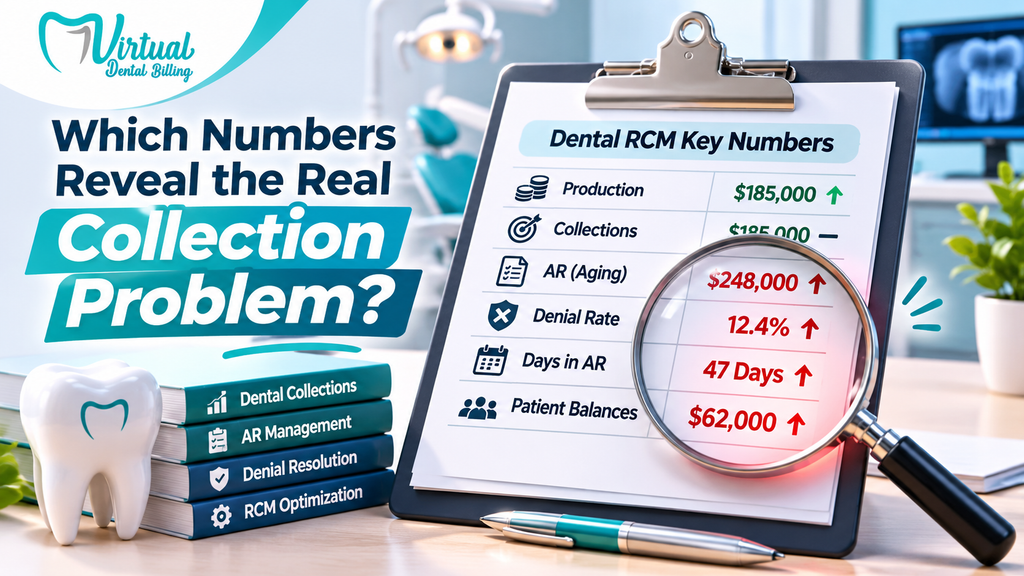
Your production report shows how much dentistry your team completed. However, it doesn’t tell you how much money actually reached your practice.
To find the difference, you need to look at a few key numbers together. These dental practice financial KPIs can reveal whether payments are delayed, adjustments are increasing, or unpaid balances are piling up.
1. Calculate Your Dental Practice Collection Rate
Your dental practice collection rate measures how much money your office collects compared with its adjusted production.
The formula is simple:
Collection Rate = (Total Collections ÷ Adjusted Production) × 100
According to the American Dental Association’s practice KPI guidance, collecting at least 98% of adjusted production is a useful benchmark for dental practices.
However, one month’s percentage doesn’t tell the whole story. Payments received today may belong to treatments completed several weeks earlier.
2. Compare Production Growth With Actual Payments
Imagine a dental practice reviewing its financial performance over two months.
The owner notices that more treatments have been completed. Yet, the bank deposits tell a different story.
| Financial Metric | Month 1 | Month 2 |
| Gross production | $100,000 | $125,000 |
| Adjusted production | $90,000 | $105,000 |
| Total collections | $86,000 | $86,000 |
| Collection rate | 95.6% | 81.9% |
Illustrative example, not actual practice data.
Here, gross production increased by 25%, but collections remained unchanged.
Meanwhile, the calculated monthly collection rate dropped from 95.6% to 81.9%.
Does this mean the practice lost $19,000 in Month 2?
Not necessarily. Some payments may still be processing, while others may relate to earlier treatments. The numbers reveal a gap worth investigating, not a confirmed loss.
3. Check How Long Payments Remain Outstanding
Once you notice a growing gap, the next step is reviewing your dental A/R aging report.
Instead of looking only at the total outstanding balance, divide unpaid accounts into aging groups:
- 0–30 days: Recent balances that may still be moving through normal payment processing.
- 31–60 days: Accounts that may need claim-status checks or patient reminders.
- 61–90 days: Older balances requiring closer investigation and documented follow-up.
- Over 90 days: Long-standing accounts that deserve priority review to determine whether they remain collectible.
Still, aging alone doesn’t explain the problem. Separate insurance balances from patient balances and check whether the amount is valid, disputed, or waiting for additional documentation.
4. Review Trends Before Making Financial Decisions
Finally, compare at least three months of financial data rather than relying on one report.
Look for these warning signs:
- Rising adjusted production: More collectible treatment value is being generated.
- Flat deposits: Cash receipts are not keeping pace with recent growth.
- Growing older receivables: Unresolved balances are staying open longer.
- Increasing adjustments: More revenue is being reduced through discounts or write-offs.
For a clearer picture, compare rolling collection trends and, where possible, track payments back to the treatment dates that generated them.
Once these numbers identify the problem, the next goal becomes clear: improve dental collections without relying on more appointments or a busier schedule.
How Can You Improve Dental Collections Without More Appointments?
Your dental practice may already have enough patients to generate healthy revenue. However, if payments are delayed or missed, filling more appointment slots will not solve the underlying problem.
The better approach to improve dental collections is to make sure every treatment moves through a clear payment process, from the first insurance check to the final deposit.
Here’s where your team can start.
1. Verify Insurance Before Treatment Begins
Imagine a patient scheduled for a crown on Friday. Before the appointment, your front desk should know whether the patient’s policy is active, what benefits may apply, and how much the patient might owe.
Without these details, even a successful treatment can lead to payment confusion.
To strengthen dental insurance verification, your team should:
- Confirm eligibility: Check whether coverage applies on the treatment date.
- Review benefits: Identify deductibles, annual limits, and procedure restrictions.
- Explain estimated costs: Help patients understand their expected financial responsibility.
Still, insurance estimates are not payment guarantees. The American Dental Association’s eligibility guidance recommends confirming coverage for the date of service.
For practices handling frequent insurance changes, Virtual Dental Billing’s insurance verification services can support these checks before appointments.
2. Make Every Claim Ready for Submission
Once treatment is completed, the next priority is preparing a claim that accurately reflects the care provided.
Before submission, check:
- Procedure codes: Match the CDT codes to the treatment documented by the dentist.
- Clinical evidence: Include required X-rays, narratives, or other supporting records.
- Patient details: Confirm subscriber information and relevant billing information.
Most importantly, assign someone to review incomplete claims rather than allowing them to remain in an unfinished queue.
3. Give Every Unpaid Balance a Next Action
Sending a claim or patient statement should never be the final step.
Instead, build a dental collections workflow where every unresolved balance has a clear owner and follow-up date.
For example:
- Pending claim: Check its status and record the payer’s response.
- Denied claim: Identify the reason and prepare a correction or appeal when appropriate.
- Patient balance: Send a clear statement and follow up respectfully when payment is overdue.
This helps your billing team work toward resolution instead of repeatedly reviewing the same accounts without progress.
4. Review Collection Performance Every Week
Finally, bring your office manager and billing team together for a short weekly review.
Focus on three questions:
- Which unpaid balances need immediate attention?
- Which payment issues keep appearing?
- Who is responsible for resolving each problem?
Track whether those actions lead to payments, corrected records, or properly resolved balances.
The goal isn’t to make your team chase more money. It’s to prevent collectible revenue from getting stuck because nobody knows what should happen next.
When these processes work together, your practice has a clearer path from completed treatment to received payment.
But how can you tell whether the billing problems are isolated mistakes or signs of a larger issue that needs professional review?
When Should You Review Your Dental Billing Process?
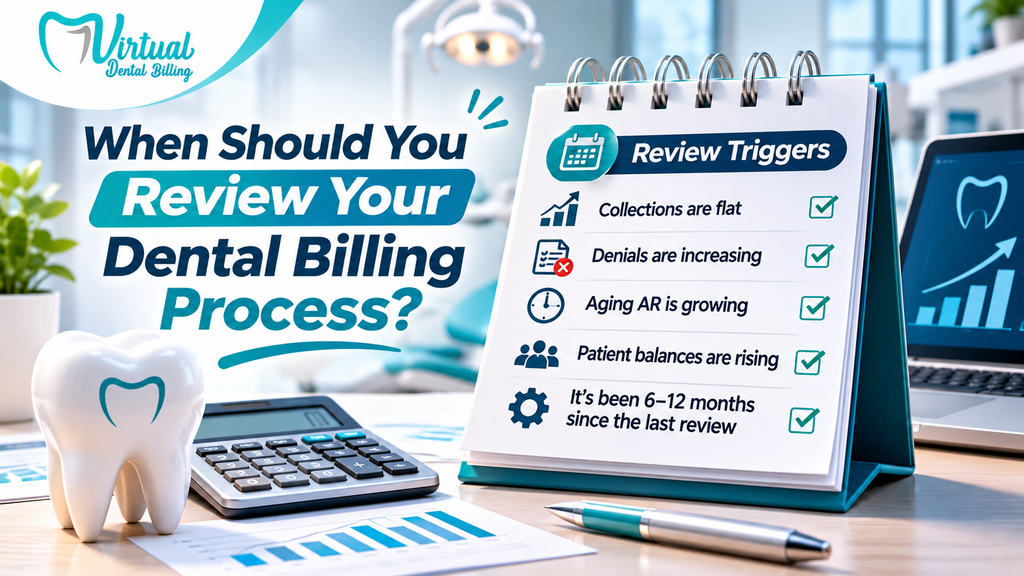
Sometimes, the biggest warning sign isn’t a drop in revenue. It’s seeing the same payment problem month after month without understanding why it keeps happening.
For example, imagine your office manager notices that several crown claims are repeatedly denied for missing documentation. Your team corrects each claim, but the same issue returns the following week. At this point, the problem may be bigger than an individual claim.
This is when a dental billing audit becomes useful. Instead of fixing errors one at a time, it helps uncover the underlying issues affecting your practice’s financial performance.
Signs Your Dental Billing Process Needs Attention
Watch for these warning signs:
- Recurring claim denials: Similar billing errors keep appearing despite previous corrections.
- Older receivables keep growing: Outstanding balances remain unresolved, especially those over 90 days.
- Unexplained adjustments: Write-offs or payment differences appear without clear supporting records.
- Missing accountability: Staff cannot easily explain who is responsible for resolving an outstanding claim.
According to the American Dental Association’s financial guidance, receivables exceeding two months of production or high balances over 90 days old can indicate collection-system problems.
What Should a Dental Revenue Cycle Audit Reveal?
Rather than reviewing every account without direction, start with a sample of recent paid, denied, and outstanding claims.
Then, investigate three questions:
- Where does the process break down? Identify whether problems begin during documentation, claim submission, or payment posting.
- Why do errors keep returning? Look for recurring causes, such as incorrect information or unclear responsibilities.
- What needs to change? Assign corrective actions, responsible team members, and dates for follow-up.
Most importantly, compare the results after making changes. Otherwise, the same issues may continue without anyone noticing.
When Does Outside Billing Support Make Sense?
If your team spends more time investigating old claims than managing current payments, additional support may be worth considering.
For example, Virtual Dental Billing offers dental revenue cycle management support, including billing-process reviews, claim follow-ups, and receivables management.
However, outsourcing should not mean losing visibility into your finances. Practice owners still need clear reports, defined responsibilities, and access to accurate payment information.
Ultimately, the purpose of reviewing your billing process isn’t just to find mistakes. It’s to understand what prevents completed treatments from turning into collected revenue, so your practice can grow without leaving its financial performance behind.
Frequently Asked Questions
1. Why Are My Dental Collections Lower Than Production?
Dental collections may remain lower than production because of contractual insurance adjustments, unpaid claims, outstanding patient balances, or delayed payments. However, not every difference represents lost revenue. Compare adjusted production with actual payments and review outstanding balances to identify the cause.
2. What Is a Good Collection Rate for a Dental Practice?
The American Dental Association identifies 98% of adjusted production as a useful collection benchmark. However, your monthly percentage may fluctuate because insurance and patient payments do not always arrive in the month treatment is completed. Reviewing several months provides a clearer picture.
3. How Can I Tell Whether Insurance or Patient Balances Are Causing the Problem?
Start by separating your insurance accounts receivable from patient balances. Then, review aging reports, claim statuses, and payment histories. If insurance balances keep growing, investigate payer delays. Meanwhile, rising patient balances may indicate problems with estimates, statements, or payment follow-ups.
4. Can Dental Practices Recover Money Lost Through PPO Write-Offs?
Legitimate PPO contractual adjustments generally cannot be recovered when the practice has agreed to those fees. However, incorrect adjustments or insurance underpayments may require further investigation. Compare the explanation of benefits with the applicable payer contract before accepting or disputing a payment difference.
5. Why Does My Bank Balance Stay Flat Even When Payments Are Posted?
Payments recorded in dental software do not always match bank deposits immediately. Processing delays, unmatched EFT deposits, incorrect posting, or reporting-date differences can create discrepancies. Regular dental EFT reconciliation helps practices determine whether payments were received, deposited, and recorded correctly.
6. When Should a Dental Practice Consider Outsourcing Billing?
Outsourcing dental billing may be worth considering when repeated denials, growing receivables, or limited staff capacity prevent timely follow-up. Before choosing a provider, review its reporting methods, service scope, data security practices, and accountability. The goal is better financial visibility, not simply transferring work elsewhere.
Conclusion: More Production Should Lead to Better Financial Visibility
Your dental practice may be treating more patients and completing more procedures, but higher production means little if collections fail to keep pace.
Before expanding your schedule, examine what happens after treatment. Are claims being resolved? Are payments correctly posted? Can your team explain outstanding balances?
Often, improving financial performance begins with understanding these gaps rather than generating more appointments.
With consistent reporting, timely follow-ups, and reliable billing processes, your practice can make better decisions about the revenue it has already earned.
For practices struggling to manage these responsibilities, Virtual Dental Billing offers professional support across insurance billing, receivables management, and payment reconciliation.
Because sustainable practice growth depends on more than the dentistry you produce. It also depends on understanding what you can collect and ensuring that payments are properly managed.