
Your dental team completes a patient’s X-rays, submits the insurance claim, and expects payment. Instead, the insurer flags the claim because similar radiographs were billed recently. The images were needed for patient care, so why is reimbursement being questioned?
The confusion often begins with the FMX dental code (D0210) and how it differs from D0274 and D0277 bitewing codes. Although these codes describe different types of dental X-rays, insurance companies may apply separate frequency limits, coverage restrictions, or reimbursement rules.
For dental practices, understanding these differences is essential. Choosing the correct dental X-ray billing codes helps ensure claims reflect the services performed, while checking insurance benefits can prevent unexpected payment issues.
Knowing which code applies and how insurers process it can make a meaningful difference in billing accuracy and patient cost estimates.
What Does FMX Dental Code D0210 Cover?
The D0210 dental code represents a comprehensive series of intraoral radiographic images used to examine the teeth and surrounding supporting structures. Unlike a single bitewing or periapical X-ray, an FMX dental X-ray series provides a broader view of the patient’s oral condition.
According to the American Dental Association (ADA), a comprehensive series is intended to show:
- Tooth crowns and roots: Structures needed to assess dental conditions.
- Periapical areas: The tissues surrounding the tips of tooth roots.
- Interproximal areas: Spaces between teeth where decay may develop.
- Alveolar bone: The bone supporting the teeth.
However, the number of images needed depends on the patient’s clinical condition.
Does D0210 Always Require 18 or 20 X-Rays?
No. D0210 does not require a fixed number of radiographic images.
Although traditional full-mouth series often contain 14–22 images, the ADA revised the code description to remove a specific image-count requirement.
For example, a patient with several missing teeth may need fewer images than someone with a complete set of natural teeth. What matters is whether the captured images provide the comprehensive coverage required by the code.
Therefore, taking 18 images does not automatically qualify a procedure as D0210, just as taking fewer images does not automatically disqualify it.
What Should Dental Teams Document?
Before reporting CDT code D0210, the practice should confirm:
- Clinical necessity: Why the comprehensive examination was needed.
- Image coverage: Whether the series adequately shows the required oral structures.
- Patient history: Whether previous diagnostic images were available and sufficient.
- Accurate records: Whether the radiographs and clinical documentation support the reported procedure.
The dentist determines which radiographs are clinically necessary based on the patient’s needs.
The key distinction is that D0210 describes a comprehensive imaging procedure, not a predetermined number of X-rays. This becomes important when comparing it with bitewing codes, which describe specific image types and quantities.
D0210 vs D0274 vs D0277: What’s the Difference?
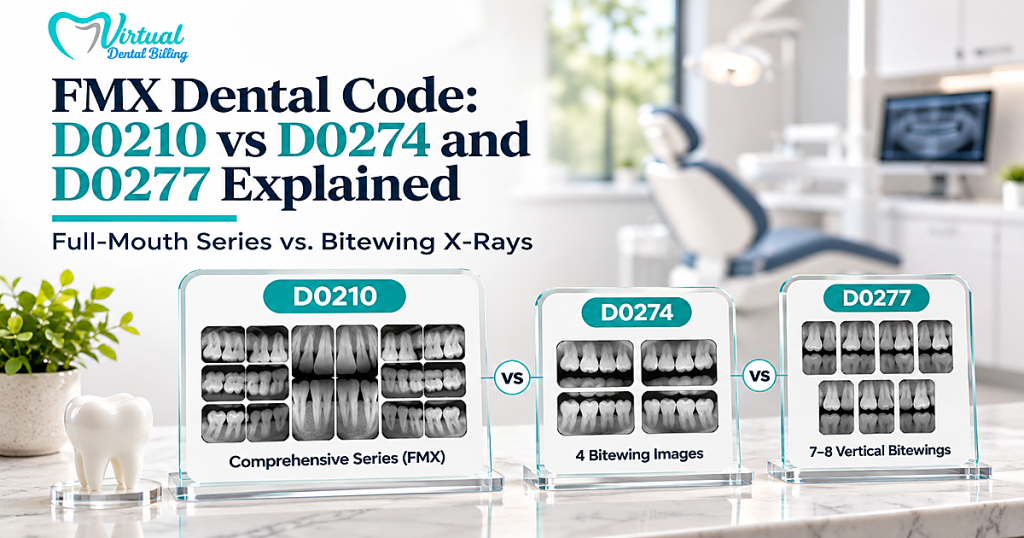
The main difference between D0210, D0274, and D0277 lies in the type and extent of radiographic imaging performed. While D0210 provides a comprehensive survey, the other two codes describe specific bitewing image sets.
Understanding these bitewing X-ray codes helps dental teams report the procedure accurately without confusing a limited examination with a full-mouth series.
D0210 vs D0274 vs D0277 Comparison
| Feature | D0210 | D0274 | D0277 |
| Imaging type | Comprehensive intraoral series | Four bitewing images | Vertical bitewing series |
| Image count | No fixed number | 4 images | 7–8 images |
| Main coverage | Teeth, roots, surrounding bone, and interproximal areas | Mainly crowns and spaces between teeth | Interproximal areas with greater vertical bone coverage |
| Full-mouth series? | Yes | No | No |
| Common billing concern | FMX benefit limits | Bitewing frequency restrictions | Vertical bitewing coverage and payer reimbursement rules |
According to Aetna’s dental radiographic coding policy, D0274 identifies four bitewing images, while the D0277 dental code specifically identifies seven to eight vertical bitewings.
Why Does the Difference Matter for Billing?
Consider a patient who needs four bitewing images to check for decay between posterior teeth. Even if the dentist captures those images vertically, the four-image set is generally reported using D0274, not D0277.
In contrast, when seven or eight vertical bitewings are clinically necessary, D0277 describes that specific imaging service.
The distinction also matters for insurance reimbursement. Some dental plans apply different benefit limits to comprehensive series and bitewing examinations, while others restrict payment when certain images are taken close together.
The American Dental Association’s guidance on bundling and downcoding explains that insurers may apply reimbursement rules when multiple radiographs are taken on the same date.
Key takeaway: The correct CDT code should reflect the imaging actually performed, while reimbursement depends on the patient’s specific insurance benefits. Clinical documentation and payer coverage rules both matter, but they serve different purposes.
How Often Does Insurance Cover FMX and Bitewings?
Imagine a patient returning for a routine dental examination. The dentist recommends new bitewing X-rays, but the insurance company shows that similar images were covered earlier in the year.
The issue may not be the dental X-ray code itself. Instead, the patient’s plan may have already reached its imaging benefit limit.
While dentists determine when radiographs are clinically needed, insurers apply their own dental X-ray frequency limits to decide when benefits are payable.
How Often Is D0210 Covered by Dental Insurance?
FMX insurance coverage varies by plan. Some insurers cover a comprehensive series every four years, while others apply a five-year waiting period between covered examinations.
For example, published federal dental plan documents show the following differences:
| Insurance plan | D0210 FMX | D0274 Bitewings | D0277 Vertical Bitewings |
| MetLife Federal Dental, 2027 | Once every 60 months | Adults: one set per calendar year | Adults: one set per calendar year |
| Delta Dental Federal, 2026 | Once every 48 months | One per calendar year | One per calendar year |
These are examples from specific plan-year documents, not universal rules for all MetLife or Delta Dental policies.
The MetLife 2027 Federal Dental Plan brochure also specifies that covered children may receive bitewing benefits every six months.
Meanwhile, Delta Dental’s 2026 federal plan combines different bitewing sets under one annual limitation. This means switching from D0274 to D0277 does not automatically create another available benefit.
Why Should Dental Teams Check Previous X-Ray Dates?
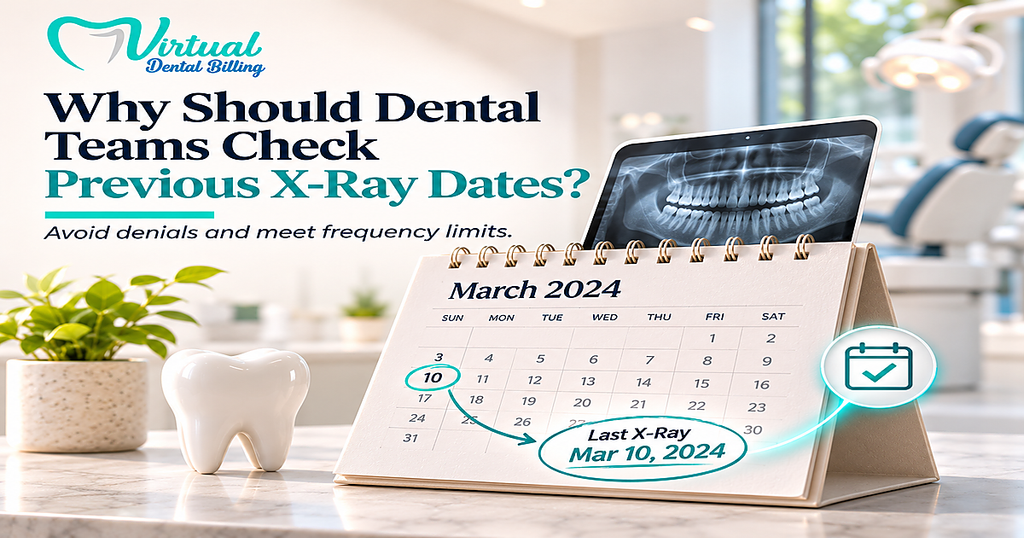
Consider a patient who received an FMX two years ago at another practice. Their new dentist may need additional images because of changes in oral health.
Even when the images are clinically necessary, the patient’s insurance may not pay for another comprehensive series so soon.
For this reason, dental insurance frequency verification should include:
- Previous imaging dates: Check when the last FMX, panoramic image, or bitewing series was completed.
- Remaining benefits: Confirm whether the specific CDT code is eligible for reimbursement.
- Combined limitations: Determine whether different radiographic procedures share the same frequency allowance.
- Patient responsibility: Explain possible out-of-pocket costs before imaging when practical.
Following a detailed insurance verification checklist can help dental teams catch these limitations before submitting claims.
For practices managing multiple insurance plans, dental insurance verification services can also support treatment-specific benefit checks and payer communication.
Does Insurance Frequency Determine When X-Rays Are Needed?
No. Clinical necessity and insurance coverage are separate decisions.
The American Dental Association’s 2026 radiography recommendations emphasize evaluating each patient’s dental history, examination findings, disease risk, and available previous images before prescribing new radiographs.
Therefore, an insurance frequency limit should not determine whether a patient clinically needs an X-ray.
The important distinction: Dentists decide which images are needed for patient care, while insurance contracts determine which imaging benefits may be payable. Clear documentation and benefit verification help practices manage both responsibilities accurately.
Can FMX and Bitewings Be Billed Together?
Taking different dental X-rays during the same appointment does not always mean each image qualifies for separate billing.
The FMX dental code D0210 describes a comprehensive intraoral series that includes bitewing images when they form part of that examination. Therefore, reporting D0274 or D0277 separately for images already included in the FMX would duplicate the service.
The American Dental Association’s coding guidance also explains that insurers may combine radiographic procedures when calculating reimbursement.
How Does Dental Insurance Bundling Work?
Consider a patient who receives a comprehensive series containing four bitewings and additional periapical images.
Since those bitewings are part of the complete examination, the practice should report the comprehensive procedure using D0210 rather than billing the same four images again under D0274.
Yet, dental insurance bundling can also affect genuinely separate procedures.
For example, some insurers may:
- Combine radiographic benefits: Process multiple imaging procedures under one reimbursement allowance.
- Apply FMX payment limits: Restrict reimbursement to the plan’s comprehensive-series benefit.
- Reduce separate payments: Consider additional radiographs included under an existing imaging benefit.
These decisions depend on the payer’s processing policies and the patient’s specific coverage.
What If the Insurance Company Combines Separate X-Ray Codes?
Sometimes, the dentist reports distinct procedures correctly, but the insurer processes them as a single benefit.
In such cases, dental billing teams should:
- Review the EOB: Identify which codes were combined and how payment was calculated.
- Check the payer policy: Determine whether the adjustment follows the patient’s benefit agreement.
- Compare clinical records: Confirm that the reported procedures match the images actually taken.
- Request clarification: Contact the insurer when a reduction appears inconsistent with its published rules.
For practices managing these payment differences, dental insurance billing services can support claim reviews, payer communication, and follow-ups.
The key distinction: Correct CDT coding describes the services performed, while insurance bundling determines how the payer processes the benefits. Understanding both helps dental teams identify legitimate adjustments without incorrectly changing their clinical records.
Why Do Dental X-Ray Claims Get Denied or Reduced?

Your dental team may select the correct X-ray procedure, but that alone does not guarantee insurance payment. Sometimes, the problem lies in the submitted claim. In other cases, the insurer applies a coverage restriction or requests information before making a decision.
Understanding these dental X-ray claim denials starts with identifying whether the issue involves coding, documentation, or the payer’s benefit decision.
Incorrect CDT Codes Can Delay Processing
Even a small coding mismatch can cause problems when the reported procedure does not match the radiographs taken.
For example, if a practice submits D0210 for images that do not meet the requirements of a comprehensive series, the payer may question the reported service.
According to the American Dental Association’s coding guidance, dentists must select the CDT code that accurately describes the procedure performed, regardless of which code offers higher reimbursement.
Missing or Unclear Radiographic Documentation
Sometimes, the code is correct, but the insurer cannot complete its review because the required records are missing or unclear.
Common dental claim documentation errors include:
- Missing attachments: Required radiographs were not included or received.
- Incorrect patient details: Images cannot be matched to the submitted claim.
- Unclear clinical records: The documentation does not adequately explain the imaging procedure when additional justification is requested.
The ADA identifies lost radiographs and inconsistent payer attachment requirements as causes of claim-processing delays.
For practices reviewing documentation issues, understanding how to prepare dental claim narratives and supporting records can help ensure that submitted information matches the patient’s clinical history.
When a Payment Reduction Is Not a Coding Error
Not every reduced payment means the dental office submitted something incorrectly.
Sometimes, the insurer accepts the reported procedure but limits reimbursement under the patient’s plan. This distinction matters because dental insurance claim corrections and appeals require different responses.
Before taking action, the billing team should:
- Read the EOB: Identify the actual reason for reduced or denied payment.
- Verify the submitted records: Check the CDT code, date of service, and relevant attachments.
- Determine the next action: Correct a genuine claim error or consider an appeal when the payer’s decision appears inconsistent with applicable benefits.
The goal is to resolve the actual cause rather than repeatedly resubmitting the same information.
Accurate dental X-ray billing depends on matching the clinical procedure, submitted records, and insurance decision. When these details are reviewed together, practices can address payment problems without changing valid clinical documentation.
Frequently Asked Questions
1. What Is the FMX Dental Code D0210?
The FMX dental code D0210 identifies a comprehensive series of intraoral X-rays that provides a detailed view of the teeth and supporting structures. The dentist determines the images needed based on the patient’s clinical condition rather than a fixed image count.
2. Is D0277 the Same as a Full-Mouth X-Ray?
No. D0277 covers seven to eight vertical bitewing images, while D0210 represents a comprehensive intraoral series. Although vertical bitewings can show more supporting bone than standard horizontal views, they do not automatically qualify as a full-mouth series.
3. Does D0274 Cover Four Vertical Bitewing X-Rays?
Yes. D0274 describes four bitewing images, whether captured horizontally or vertically. D0277 applies specifically to seven or eight vertical bitewing images. Dental teams should select the code that accurately represents the imaging procedure performed.
4. Does D0210 Include a Panoramic X-Ray?
No. D0210 applies to a comprehensive series of intraoral radiographic images. Since a panoramic X-ray is an extraoral imaging procedure, it is reported separately using CDT code D0330 when performed. Insurance reimbursement may still be subject to bundling rules.
5. Can Insurance Pay for Bitewings and FMX on the Same Day?
Payment depends on the procedures performed and the patient’s insurance plan. Bitewings already included in an FMX should not be billed again as separate images. For genuinely distinct services, insurers may apply additional reimbursement restrictions.
6. What Should a Dental Practice Do When an FMX Claim Is Denied?
First, review the explanation of benefits (EOB) to identify the denial reason. Then, verify the reported CDT code, imaging records, previous radiograph dates, and applicable coverage rules. If the payer’s decision appears incorrect, request clarification or submit an appropriate appeal.
Conclusion: Accurate Coding Comes Before Insurance Payment
Understanding the FMX dental code and its differences from D0274 and D0277 helps dental practices avoid confusion when reporting radiographic procedures.
While the correct code reflects the X-rays performed, insurance reimbursement depends on the patient’s benefits and the payer’s processing rules. Neither should replace the dentist’s clinical judgment.
For dental teams, accurate records, careful benefit verification, and timely claim reviews are essential to managing these differences.
Practices seeking additional assistance can explore Virtual Dental Billing for insurance verification, claims processing, and billing support.
Ultimately, better X-ray billing begins with reporting the right procedure, understanding the patient’s coverage, and resolving payment discrepancies with accurate documentation.