
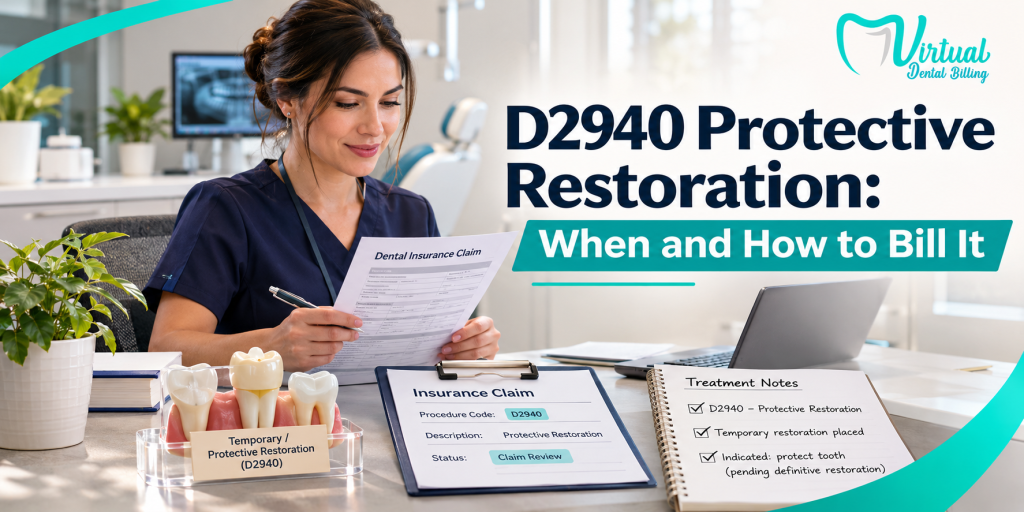
Dental teams often provide temporary protection for damaged or decayed teeth when permanent treatment cannot be completed during the same visit. Yet, reporting these procedures correctly can be confusing, especially when insurance companies apply different billing and coverage rules.
The D2940 dental code, previously known as protective restoration, is now officially called placement of interim direct restoration. It covers restorative material placed to protect a tooth, relieve discomfort, or prevent further damage until definitive treatment can be completed. The ADA updated this code description in 2025.
Correct D2940 billing requires more than selecting the right procedure code. Dental practices must document why the restoration was necessary, identify the treatment performed, and review payer-specific coverage rules.
This guide explains when to use D2940, how to bill it correctly, what documentation supports the claim, and which common mistakes dental billing teams should avoid.
What Is D2940 in Dental Billing?
D2940 is a Current Dental Terminology (CDT) code used for the placement of an interim direct restoration. Dentists use this procedure to protect a damaged or decayed tooth when definitive treatment cannot be completed immediately.
The restoration may help relieve pain, manage tooth decay, support healing, or prevent further damage. It can also create a seal for endodontic isolation when clinically appropriate.
The American Dental Association (ADA) changed the code’s name from protective restoration to placement of interim direct restoration on January 1, 2025. The updated description allows different restorative materials and placement methods when the procedure meets the code’s clinical purpose.
What Does the D2940 Dental Code Cover?
The D2940 dental code covers the direct placement of restorative material to temporarily protect tooth structure or surrounding tissue until further treatment is possible.
For example, a patient may visit with a fractured tooth that needs a crown. If the dentist cannot complete the planned treatment that day, an interim restoration may be placed to protect the exposed tooth structure.
However, D2940 should not be reported for closing an endodontic access opening or placing a base or liner beneath another restoration. These procedures do not meet the code’s intended purpose.
The key distinction is the purpose of treatment. D2940 represents an interim protective procedure, not a permanent restoration. Whether the procedure qualifies for separate reimbursement depends on the patient’s insurance benefits and the payer’s billing policies.
When Should Dentists Use D2940?
Dentists should use D2940 when an interim direct restoration is clinically necessary to protect a tooth or surrounding tissue until definitive treatment can be provided. Common reasons include tooth fractures, active decay, pain management, and situations where further treatment must be delayed.
The decision should be based on the patient’s clinical condition and the purpose of the restoration, not simply whether temporary filling material was used.
Common Situations Where D2940 Is Appropriate
1. Protecting a Fractured Tooth
When a tooth fractures and exposes sensitive dentin, an interim restoration may protect the remaining tooth structure until permanent treatment is possible.
For example, a patient with a broken molar may need a crown, but the dentist first places restorative material to reduce sensitivity and protect the damaged area.
2. Managing Tooth Decay
Dentists may use D2940 protective restoration during caries management when definitive treatment cannot be completed immediately.
An interim restoration can help protect the affected tooth while the dentist monitors its condition or plans further treatment.
3. Relieving Dental Pain
Patients experiencing discomfort from exposed or damaged tooth structure may benefit from an interim restoration. The material can protect sensitive areas and provide temporary relief while the dentist determines the appropriate long-term treatment.
4. Supporting Healing and Tissue Protection
When damaged tooth structure affects nearby soft tissue, an interim restoration may help maintain tissue form and protect the area during healing.
5. Creating a Seal for Endodontic Isolation
The updated D2940 CDT code includes creating a seal for endodontic isolation when clinically appropriate. This differs from simply closing an access opening after root canal treatment, which is excluded from D2940.
When Should D2940 Not Be Used?
Not every temporary restoration qualifies for D2940 billing. The code should not be used for:
- Closing an endodontic access opening.
- Placing a base or liner beneath another restoration.
- Reporting a definitive restoration as an interim procedure.
- Billing a routine preventive restoration that does not meet D2940’s clinical purpose.
These distinctions are important because some insurers also bundle D2940 into other procedures. For example, Delta Dental’s published clinical criteria state that D2940 is not a separate benefit under most of its plans.
www1.deltadentalins.com
Before submitting a claim, dental teams should confirm the clinical reason for treatment and check whether the patient’s plan allows separate reimbursement.
D2940 vs. Other Dental Restoration Codes
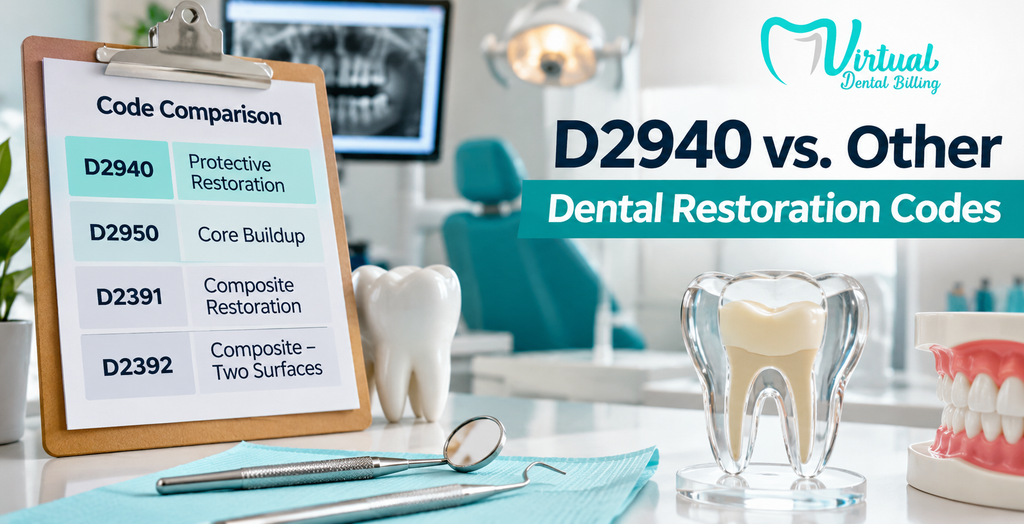
D2940 is often confused with other restorative dental codes because several procedures involve placing material on a damaged tooth. However, each code serves a different clinical purpose. Choosing the correct code depends on whether the dentist is providing temporary protection, rebuilding tooth structure, or completing a permanent restoration.
D2940 vs. D2949 vs. D2950
The following table explains the main differences between these commonly confused CDT codes.
| CDT Code | Procedure | Primary Purpose |
| D2940 | Placement of interim direct restoration | Protects a tooth or tissue until definitive treatment |
| D2949 | Restorative foundation for an indirect restoration | Improves tooth preparation form, including filling undercuts |
| D2950 | Core buildup, including pins when required | Rebuilds insufficient tooth structure to support a crown |
| D2391–D2394 | Posterior resin-based composite restorations | Restores one or more surfaces of a posterior tooth |
How Is D2940 Different From D2949?
D2940 provides interim protection when definitive restoration is delayed. D2949, however, involves placing restorative material to create a suitable foundation for an indirect restoration, such as a crown or onlay.
For example, if a dentist places material to protect exposed dentin before a later appointment, D2940 may be appropriate. If the dentist fills undercuts to improve the shape of a crown preparation, D2949 better describes that procedure.
D2940 vs. D2950: Interim Restoration or Core Buildup?
D2950 applies when a tooth lacks enough remaining structure to provide adequate strength and retention for a planned crown. The dentist places core buildup material to replace missing coronal structure.
In contrast, D2940 protective restoration provides temporary protection without necessarily rebuilding the tooth to support a crown.
The ADA’s guidance on core buildup billing explains that D2950 should not be reported when restorative material is used only to fill undercuts or irregularities in a crown preparation.
Can D2940 and a Permanent Restoration Be Billed Together?
Reporting D2940 and a permanent restoration for the same tooth may create reimbursement issues, especially when both procedures occur on the same date.
Some insurers consider interim restorations part of the definitive treatment rather than a separately payable service. Coverage depends on the patient’s benefits, treatment circumstances, and payer policies.
Dental teams should review the treatment record and applicable claim rules before submitting both procedures. Following a consistent dental claim denial management process can help identify coding errors, bundling issues, and missing documentation before they affect reimbursement.
The correct code should always describe the treatment actually performed, regardless of which procedure offers higher reimbursement.
How to Bill D2940 Correctly
Correct D2940 billing starts with accurate clinical records and a clear reason for placing the interim restoration. Dental teams must show why the tooth needed protection, what treatment was performed, and why definitive restoration was delayed.
Following these steps can help practices submit complete claims and reduce avoidable billing errors.
1. Confirm That D2940 Matches the Treatment
Before selecting CDT code D2940, review the dentist’s clinical notes to confirm that the procedure involved direct placement of an interim restorative material.
The record should explain the treatment’s purpose, such as protecting fractured tooth structure, managing caries, or relieving discomfort. If the dentist completed a permanent restoration instead, the corresponding definitive restoration code should be used.
2. Document the Clinical Necessity
Clear clinical documentation helps insurance reviewers understand why an interim direct restoration was needed.
The treatment record should include:
- Tooth number: Identify the tooth receiving treatment.
- Clinical condition: Describe the fracture, decay, sensitivity, or other relevant findings.
- Treatment performed: Record the restorative material used and the procedure completed.
- Reason for interim treatment: Explain why definitive restoration was not completed.
- Future treatment plan: Identify the planned treatment or follow-up, when known.
Supporting photographs or radiographs may be included when relevant or requested by the payer. They do not replace a complete clinical narrative.
3. Submit the Correct Claim Information
When preparing a D2940 dental claim, billing teams should verify the patient details, treatment date, procedure code, tooth number, and submitted fee.
The claim should match the clinical documentation. Missing tooth identification, inconsistent treatment dates, or incorrect procedure codes may result in requests for additional information or claim rejections.
4. Verify Insurance Benefits Before Submission
D2940 insurance coverage varies between dental plans. Some insurers may reimburse the procedure separately, while others apply frequency limits, exclusions, or bundling rules.
For example, certain Blue Cross Blue Shield of Massachusetts benefit schedules list a limit of one D2940 procedure per tooth per lifetime. This is a plan-specific example, not a rule followed by every insurer.
Using a consistent dental insurance verification checklist can help billing teams review applicable benefits and restrictions before filing the claim.
5. Review the Claim Before Filing
Before submitting the claim electronically, confirm that the CDT code, tooth number, clinical notes, and insurance information are consistent.
When a payer requires a narrative or supporting records, include them according to its submission guidelines. Complete documentation helps the insurer evaluate the treatment, although it does not guarantee reimbursement.
Billing takeaway: The most important requirement is that the clinical record supports the purpose of the interim restoration. Accurate coding, complete documentation, and verified payer rules help reduce preventable claim problems.
Does Dental Insurance Cover D2940?
D2940 insurance coverage depends on the patient’s dental plan, the reason for treatment, and the insurer’s reimbursement policies. Some plans cover interim direct restorations as separate procedures, while others limit payment when additional restorative or endodontic treatment is performed on the same tooth.
Even when D2940 is clinically necessary, insurance approval is not guaranteed.
How Do Insurance Companies Cover D2940?
Dental insurers apply different rules to D2940 reimbursement. The following examples show how coverage can vary.
| Insurance Provider | D2940 Coverage Guidelines |
| Delta Dental | Certain plans cover emergency pain relief once per tooth. Additional treatment may affect separate reimbursement. |
| UnitedHealthcare | Some plans limit separate coverage to cases without other treatment on the same tooth, except examinations and X-rays. |
| Blue Cross Blue Shield of Massachusetts | Coverage varies by plan. Certain benefits allow one restoration per tooth per lifetime. |
These examples reflect published payer policies, not universal rules for every plan.
What Can Affect D2940 Reimbursement?
Several factors may determine whether an insurer pays a D2940 dental claim.
- Frequency limitations: Some plans restrict how often D2940 can be reimbursed for the same tooth.
- Same-day treatment: Insurers may bundle the interim restoration with definitive treatment performed during the same visit.
- Clinical necessity: Documentation must support the reason for placing the interim restoration.
- Patient benefits: Deductibles, coverage percentages, annual maximums, and plan exclusions can affect payment.
For example, Delta Dental’s 2026 handbook identifies situations where D2940 cannot be billed separately to the patient when performed with certain restorative, bridge, or endodontic procedures.
Can Patients Be Charged When D2940 Is Not Covered?
Patient responsibility depends on the insurance contract, provider participation agreement, and applicable billing restrictions.
When D2940 is denied, dental teams should review the explanation of benefits (EOB) before transferring the balance to the patient.
Some denials represent contractual write-offs rather than patient responsibility. Billing the patient without reviewing these restrictions may lead to incorrect charges and payment disputes.
The key is to distinguish between a noncovered service, a bundled procedure, and an actual patient-responsibility balance. This helps dental practices collect appropriate payments while following payer contracts.
D2940 Dental Claim Narrative Example
A clear D2940 dental narrative helps explain why an interim direct restoration was necessary. The narrative should describe the tooth’s clinical condition, the treatment performed, and why definitive restoration could not be completed during the visit.
Although not every insurer requires a separate narrative, accurate treatment notes can support claim reviews and requests for additional documentation.
Sample D2940 Narrative for a Fractured Tooth
Consider a patient who visits the dental office with a fractured lower molar. The tooth has exposed dentin and sensitivity, but the planned crown treatment cannot be completed during the same appointment.
Example Clinical Narrative:
Tooth #19 presented with a fractured cusp and exposed dentin, causing sensitivity to cold and chewing. An interim direct restoration was placed using glass ionomer material to seal and protect the exposed tooth structure. Definitive crown treatment is planned for a subsequent visit.
This example demonstrates the clinical purpose of D2940 protective restoration without adding unnecessary details.
What Should a D2940 Narrative Include?
A complete narrative should answer four important questions:
- What was the clinical problem? Identify the fracture, decay, exposed dentin, or other relevant condition.
- Why was interim treatment necessary? Explain the need for immediate protection or symptom management.
- What treatment was performed? Document the material placed and its clinical purpose.
- What happens next? Describe the planned definitive treatment when known.
Common Narrative Mistakes to Avoid
Generic statements such as “temporary filling completed” may not provide enough information for an insurer to understand the procedure.
Dental teams should also avoid using the same narrative for every patient. Each D2940 claim narrative must reflect the actual clinical findings and treatment recorded by the dentist.
Supporting radiographs, photographs, or additional records may be submitted when clinically relevant or required by the payer.
Important: This narrative is an illustrative example, not a template to copy into every claim. The treating dentist must verify that all documented findings and procedures match the patient’s actual record.
A well-supported narrative can make claim reviews easier, but it does not override insurance exclusions or guarantee reimbursement.
How Can Virtual Dental Billing Help With D2940 Claims?
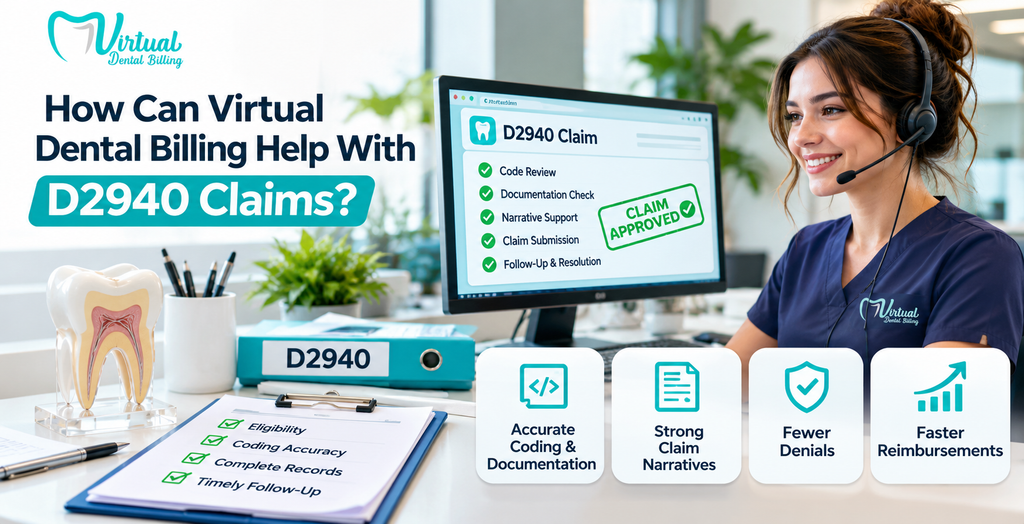
Even a correctly coded D2940 claim can face payment delays when supporting records are missing or payer requirements are overlooked. Dental practices need a reliable billing process that connects clinical documentation, insurance verification, and claim follow-up.
Virtual Dental Billing helps dental offices manage these tasks through its dental insurance billing services. Our team reviews claim information, checks payer requirements, and follows up on outstanding claims to help reduce avoidable billing delays.
For D2940 billing, this support includes identifying missing claim details, checking available benefit information, coordinating documentation requests with the dental office, and reviewing insurance responses.
When claims remain unpaid, our dental accounts receivable services help practices investigate outstanding balances, address correctable billing issues, and determine the appropriate next steps.
Our team works with the clinical records provided by your practice. Coding and claim decisions must reflect the treatment actually performed and the applicable payer rules.
Need help managing dental insurance claims? Contact Virtual Dental Billing’s revenue cycle management team to discuss how we can support your practice’s claim submission, insurance follow-up, and payment tracking.
Frequently Asked Questions About D2940
Is D2940 the Same as a Temporary Filling?
Not exactly. D2940 describes an interim direct restoration placed for a specific clinical purpose, such as protecting a damaged tooth or managing discomfort. While temporary restorative materials may be used, not every temporary filling qualifies for D2940.
Can D2940 Be Billed on the Same Day as a Crown?
D2940 and a crown may be reported on the same date only when the documented procedures support the codes used. However, insurers may bundle the interim restoration into the crown procedure and deny separate reimbursement. Dental teams should verify payer rules before billing.
Does D2940 Require a Tooth Number?
Yes. D2940 dental claims should identify the tooth receiving the interim restoration. The tooth number helps the insurer review treatment history, apply frequency limitations, and determine whether other procedures affect coverage.
Is D2940 Covered Under Emergency Dental Benefits?
Some dental insurance plans cover D2940 when an interim restoration is necessary to relieve discomfort or protect a damaged tooth during emergency treatment. Coverage varies by policy, and emergency treatment does not automatically qualify the procedure for reimbursement.
Can D2940 Be Used More Than Once on the Same Tooth?
Clinically, an interim restoration may be needed more than once, but D2940 insurance coverage can be subject to frequency limitations. Some plans restrict reimbursement to one occurrence per tooth within a defined period or over the patient’s lifetime. Always review the specific benefit terms.
Does D2940 Require a Predetermination?
D2940 does not have a universal predetermination requirement. Some plans may request supporting documentation or a pretreatment estimate, depending on their policies. Emergency treatment should be documented appropriately, and practices should verify payer-specific requirements.
Can D2940 Be Billed After Root Canal Treatment?
D2940 should not be used simply to close an endodontic access opening after root canal treatment. If a separate interim restoration is clinically necessary for another qualifying purpose, the dentist must document the distinct treatment. Separate insurance reimbursement may still be restricted.
What Happens if Insurance Denies D2940?
When a D2940 claim is denied, the billing team should review the explanation of benefits to identify the reason. Missing information may require a corrected claim, while a disputed denial may support an appeal. Contractual bundling or benefit exclusions may require an adjustment rather than additional billing to the patient.
Is D2940 Limited to Certain Restorative Materials?
No. The updated D2940 CDT code does not restrict the procedure to one restorative material. The dentist selects an appropriate material based on the clinical situation, while the treatment record should explain its purpose and placement.