
Your dental office accepts a patient’s insurance, completes the treatment, and submits the claim. Everything looks correct until the insurer denies payment because the dentist isn’t part of the patient’s specific network.
For many dental practices, this confusion starts with not understanding the differences between DHMO vs EPO vs PPO insurance plans.
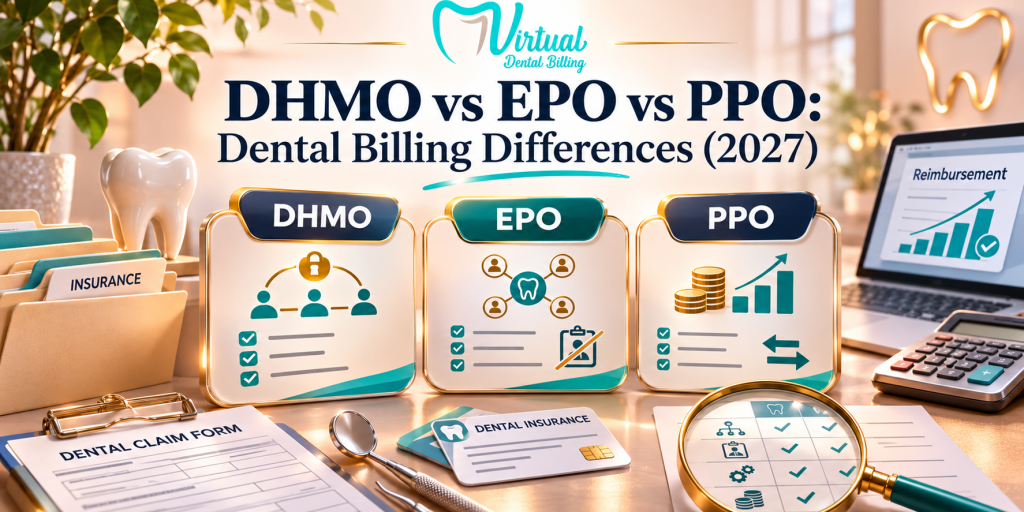
Although these plans help patients pay for dental care, they follow different rules for provider networks, claim submissions, reimbursement, and patient responsibility. DHMO plans often use fixed monthly payments, EPO plans generally require patients to stay within a specific network, and PPO plans usually offer more flexibility when choosing a dentist.
Understanding these dental insurance billing differences helps office managers and billing teams verify benefits, prepare accurate claims, and avoid unexpected payment problems.
This guide explains how each plan works, what changes during the billing process, and which details dental offices should check before treatment.
DHMO vs EPO vs PPO: Side-by-Side Billing Comparison
The biggest difference between DHMO vs EPO vs PPO dental billing is how dentists receive payment and which network rules apply to patient treatment.
DHMO plans commonly use capitation, EPO plans generally pay for covered services within an exclusive network, and PPO plans use contracted fees with possible out-of-network benefits.
Understanding these differences helps dental offices estimate patient costs, apply the correct fee schedules, and avoid preventable billing errors.
DHMO vs EPO vs PPO Dental Billing Comparison Chart
| Billing Feature | DHMO | EPO | PPO |
| Provider payment | Usually monthly capitation | Generally fee-for-service | Contracted fee-for-service |
| Provider network | Assigned or selected network dentist | Participating EPO dentists only | In-network and often out-of-network |
| Claim submission | Encounter reports or claims may be required | Claims generally submitted for covered treatment | Claims submitted for reimbursement |
| Patient costs | Usually fixed procedure copayments | Copayments, deductibles, or coinsurance depending on plan | Deductibles and coinsurance commonly apply |
| Out-of-network coverage | Generally unavailable | Generally unavailable | Often available at reduced benefits |
| Reimbursement basis | Capitation plus applicable service payments | Network-contracted allowable fees | Contracted fees or applicable out-of-network allowances |
| Main billing concern | Patient assignment and capitation accuracy | Exact network participation | Fee schedules, insurance payments, and adjustments |
| Important records | Patient roster, copayment schedule, encounter records | Network status, benefits, claims, EOBs | Provider contracts, fee schedules, claims, EOBs |
How Do These Differences Affect Dental Practice Revenue?
Consider a dental office that provides the same restorative procedure to three patients, each with a different dental insurance plan.
Under a DHMO: The dentist may already receive a monthly capitation payment for the assigned patient. The practice must then apply the correct patient copayment and check whether any additional payment is available.
Under an EPO: The practice generally submits a claim based on the plan’s contracted reimbursement rules. If the dentist is outside the required network, the patient may receive no insurance benefit.
Under a PPO: The insurer processes the claim using the applicable benefit provisions and fee schedule. The office must post the insurance payment, apply any required contractual adjustment, and calculate the patient’s remaining balance.
PPO reimbursement deserves particular attention because different contracts can produce different allowable amounts for the same procedure. Our guide to dental PPO fee schedules explains how dental practices can review contracted rates and identify revenue gaps.
Which Plan Requires the Most Billing Attention?
No single dental insurance plan is automatically the most difficult to bill. Each creates different administrative responsibilities.
DHMO billing requires accurate enrollment and payment tracking. EPO billing places greater importance on network verification, while PPO billing often requires closer attention to contractual adjustments and patient balances.
The key takeaway: Dental practices should not follow one billing workflow for every insurance plan. Understanding the payment model and network restrictions helps teams manage claims accurately and collect the amounts they are entitled to receive.
How Does Dental Billing Work Under a DHMO?
DHMO dental billing works differently from traditional fee-for-service insurance. Instead of receiving a separate insurance payment for every covered procedure, participating dentists typically receive a fixed monthly payment for each eligible patient assigned to their practice.
This payment system is called dental capitation. However, practices must still track patient assignments, apply the correct copayments, and report treatment according to their payer contracts.
How Do DHMO Capitation Payments Work?
Under a typical DHMO capitation model, the insurance company pays the dentist a contracted amount per assigned patient each month, whether or not that patient visits the office.
For example, imagine a practice has 100 eligible assigned patients and a hypothetical capitation rate of $10 per patient.
The practice would receive $1,000 in monthly capitation payments, subject to its contract and roster reconciliation.
Certain procedures may also have patient copayments or qualify for additional payments under the contract.
This makes DHMO revenue less dependent on individual insurance claims, but accurate enrollment records remain essential.
Why Must Dental Offices Check Patient Assignment?
Before scheduling treatment, the billing team should confirm that the patient is enrolled in the DHMO and assigned to the correct dentist or practice.
A patient might have active insurance but still be assigned to another provider. Depending on the plan, this can create payment or authorization problems.
Dental offices should check:
- The patient’s active enrollment and effective date.
- The assigned dentist or practice location.
- The current DHMO patient roster.
- Any assignment-change or referral requirements.
Our dental insurance verification checklist can help teams organize these checks before treatment.
Some insurers allow assignment corrections or automatic assignment under specific conditions, so practices should follow the payer’s current rules.
Do DHMO Dentists Still Submit Claims?
Sometimes. Although capitation covers many services, some DHMO contracts require encounter reports to document completed treatment.
These reports may include the patient’s information, date of service, CDT procedure codes, and applicable copayments.
Other services may require separate claims or authorization, depending on the contract.
For example, UnitedHealthcare’s California DHMO provider guidance requires certain capitated services to be reported through encounter submissions, even when no additional insurance payment is due.
What DHMO Billing Mistakes Should Practices Avoid?
Common problems include outdated patient rosters, incorrect copayment schedules, missing encounter reports, and failure to reconcile monthly capitation payments.
To prevent these issues, billing teams should compare their assigned-patient roster with payer payment reports and review treatment records regularly.
The key takeaway: Successful DHMO billing depends on more than collecting copayments. Accurate patient assignments, capitation reconciliation, and proper encounter reporting help dental offices protect revenue and maintain reliable billing records.
How Does PPO Dental Billing Work?
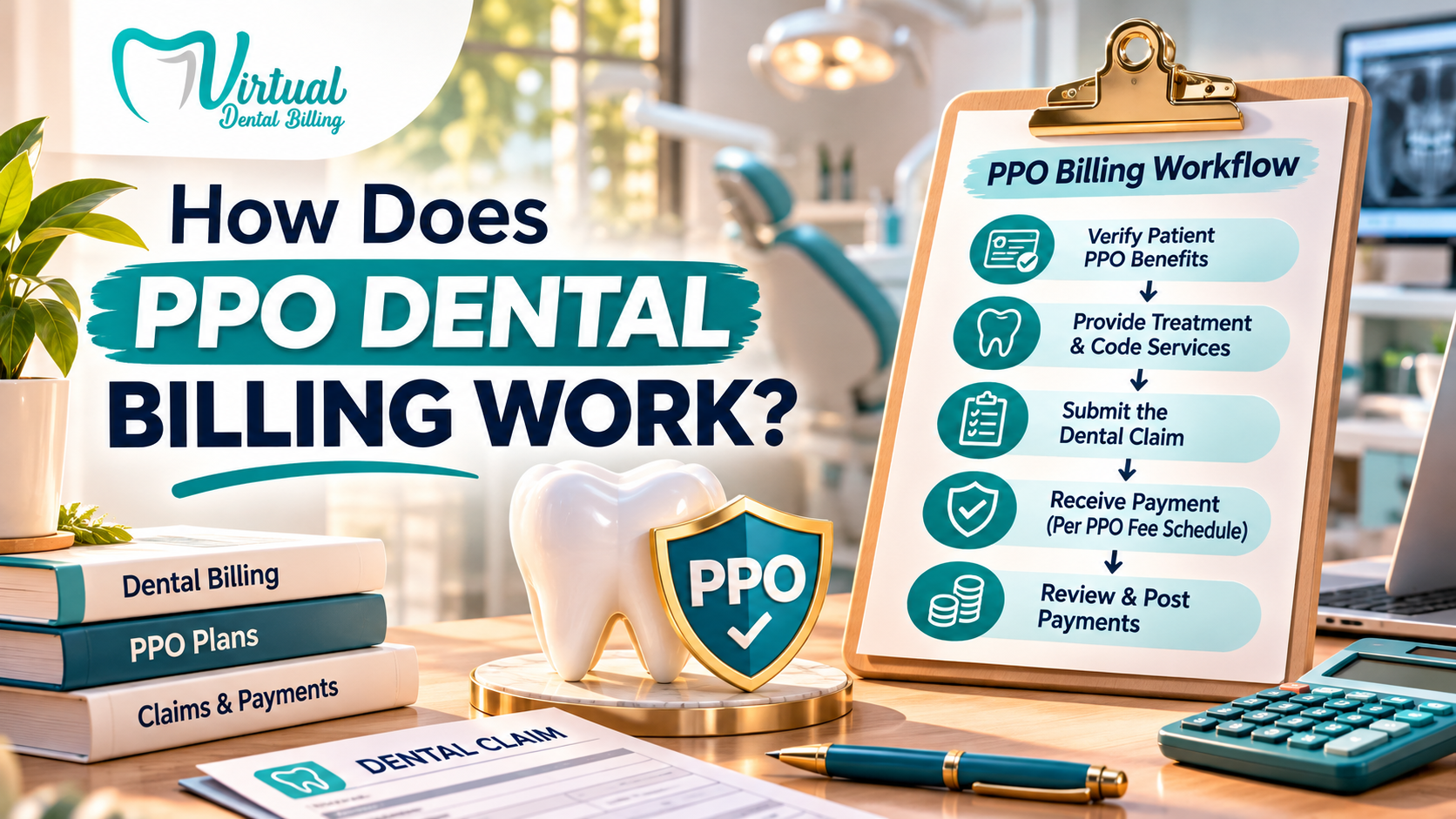
PPO dental billing follows a fee-for-service model in which participating dentists agree to accept contracted rates for covered procedures. After treatment, the insurance company processes the claim according to the patient’s benefits and the provider’s agreement.
Unlike DHMO capitation, PPO payments generally depend on the services performed. Dental offices must track the allowed amount, insurance payment, contractual adjustments, and remaining patient responsibility.
How Do PPO Contracted Fees Affect Reimbursement?
Every participating dentist has an agreed fee schedule with the insurance network. This determines the maximum amount the practice can generally collect for covered services under its contract.
For example, a dentist may charge $300 for a procedure, while the PPO contracted fee is $220.
The $80 difference is normally recorded as a contractual adjustment, meaning the practice cannot collect that amount from the patient for the covered in-network service.
The American Dental Association recommends reporting the practice’s full fee on dental insurance claims and applying required contractual adjustments during payment processing.
How Are PPO Deductibles and Patient Balances Calculated?
Patient responsibility depends on the plan’s deductible, coinsurance percentage, and remaining benefits.
Consider this hypothetical PPO claim:
| Billing Detail | Amount |
| Dentist’s standard fee | $300 |
| PPO contracted allowable fee | $220 |
| Remaining deductible applied | $50 |
| Amount after deductible | $170 |
| Insurance pays 80% of $170 | $136 |
| Patient coinsurance (20%) | $34 |
| Total patient responsibility | $84 |
| Contractual adjustment | $80 |
In this example, the patient owes $50 toward the deductible plus $34 in coinsurance. Combined with the $136 insurance payment, the practice receives the $220 contracted allowable amount..
What Happens When a PPO Patient Visits an Out-of-Network Dentist?
Many PPO plans provide some out-of-network dental benefits, but reimbursement may be lower than for participating dentists.
The insurer may calculate benefits using a separate allowed amount. Depending on the plan, applicable laws, and provider agreements, the patient may also owe charges above that amount.
Before treatment, dental offices should confirm out-of-network benefits and explain the estimated patient responsibility.
Why Is Accurate PPO Payment Posting Important?
Once the insurance company processes a claim, the billing team should review the explanation of benefits (EOB) before finalizing the patient’s balance.
This includes checking whether the insurer applied the correct fee schedule, deductible, coinsurance, and contractual adjustment.
Practices concerned about consistently low contracted reimbursements can also explore PPO negotiation services to review payer agreements and identify opportunities for improved fee schedules.
The key takeaway: Accurate PPO billing requires more than submitting claims. Dental teams must understand contracted fees, calculate patient responsibility correctly, and reconcile payments to avoid unnecessary write-offs or incorrect patient balances.
Which Billing Mistakes Lead to Denials or Lost Revenue?
Even when dental offices understand the differences between DHMO, EPO, and PPO plans, small billing mistakes can still affect collections. Some errors cause immediate claim denials, while others lead to missed payments, incorrect patient balances, or unnecessary write-offs.
The most common problems often begin with inaccurate insurance information or failure to follow the patient’s specific plan rules.
1. Assuming the Dentist Is In-Network for Every Plan
Being contracted with an insurance company does not always mean the dentist participates in all its networks.
For example, a practice may accept a carrier’s PPO plan but not its EPO network. If the office overlooks this difference, the patient may receive an unexpected bill or the claim may be denied for out-of-network treatment.
How to avoid it: Verify the treating dentist’s network status, practice location, and participation effective date for the patient’s exact plan before treatment.
2. Missing DHMO Capitation Payments
Under DHMO contracts, payment errors may occur when assigned patients are missing from the payer’s roster or monthly capitation payments do not match eligible enrollment records.
Because capitation is not always connected to individual claim payments, these discrepancies can go unnoticed.
How to avoid it: Reconcile monthly capitation reports against patient assignment rosters and investigate missing or incorrect payments with the payer.
3. Applying Incorrect PPO Contractual Adjustments
Incorrect fee schedules can reduce dental practice revenue or create inaccurate patient balances.
Suppose a PPO contract allows $180 for a procedure, but the billing team mistakenly applies a $150 allowable amount. The practice could write off an additional $30 that was not required by its agreement.
How to avoid it: Maintain updated fee schedules and compare each explanation of benefits (EOB) with the applicable provider contract before posting adjustments.
4. Submitting Claims With Incorrect Information
Wrong member IDs, provider details, procedure codes, or treatment dates can prevent claims from processing correctly.
For example, reporting the wrong rendering provider may cause an otherwise valid in-network claim to be processed under different network terms.
How to avoid it: Review patient information, CDT codes, provider identifiers, and required attachments before submission.
For more practical examples, explore our guide to common dental claim denial reasons.
5. Failing to Follow Up on Unpaid Claims
An accepted claim is not necessarily a paid claim. Without regular follow-up, dental offices may overlook pending requests, unresolved denials, or underpayments until correction or appeal deadlines have passed.
How to avoid it: Track outstanding claims by payer, aging category, and denial reason. Review EOBs promptly and follow the correct process for corrections, reconsiderations, or appeals.
Quick Guide to Preventing Revenue Loss
| Billing mistake | Potential impact | Preventive action |
| Wrong provider network | Denied benefits or unexpected patient costs | Confirm exact network participation |
| Missing DHMO roster payments | Uncollected capitation revenue | Reconcile monthly enrollment and payments |
| Incorrect PPO adjustments | Excessive write-offs | Review contracted fee schedules |
| Claim information errors | Rejections or delayed payments | Check claim details before submission |
| Missed insurance follow-ups | Aging receivables and missed deadlines | Monitor unpaid claims regularly |
The key takeaway: Preventing dental insurance billing errors requires different checks for each plan. DHMO practices need accurate capitation tracking, EPO practices must confirm network participation, and PPO practices must carefully review reimbursement and contractual adjustments.
What Should Dental Offices Verify Before Treatment?
Before treating a patient with DHMO, EPO, or PPO dental insurance, dental offices should confirm the patient’s eligibility, network participation, and treatment benefits.
Even when the patient presents an active insurance card, coverage details may have changed. Verifying the correct information before the appointment helps prevent unexpected denials, inaccurate estimates, and patient billing disputes.
Dental Insurance Verification Checklist for DHMO, EPO, and PPO
| What to Verify | What Dental Teams Should Check |
| Patient eligibility | Confirm active coverage, member ID, and effective dates. |
| Plan type | Identify whether the patient has DHMO, EPO, or PPO coverage. |
| Provider network | Verify the treating dentist’s participation in the exact plan and location. |
| DHMO assignment | Confirm the patient is assigned to the correct practice when required. |
| Treatment benefits | Review covered procedures, exclusions, waiting periods, and frequency limits. |
| Patient costs | Check copayments, deductibles, coinsurance, and remaining annual benefits, where applicable. |
| Authorization rules | Determine whether referrals, preauthorization, or other approvals are required. |
How Should the Front Desk Handle Benefit Verification?
The front-desk team should complete these checks before the scheduled treatment, particularly for new patients and major procedures.
A practical workflow includes three steps:
1. Confirm insurance information before the appointment.
Collect the patient’s insurance details and verify eligibility through the payer’s portal or provider support team.
2. Review benefits for the planned procedures.
Use the proposed CDT codes to check coverage limitations, network rules, and estimated patient responsibility.
For treatments requiring prior authorization or a pretreatment estimate, follow the specific payer’s instructions.
3. Record the verification results.
Document the verification date, information received, applicable restrictions, and any payer reference number. This gives the billing team a record to review if questions arise after treatment.
Practices that need additional administrative support can use professional dental insurance verification services to coordinate eligibility checks and benefit reviews before appointments.
Does Insurance Verification Guarantee Payment?
No. Dental insurance verification confirms reported benefits, not guaranteed reimbursement.
Final payment may change because of eligibility updates, remaining benefit limits, claim processing rules, or treatment-specific exclusions.
The American Dental Association also explains that pretreatment estimates and authorizations do not necessarily guarantee payment.
For this reason, dental offices should communicate estimated costs clearly and explain that the final patient balance may change after claim processing.
The key takeaway: Accurate pre-treatment verification helps dental teams understand each patient’s plan before care begins. It also supports clearer financial conversations and reduces avoidable billing confusion.
How Can Virtual Dental Billing Help Manage Different Insurance Plans?
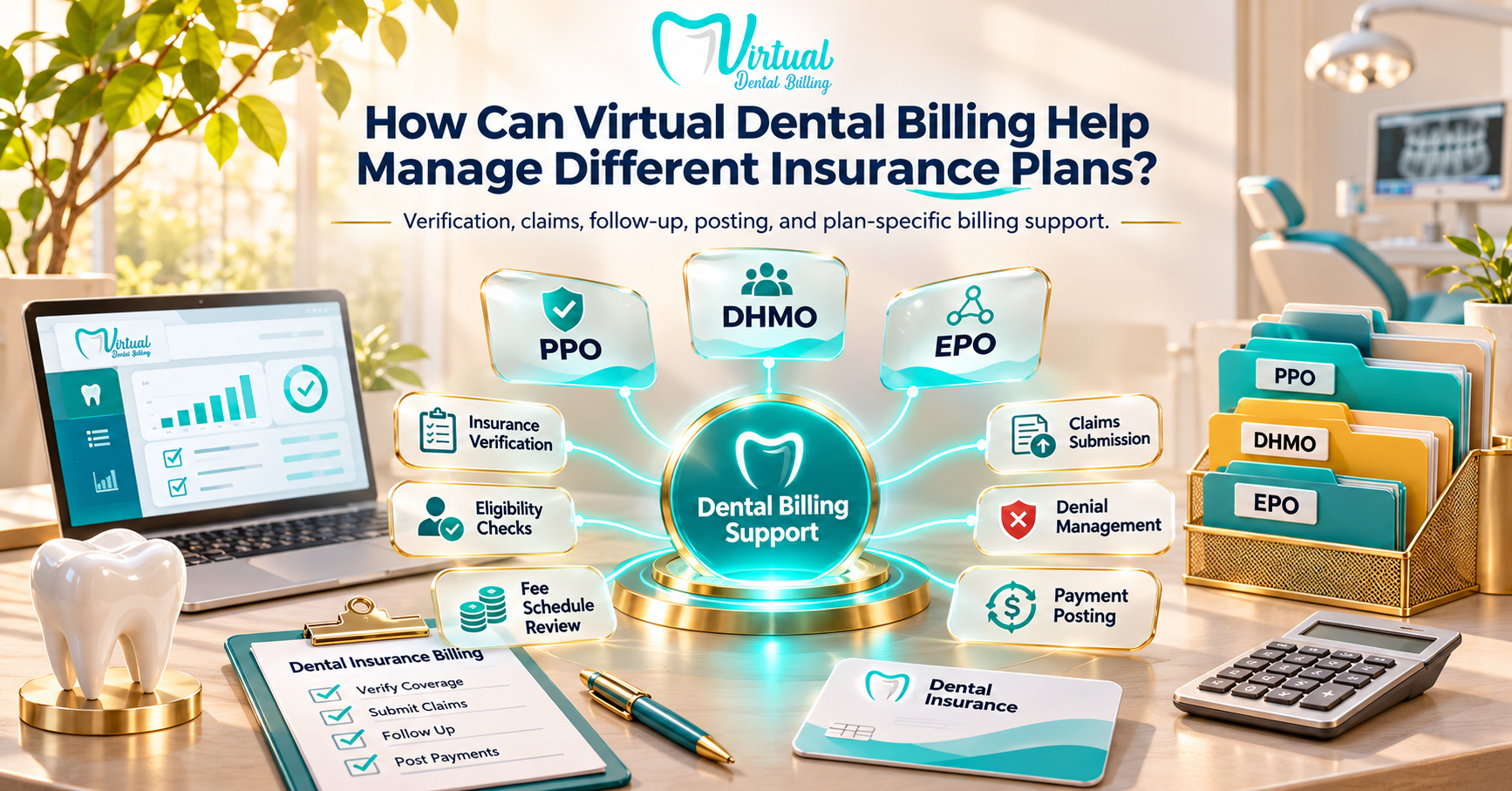
Managing DHMO, EPO, and PPO dental insurance plans can put extra pressure on dental office staff. Each plan has different payment rules, network requirements, and billing procedures. Without a consistent process, practices may face delayed claims, incorrect patient balances, or missed insurance payments.
Virtual Dental Billing helps dental practices organize their insurance billing workflows, review claim information, and follow up on outstanding payments.
1. Plan-Specific Insurance Verification
Our billing team helps dental offices verify patient eligibility, coverage restrictions, and treatment benefits before claims are submitted.
For DHMO patients, this may involve checking assignment information and applicable copayments. EPO patients require careful network verification, while PPO patients need accurate benefit and deductible information.
These checks help practices identify potential billing problems before they affect collections.
2. Accurate Claims and Payment Posting
Different insurance plans also require different approaches to claim processing and payment reconciliation.
Our dental insurance billing services support claim preparation, submission, payment review, and insurance follow-up.
Using the practice’s records and payer information, our team helps:
- Review patient, provider, and CDT code details.
- Check supporting documentation before submission.
- Post insurance payments and contractual adjustments accurately.
- Identify unexpected payment differences and outstanding balances.
For capitated DHMO arrangements, billing and encounter-reporting requirements depend on the provider’s specific contract.
3. Denial Management and Insurance Follow-Up
Unpaid claims require regular attention, especially when several insurance networks are involved.
Our team reviews denial reasons, checks claim status, and coordinates corrections or appeals when supported by the payer’s rules and available documentation.
This helps dental offices identify unresolved insurance balances instead of allowing them to remain unpaid without follow-up.
4. Clearer Revenue Cycle Management
At Virtual Dental Billing, we support dental practices with insurance verification, claim management, payment posting, and accounts receivable follow-up.
By organizing these administrative tasks, we help dental teams spend less time tracking billing problems and more time supporting patients.
Need help managing different dental insurance plans? Explore our billing services to learn how we can support your practice’s insurance workflow.
The key takeaway: Effective DHMO, EPO, and PPO billing requires accurate plan information, consistent claim reviews, and timely follow-up. Professional billing support can help dental practices reduce preventable errors and manage their revenue cycle more effectively.
Frequently Asked Questions About DHMO, EPO, and PPO Dental Plans
1. Is EPO Dental Insurance the Same as PPO?
No. EPO dental insurance generally covers treatment only within its approved provider network, while PPO plans often provide some out-of-network benefits. Both commonly use fee-for-service reimbursement, but their network restrictions and patient costs differ.
2. Can the Same Dentist Be In-Network for PPO but Out-of-Network for EPO?
Yes. Dental insurers may operate separate PPO and EPO networks. Participating in one does not automatically qualify a dentist for the other. Dental offices should verify the treating provider’s participation in the patient’s exact plan before treatment.
3. Do DHMO Dentists Receive Payment When Patients Do Not Visit?
Usually, yes. Under a typical DHMO capitation arrangement, dentists receive monthly payments for eligible assigned patients regardless of whether they schedule appointments. However, payment amounts and eligibility depend on the provider contract and enrollment records.
4. Can PPO Patients Visit Out-of-Network Dentists?
Yes. Many PPO dental plans provide benefits for out-of-network treatment, although patients may face higher out-of-pocket costs. Coverage, reimbursement limits, and possible balance billing depend on the specific plan, provider agreement, and applicable laws.
5. Do EPO Dental Plans Require Referrals to Specialists?
Not always. Some dental EPO plans allow patients to visit participating specialists without referrals. For example, Cigna’s dental EPO does not require specialist referrals. Other plans may have different rules, so dental offices should verify the patient’s benefits.
6. What Happens if a Patient Changes Dental Insurance Plans During Treatment?
Billing teams should verify the new plan’s effective date, provider network, and coverage rules. Treatment performed before and after the change may fall under different benefits. Claims should reflect the actual service dates and applicable payer requirements.
Conclusion: Managing DHMO, EPO, and PPO Dental Billing
Understanding DHMO vs EPO vs PPO dental billing helps dental practices avoid common insurance mistakes and manage payments more accurately.
DHMO plans typically require careful capitation and patient assignment tracking. EPO plans place greater importance on network verification, while PPO plans require close attention to contracted fees, insurance reimbursements, and patient balances.
No matter which plans your practice accepts, accurate eligibility checks, timely claim submissions, and consistent payment follow-up remain essential.
Virtual Dental Billing helps dental offices manage these responsibilities through insurance verification, claims processing, payment posting, and denial follow-up.
With the right billing support and plan-specific workflows, dental practices can reduce preventable errors, improve collection processes, and keep their teams focused on patient care.