
In some cases, you might have a crowded schedule and always be busy with dental patients. However, your bank account may not show all of the efforts your team has put in. It may stem from uncompensated claims, billing mistakes, late payments and any other variety of insidious impacts on cash flow.
Small errors in dental billing systems cause many dentists to lose money. These dental revenue cycle errors can lead to unpaid balances, more work for staff, and tougher budgets for everyday operations. Even a minor claim error can delay payment for treatment already completed.
Don’t worry, however, because there are many of these issues that can be prevented. By knowing the five main errors, you’ll be able to prevent revenue loss, deal with unpaid claims, and boost claim accuracy. Mistake No. 3 is worthy of special attention as unpaid claims can cost thousands of dollars to be left uncollected.
What Are Dental Revenue Cycle Mistakes?
Dental Revenue Cycle Mistakes” refer to any mistake that is made by the dental practices while dealing with insurance claims, patient payments, and billing records. These errors can lead to reimbursement delays, higher unpaid balances, and impact the financial wellness of your practice.
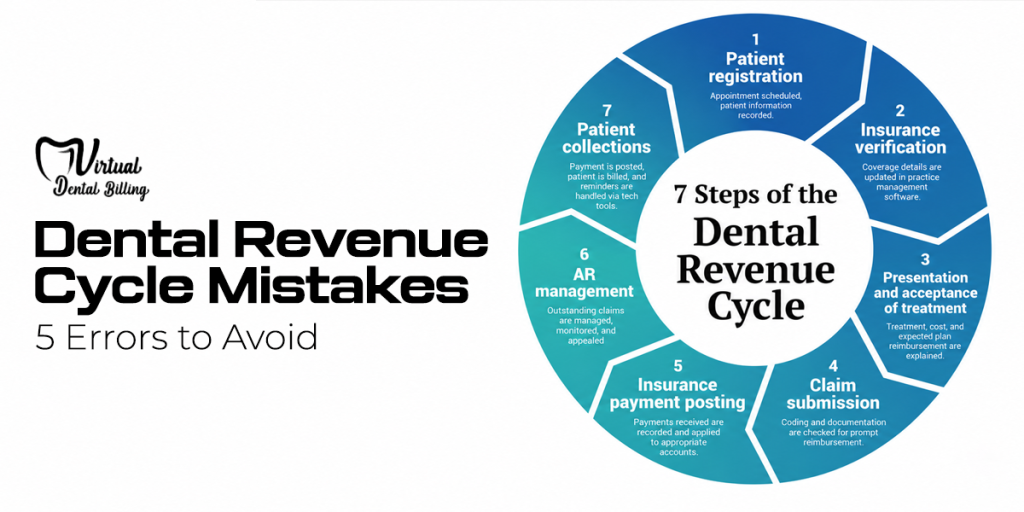
The dental revenue cycle is the process that starts with patient scheduling and concludes with the complete collection of dental revenue. These steps need to be accurate with information and proper billing procedures.
There are several important steps in the process:
- Patient registration: Collecting correct personal and insurance information.
- Insurance verification: Confirming coverage, benefits, and eligibility before treatment.
- Treatment documentation: Recording procedures and selecting accurate dental codes.
- Claim submission: Sending complete insurance claims for payment.
- Payment posting: Recording insurance payments, adjustments, and patient balances.
- Claim follow-up: Checking unpaid or denied claims and resolving payment issues.
- Patient collections: Collecting remaining balances from patients.
Any errors that occur during the process can delay payments. Inaccurate insurance information can result in denied claims, and lack of documentation can lead to delayed reimbursements.
Knowing what these mistakes are can assist your team in pinpointing weak points in your billing procedure. If done correctly, dental revenue cycle management can minimize unnecessary mistakes and ensure timely payments.
1. Skipping Dental Insurance Verification Before Treatment
Imagine completing a dental procedure only to discover that the patient’s insurance coverage has expired. Your team now faces a rejected claim and an unexpected payment problem. Such situations often happen when dental offices skip insurance verification before treatment.
Dental insurance verification helps you confirm whether a patient has active coverage and what benefits may apply. Without proper verification, your practice may face claim denials, payment delays, and incorrect patient estimates. Even returning patients may have changes in their insurance plans.
Why Is Insurance Verification Important?
Insurance coverage can change when patients switch jobs, change providers, or reach their annual benefit limits. For this reason, relying on old insurance records can lead to billing errors.
According to the American Dental Association (ADA), dental practices should verify patient eligibility on the date of service. However, insurance verification does not guarantee payment because coverage information can change.
Common Insurance Verification Mistakes
Several errors can affect your dental billing process:
- Expired insurance policies: Using coverage details that are no longer active.
- Incorrect patient information: Entering wrong member IDs or insurance details.
- Missing benefit checks: Failing to confirm deductibles, annual limits, or waiting periods.
- Unverified treatment coverage: Assuming the patient’s plan covers every procedure.
- Outdated insurance records: Using information from previous appointments without checking for changes.
These mistakes can cause claim rejections and unexpected patient balances. Consequently, your billing team may spend extra time correcting information and contacting insurance companies.
How to Avoid This Mistake
Start by verifying insurance eligibility before each appointment involving covered treatment. Next, confirm the patient’s policy details, available benefits, and treatment limitations.
For expensive procedures, consider requesting a predetermination of benefits when appropriate. However, remember that insurance estimates do not guarantee final payment.
Finally, explain the patient’s expected financial responsibility before starting treatment. This helps reduce payment confusion and keeps your billing process more organized.
Quick Tip: Create a standard insurance verification checklist for your front desk team. Regular verification can help prevent avoidable billing errors and protect your practice’s cash flow.

2. Using Incorrect Dental Codes or Incomplete Claim Information
Your dental team may complete a procedure correctly, but one coding mistake can delay the insurance payment. For example, selecting the wrong procedure code or leaving out treatment details may cause a claim rejection. Such errors create extra work for your billing staff and slow down the payment process.
Incorrect dental coding is one of the common Dental Revenue Cycle Mistakes that can affect your practice’s cash flow. Even small errors in claim information may require corrections and resubmissions before payment can be processed.
Why Does Accurate Dental Coding Matter?
Current Dental Terminology (CDT) codes are used in dental practices to report dental treatments to insurance companies. These codes are used to outline the procedures carried out, and are vital to the correct processing of claims by insurance companies.
The American Dental Association (ADA) is continually revising the CDT codes annually to incorporate changes to dental procedures. Hence, out-of-date codes can lead to billing issues and raise the probability of payment delays.
However, by selecting a valid code, this does not ensure insurance coverage. You will also have to ensure that the chosen code corresponds to the treatment provided and satisfies the claims conditions of the insurer.
Common Dental Coding and Claim Submission Mistakes
Several coding and documentation errors can affect insurance claim processing:
- Outdated CDT codes: Using old procedure codes instead of the current code set.
- Incorrect procedure codes: Selecting codes that do not match the treatment performed.
- Missing tooth information: Leaving out required tooth numbers or surfaces.
- Incomplete clinical documentation: Submitting claims without necessary treatment notes or X-rays.
- Incorrect patient details: Entering wrong insurance IDs, treatment dates, or provider information.
- Duplicate claim submissions: Sending the same claim again without checking its original status.
These mistakes can lead to claims being denied and/or delayed. These mistakes may result in claims being denied and/or delayed. As a result, your invoicing team could end up spending more time in resolving claims than processing new ones.
How to Avoid This Mistake
Utilizing the existing CDT code set and verify that the codes correspond to the treatment rendered. Then, carefully read the patient’s information, procedure information, and supporting documents prior to submitting the claim.
If the procedure is complex, check with the insurer what documentation is required before the procedure takes place. In certain cases, such as some treatments, X-rays or periodontal records or clinical notes might be required to back up the claim.
Frequent staff training can also help minimize repetitive coding mistakes. It is important to keep your billing team up to date on the changes in CDT codes annually because they can change from one year to the next, as this will ensure proper claim submission.
Last but not least, review rejected claims to find out what billing errors are occurring and make changes where necessary. This method will minimize the number of unnecessary corrections, and make your practice more likely to be paid on time.
Quick Tip: Make a claim submission checklist including CDT codes, patient information, tooth information, and attachments. By checking this information prior to submission, dental billing errors can be avoided.
3. Ignoring Unpaid Dental Claims and Accounts Receivable
Even though claims are submitted, you may not receive payment for every claim submitted to the insurance company. Others may still be pending because they still need to receive the documents, insurance checks, or have a billing error. If you fail to follow up, these unpaid balances can accumulate and impact your practice’s cash flow.
One of the most expensive Dental Revenue Cycle Mistakes is failing to pay a claim that was not paid for by the patient. But the payment is not received until your office pays the salaries, supplies, and other costs associated with running your business on a day-to-day basis.
Why Do Unpaid Dental Claims Hurt Your Practice?
Money due to your practice for completed dental services is known as dental accounts receivable (A/R). Balances can consist of unpaid patient bills and pending insurance payments.
If you have 20 unpaid insurance claims that are valued at $400 each, then, for instance, you can expect that each claim will cost $400. This means that there is $8,000 of revenue still due that hasn’t been paid or resolved. Some of these claims may ultimately be paid; others may require adjustments to be made, supporting documents, or further investigation.
As the number of these balances increases, your team may find it difficult to keep track of all unpaid claims. This means that when patients forget to follow up, issues with paying bills may be more difficult to resolve.
Common Dental Accounts Receivable Mistakes
Several billing habits can lead to growing unpaid balances:
- Missing claim follow-ups: Submitting claims without checking their payment status.
- Ignoring aging reports: Failing to review claims that remain unpaid for long periods.
- Delayed denial responses: Waiting too long to correct or appeal denied claims.
- Poor payment tracking: Missing underpayments or failing to record insurance payments correctly.
- Unclear staff responsibilities: Leaving unpaid claims without someone assigned to resolve them.
- Missed filing deadlines: Failing to submit corrections or appeals within payer deadlines.
These issues can increase administrative work and delay collections. As a result, your practice may have less cash available for regular operating expenses.
How to Improve Dental A/R Management
First, get a weekly review of your accounts receivable aging report. This report allows you to see which claims have not been paid and for how long.
Next, organize claims into 0–30, 31–60, 61–90, and over 90-day categories. The old claims might require more of a look-in, particularly if insurance is near.
In case of unpaid claims, contact the insurance company to find out the delay or check the payer portal. Identify the problem, follow up on missing documents, fix claim problems, and appeal if applicable.
It is possible to prevent unpaid claims from being forgotten by regular follow-ups. Then it’s easier to manage if you have clear responsibilities for your billing team.
Can Professional Dental Billing Services Help?
When your front desk is also responsible for scheduling appointments, taking patient calls and processing insurance paperwork, it can be difficult to manage unpaid claims. The competing tasks make it possible for claim follow-ups to be done in less time than required.
Professional dental accounts receivable services from Virtual Dental Billing can support practices with aging reports, unpaid claim reviews, insurance follow-ups, and denial management.
Their staff looks after some of the best balances, pinpoints payment problems, and keeps an eye on the following steps that must be taken to settle claims. This can help make your office’s billing records more organized, and it can relieve the burden on your internal staff.
Quick Tip: Dedicate time every week to review unpaid claims, particularly those in the 60- or 90-day period. Follow-up can be used to help your practice detect payment issues early and increase dental revenue collection.

4. Poor Patient Billing and Payment Communication
Your dental office may be doing a great job with insurance claims, but there may be an issue with your patient’s billing. Patients may think that their health insurance will pay for most of the treatment. However, when they are hit with an unexpected bill, they can get confused due to their financial illiteracy.
An area where you can make a dental revenue cycle error is by failing to communicate well with the patient, which can lead to unpaid balances and billing problems. When the patient is told that there is something they don’t understand, they can book an appointment with the doctor for further information or a payment deferral.
Why Does Clear Patient Billing Matter?
Dental insurance does not always pay for the entire treatment. Patients may be required to cover costs that are not covered by the plan, such as deductibles, copayments, coinsurance, or charges.
For instance, if a patient gets dental care that costs $1,000, they will have an increased debt of $1,000. Your office assumes that insurance will cover $700, based on the available information regarding the benefits. The patient thinks he should pay the remaining $300.
But the insurance company may work around the claim differently due to plan restrictions, exclusions or other insurance requirements. As a result, the patient’s final bill may vary once the claim is processed.
If there is no explanation, the patient may be confused by the bill or delay paying. This can cause additional stress in your billing process as well as push your patient balances further.
Common Patient Billing and Communication Mistakes
Several billing practices can create confusion and delay patient payments:
- Unclear treatment estimates: Failing to explain expected out-of-pocket costs before treatment.
- Incorrect patient balances: Sending statements without recording insurance payments or adjustments correctly.
- Delayed billing statements: Waiting too long to notify patients about outstanding amounts.
- Confusing billing descriptions: Using technical terms that patients may not understand.
- Missing payment reminders: Failing to follow up on overdue patient balances.
- Limited payment options: Offering payment methods that may not meet patients’ needs.
These problems can make collecting payments more difficult. As a result, your staff may spend more time answering billing questions and resolving payment concerns.
How to Improve Patient Billing and Collections
Start by discussing estimated treatment costs before the appointment. Next, explain what insurance may cover and how much the patient might need to pay.
For example, provide a written estimate that shows the treatment cost, expected insurance contribution, and estimated patient balance. However, explain that final charges may change after the insurance company processes the claim.
Clear billing statements can also help patients understand their payments. Therefore, include treatment details, insurance adjustments, previous payments, and the remaining balance on each statement.
Regular payment reminders can reduce forgotten balances. For this reason, establish a consistent follow-up process that respects patient privacy and applicable billing rules.
Finally, give patients an easy way to ask questions about their bills. When patients understand their charges, they can make better financial decisions and resolve payment issues sooner.
Quick Tip: Review patient balances before sending statements and explain expected costs in plain language. Clear communication can reduce billing confusion, support timely collections, and improve the patient experience.

5. Failing to Track Billing Performance and Denial Patterns
Your dental practice may collect payments every month, but do you know how many claims remain unpaid? Many dental offices focus on total collections without checking where payment delays begin. Unfortunately, this habit can allow small billing problems to grow into larger financial issues.
Failing to track billing performance is one of the Dental Revenue Cycle Mistakes that can make revenue problems difficult to identify. Without regular reports, your team may overlook repeated claim denials, growing patient balances, and missed payment opportunities.
Why Should You Track Dental Billing Performance?
Dental billing reports provide you with insight into the efficiency of your practice’s billing and collections. These reports will also assist you in understanding why some claims are taking longer to process.
Your office or center may have 200 insurance claims in a month, for instance. When 30 claims are denied, your team must know what the reason for the denials was. Otherwise, the same mistakes can happen in subsequent claims.
You are able to spot patterns with regular performance reviews and ensure you are getting better billing accuracy. This means that your team can concentrate on the issues that may be causing the majority of payment delays.
Key Dental Billing Metrics You Should Monitor
Tracking the right numbers can help you understand your practice’s financial performance.
| Billing Metric | What It Tells You |
| Claim denial rate | How often insurance companies deny submitted claims. |
| Claim rejection rate | How often claims fail initial processing checks. |
| Collection rate | How much collectible revenue your practice receives. |
| A/R aging | How long insurance and patient balances remain unpaid. |
| Average payment time | How long insurance payments take after claim submission. |
| Patient outstanding balances | How much money patients still owe your practice. |
These metrics provide a clearer picture of your billing process. However, tracking numbers alone will not fix the problems behind them.
How to Reduce Repeated Claim Denials
First, go through denied claims to find out the most frequent reasons. Then, identify and categorize similar denials to find common issues.
For instance, several claims may be rejected due to incorrect insurance information or missing documentation. Rather than correct each claim, update your billing process to avoid such mistakes.
You can also inform your team through monthly billing meetings. In these reviews, discuss unpaid balances, denial patterns, and payment delays.
Last but not least, identify clear ownership of recurring issues. This will enable your team to transform billing reports into actionable improvements.
Quick Tip: Check the three most common denial reasons monthly. Get those errors right first of all to minimise re-claiming errors and improve claims processing.
Protect Your Dental Practice From Costly Revenue Cycle Mistakes
Your dental practice has been working diligently to offer quality dental care, but billing complications can impact your earnings. Even minor inaccuracies on insurance verifications, claim submission, or payment tracking can cause delays and unpaid balances.
Fortunately, many Dental Revenue Cycle Mistakes can be avoided by simply adopting better billing practices. Making timely claim follow-ups, accurate procedure coding, and regular insurance checks can improve your practice’s cash collections.
Patient communication plays a role as well. If patients know how much their treatment is going to cost and what they are obligated to pay, then they are more likely to know what to do when they get a bill with mixed numbers and amounts. Monitoring denials and outstanding balances will allow your team to detect issues in a timely manner before they escalate.
As your practice grows, though, you may find internal billing to be challenging. Dental Billing Support can assist your team with the management of claims, follow-up on payments and spend more time with patients.
Ready to improve your dental billing process? Visit Virtual Dental Billing to explore billing support services that can help your practice manage insurance claims and outstanding payments.
Remember, protecting your dental revenue starts with fixing small mistakes before they become expensive problems.