
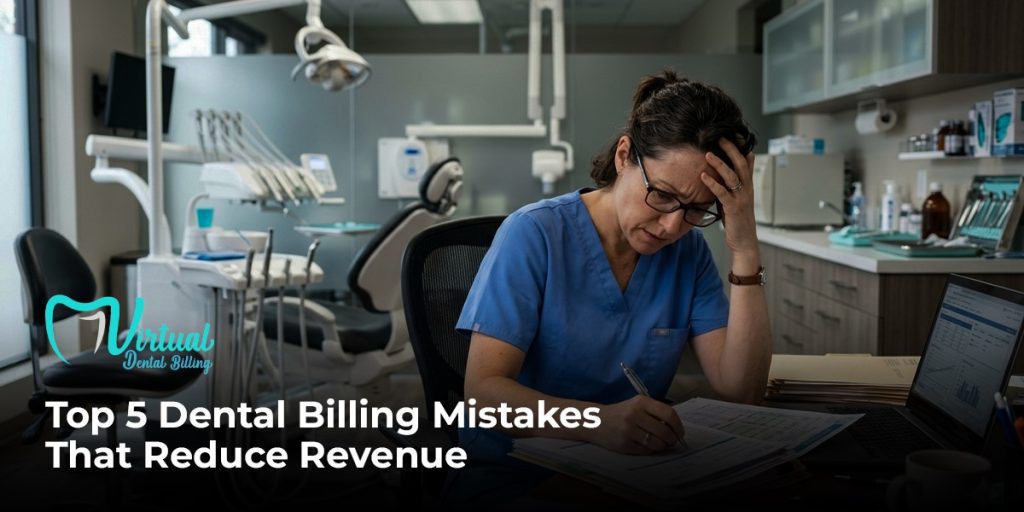
Suppose at the end of the month, you check all of your reports and notice some dental billing errors because the numbers were not according to your expectations. At first, everything looks normal, but as you compare your production with your actual collections, you find gaps that point toward hidden dental billing mistakes that quietly reduce your revenue.
Most dental practices struggle because small billing issues keep interrupting the payment flow, and those issues often start long before the claim even reaches the insurance company.
These problems don’t show up as one big error; instead, they appear as small gaps across different stages of the process, which makes them harder to notice and even harder to fix once they spread.
That is where your dental practice revenue cycle starts to break, because one small mistake at the beginning moves forward into coding, submission, and follow-up. And by the time it reaches the insurance company, it turns into delays, denials, or lost payments.
Once you understand where these gaps exist, you stop reacting to problems at the end and start controlling them from the beginning, which makes a direct difference in how consistently your practice gets paid.
In this guide, you will learn the most common mistakes that reduce revenue, how they impact your cash flow, and what you can do to fix them step by step without adding unnecessary complexity to your workflow.
Top 5 Dental Billing Mistakes That Reduce Revenue
Now that you understand how small gaps in the process turn into real revenue problems, it becomes easier to see why fixing these issues is not about working harder, but about working more accurately at every stage of your billing flow.
Most of these mistakes don’t look serious when they happen, but once they move through your system, they start affecting approvals, payments, and timelines, which is why identifying them early can save both time and revenue.
Let’s break them down one by one.
Mistake #1: Incorrect Patient Information Entry
Everything in your dental billing process starts with accurate patient data, and when that data does not match insurance records, it leads to immediate dental insurance claim errors and stops the claim from moving forward.
At first, it looks like a small issue, but once the claim gets rejected, your team has to correct and resubmit it, which delays payments, increases workload, and contributes to long-term dental revenue loss.
What usually goes wrong
- Misspelled patient name
- Incorrect date of birth
- Wrong insurance ID
- Missing subscriber details
- Outdated employer or insurance provider
Why this mistake matters
When patient information is incorrect:
- Claims get rejected immediately
- Payments get delayed
- Staff time is wasted on rework
- The risk of claim denials in dental billing increases
And instead of getting paid on time, your team starts fixing problems that could have been avoided at the start.
How it impacts your revenue
This is where things connect.
One incorrect entry may seem small, but when:
- claims get delayed
- resubmissions increase
- deadlines get closer
You start facing real dental revenue loss, especially when claims fall outside filing limits.
How to fix it (Simple system)
You don’t need complex tools here; you need consistency.
Follow this checklist:
- Verify patient details at every visit, not just the first time
- Match insurance information with official records
- Confirm spelling, ID numbers, and dates carefully
- Recheck data before claim submission
- Train front desk staff to treat data accuracy as a priority

Mistake #2: Skipping Insurance Verification
Most practices don’t realize this, but the real billing problem often starts before the billing even begins.
When insurance verification is skipped, your team makes treatment decisions without knowing what the insurance will actually support, and that means you move forward blindly while assuming the claim will work later.
At that moment, nothing feels wrong because the procedure gets completed and the patient leaves, but the issue shows up later when the claim reaches the insurance company and turns into unexpected dental insurance billing problems.
What usually goes wrong
Instead of checking full details, teams often:
- Rely on old insurance records
- Trust patient-provided information
- Skip the benefit breakdown for procedures
- Ignore waiting periods and frequency limits
- Miss coordination between primary and secondary plans
Why this mistake feels small but isn’t
Verification does not fail loudly.
It fails later.
- Treatment gets done
- The claim gets submitted
- Then, the insurance reduces or rejects it
And suddenly, you are left with a gap between expected payment and actual payment.
Where it actually hits your revenue
This mistake doesn’t just delay payments; it shifts financial responsibility.
- Insurance does not pay
- Patient does not expect to pay
- Your team struggles to collect
This is where silent dental revenue loss begins, because even though work is completed, payment does not follow as expected.
At the same time, this also increases claim denials in dental billing, especially for procedures with strict coverage rules.
How to fix it (Make verification a decision step)
Instead of treating verification as a routine task, treat it as a decision checkpoint before treatment starts.
Build this habit into your workflow:
- Verify eligibility before scheduling high-value procedures
- Break down the benefits for each treatment, not just general coverage
- Check limitations, waiting periods, and exclusions
- Confirm dual insurance coordination clearly
- Document verification details for future reference

Mistake #3: Using Incorrect or Outdated CDT Codes
Coding is where many billing decisions get locked in, and when the wrong code enters the claim, everything that follows starts moving in the wrong direction, even if the treatment itself was done correctly.
At the same time, coding errors don’t always come from a lack of knowledge; they often happen because codes change, details get missed, or the clinical side and billing side don’t stay aligned, which leads to frequent dental billing and coding mistakes.
Where coding starts going wrong
Instead of one big mistake, it usually shows up in small ways:
- Using outdated CDT codes
- Selecting a general code instead of a specific one
- Missing required modifiers
- Coding based on habit instead of documentation
- Not matching clinical notes with the billing code
Why coding errors are risky
Coding directly decides how the insurance company reads your claim.
When codes don’t match expectations:
- Claims get downgraded
- Payments get reduced
- Claims get denied completely
And this is where most dental insurance claim errors begin, even when the procedure itself was valid.
Common Coding Mistakes and Their Impact
| Coding Issue | What Happens | Result |
|---|---|---|
| Outdated CDT code | Insurance cannot be processed correctly | Claim denial |
| Generic code used | Insurance applies a lower value | Reduced payment |
| Missing modifier | Procedure not fully understood | Partial approval |
| Code mismatch with notes | Claim flagged for review | Delay or rejection |
| Incorrect procedure code | Wrong treatment billed | Full denial |
How it impacts your revenue
When coding errors repeat:
- Payments become inconsistent
- Claims take longer to process
- Rework increases
And over time, this leads to steady dental revenue loss, because even approved claims may not pay the full expected amount.
How to fix it (Build coding accuracy)
Instead of relying on memory, create a system that supports accuracy.
Follow this checklist:
- Update CDT codes every year
- Cross-check codes with clinical documentation
- Use specific codes instead of general ones
- Train the billing and clinical teams together
- Review claims before submission
Pro Tip
Coding should not depend on habit; it should depend on current guidelines and clear documentation, because even a small mismatch can change how the insurance company processes your entire claim.
Mistake #4: Missing Supporting Documentation
Even when your codes are correct and your claim gets submitted on time, it still may not move forward if the insurance company does not see enough proof to justify the treatment.
That’s because billing is not just about what you did, it is about what you can prove, and when required documents are missing, the claim slows down, gets flagged, or turns into avoidable dental insurance claim errors.
At first, this feels confusing because everything looks accurate from your side, but from the insurance perspective, the claim lacks evidence, which leads to delays or rejections.
Where documentation starts breaking
This usually happens when:
- Clinical notes are incomplete
- Required attachments are not added
- Documentation does not match the procedure code
- Files are unclear or missing key details
And because of this, even valid treatments struggle to get approved.
Essential documents you must include (and why they matter)
Not every claim needs the same level of documentation, but certain procedures require clear supporting proof.
Here are the most important ones:
- X-rays (Radiographs)
These help insurance companies see the actual condition of the tooth or bone structure, and without them, procedures like crowns, extractions, or root canals may not get approved. - Periodontal Charting
This shows gum health and pocket depth, which becomes necessary for procedures like scaling and root planing, because it proves medical necessity. - Intraoral Photos
These provide visual evidence of damage, decay, or wear, and they help justify treatments when X-rays alone are not enough. - Clinical Notes (SOAP Notes)
These explain the condition, diagnosis, and treatment plan in written form, and they connect your procedure with a clear reason, which helps prevent dental billing errors. - Narrative Reports
These describe complex procedures in detail, especially for surgeries or special cases, and they help the reviewer understand why the treatment was required. - Pre-treatment Estimates or Pre-authorizations
These confirm that the insurance company reviewed the case before treatment, which reduces the chances of rejection later.
Why are missing documents causing delays
When documentation is incomplete:
- Insurance cannot confirm the necessity
- Claims get placed on hold
- Additional requests are sent
- Approval timelines increase
And instead of getting paid quickly, your claim enters a back-and-forth cycle.
How it impacts your revenue
This mistake does not always lead to direct denial, but it slows everything down.
- Payments get delayed
- Cash flow becomes inconsistent
- Staff spend more time on follow-ups
And over time, this creates hidden dental revenue loss because delayed payments affect your overall collection cycle.
How to fix it (Build a documentation system)
Instead of attaching documents randomly, build a clear process.
Follow this checklist:
- Create a document requirement list for each procedure
- Train clinical staff on what to capture and when
- Attach documents before claim submission, not after
- Ensure notes match the procedure code
- Use clear and high-quality images

Manual Billing vs Professional Dental Billing Services
Once you start fixing billing mistakes, you also begin to notice something important.
Even when your team understands the process, maintaining consistency across every step becomes difficult because billing is not a one-time task; it is a continuous system that requires accuracy, follow-up, and constant updates.
This is where the difference between manual handling and professional dental billing services becomes clear.
How manual billing usually works
In most practices, billing depends heavily on internal staff.
- The front desk manages patient data
- The billing team handles claims
- The clinical team provides documentation
At first, this setup looks manageable, but as patient volume grows, small gaps start appearing.
- Data entry mistakes increase
- Follow-ups get delayed
- Coding inconsistencies appear
- Claims require rework
And over time, these small gaps turn into repeated dental billing mistakes that affect revenue flow.
How professional billing services change the process
With outsourced dental billing services, the focus shifts from handling tasks to managing outcomes.
Instead of reacting to problems, the system is built to prevent them.
- Claims are reviewed before submission
- Codes are aligned with updated guidelines
- Documentation is checked for completeness
- Follow-ups are tracked consistently
This creates a smoother billing flow where fewer claims get delayed or denied.
Side-by-side comparison
| Factor | Manual Billing | Professional Billing Services |
|---|---|---|
| Accuracy level | Depends on staff consistency | Structured and standardized |
| Claim approval rate | Lower due to errors | Higher due to validation |
| Follow-up process | Often delayed | Consistent and tracked |
| Coding updates | Missed or delayed | Regularly updated |
| Revenue flow | Unpredictable | More stable and controlled |
What this means for your practice
When billing stays manual without a strong system:
- Errors repeat
- Payments slow down
- Staff workload increases
But when you bring in structured dental billing services:
- Errors reduce
- Claims move faster
- Revenue becomes more predictable
Dental Billing Mistakes Prevention Checklist
By now, you’ve seen how small gaps across different stages lead to bigger billing problems, but instead of trying to fix each issue separately every time, the smarter approach is to follow a simple checklist that keeps your entire process aligned.
When your team follows a consistent system, most dental billing mistakes never reach the claim stage, which means fewer delays, fewer denials, and more stable revenue.
Daily Billing Accuracy Checklist
These are the steps your team should follow every day to prevent common dental billing errors before they start.
- Verify patient information at check-in
- Confirm active insurance coverage
- Check treatment codes before submission
- Attach the required documentation for procedures
- Review claims for accuracy before sending
Weekly Revenue Protection Checklist
These steps help you control issues that don’t show up immediately but affect your collections over time.
- Review pending and unpaid claims
- Track follow-ups on submitted claims
- Check for rising claim denials in dental billing
- Identify repeated errors in coding or documentation
- Monitor delays in insurance responses
Monthly Billing Performance Checklist
This is where you step back and look at the bigger picture.
- Audit a sample of submitted claims
- Analyze patterns in dental insurance claim errors
- Review revenue gaps between production and collections
- Update coding practices based on latest guidelines
- Evaluate overall dental practice revenue cycle performance
Quick Overview Table
| Task | Frequency | Purpose |
|---|---|---|
| Patient & insurance verification | Daily | Prevent early-stage errors |
| Code and claim review | Daily | Reduce denials |
| Claim follow-up tracking | Weekly | Improve payment speed |
| Error pattern analysis | Monthly | Fix root causes |
| Revenue cycle review | Monthly | Improve collections |
Conclusion: Fixing Billing Is a Decision, Not a Task
At this point, the problem is no longer about understanding dental billing mistakes; it is about deciding how you want your billing process to work moving forward.
You now have two clear paths.
Option 1: Keep fixing issues as they appear
- Claims will continue to get delayed
- Denials will keep repeating
- Your team will stay busy fixing errors
And even though the work gets done, your revenue will not reflect your effort.
Option 2: Build a controlled billing system
- Errors get reduced before submission
- Claims move faster
- Payments become more predictable
Because when your process becomes structured, your results start improving automatically.
The reality is simple.
Billing is not just an administrative task, it is the backbone of your revenue cycle, and when it lacks structure, even small mistakes can disrupt your entire cash flow.
FAQs
1. What are the most common dental billing mistakes?
The most common dental billing errors include incorrect patient information, coding mistakes, missing documentation, skipped insurance verification, and lack of pre-authorizations, and these errors often lead to denied or delayed claims.
2. Why do dental insurance claims get denied?
Dental claims usually get denied when the information does not match insurance records, required documents are missing, or incorrect CDT codes are used, and even small errors in data or coding can stop the claim from being processed.
3. How can I reduce claim denials in dental billing?
You can reduce claim denials in dental billing by verifying insurance before treatment, using updated codes, attaching complete documentation, and reviewing claims before submission, because accurate and complete claims are more likely to get approved quickly.
4. How does dental billing affect revenue?
Dental billing directly impacts revenue because errors in billing slow down payments, increase rework, and create gaps between production and collections, which leads to long-term revenue loss if not controlled properly.
5. Should I outsource dental billing services?
If your team struggles with consistency, frequent errors, or delayed payments, working with professional dental billing services can help improve accuracy, reduce denials, and create a more stable revenue flow through structured processes.